Alcohol's "Weight Gain Bill"
This article is for health education purposes only and is for informational reference; it does not constitute medical advice. If you have health concerns, please consult a professional doctor.
With Mid-Autumn Festival and National Day coming up, there will be one dinner and drinking gathering after another. Many people, while raising their glasses, wonder: I don't even eat that much, so why has my belly gotten bigger these past two years? Today, let's break down alcohol's "weight gain bill" item by item.
First, three sets of numbers:
-
The energy density of alcohol is 7 kcal/gram, second only to fat (9 kcal/gram), and nearly double that of carbohydrates and protein (4 kcal/gram each)[[1]][[2]];
-
The World Health Organization's Global Status Report on Alcohol and Health 2024 estimates that about 2.6 million deaths worldwide each year are alcohol-related, accounting for about 4.7% of all deaths[[9]];
-
The Lancet Global Burden of Disease Study (GBD 2020) shows that among people who drink at "harmful levels," 76.9% are men[[6]].
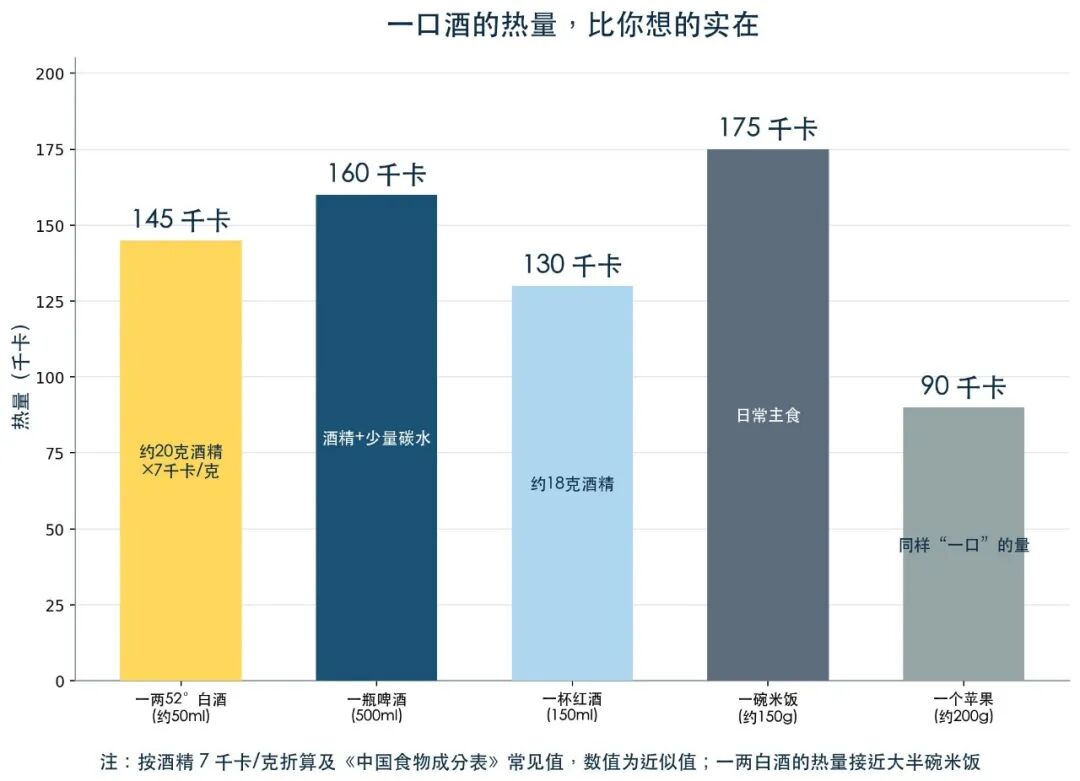
1. The calories in one liang of baijiu are close to most of a bowl of rice
Let's do the math first: one liang (about 50 milliliters) of 52-proof baijiu contains about 20 grams of alcohol, which at 7 kcal/gram comes to ≈ 140 kcal; while one bowl of rice (about 150 grams) is ≈ 170 kcal. In other words, one liang of baijiu downed in a single gulp has calories equivalent to most of a bowl of rice—and rice at least fills you up, while alcohol only goes to your head.
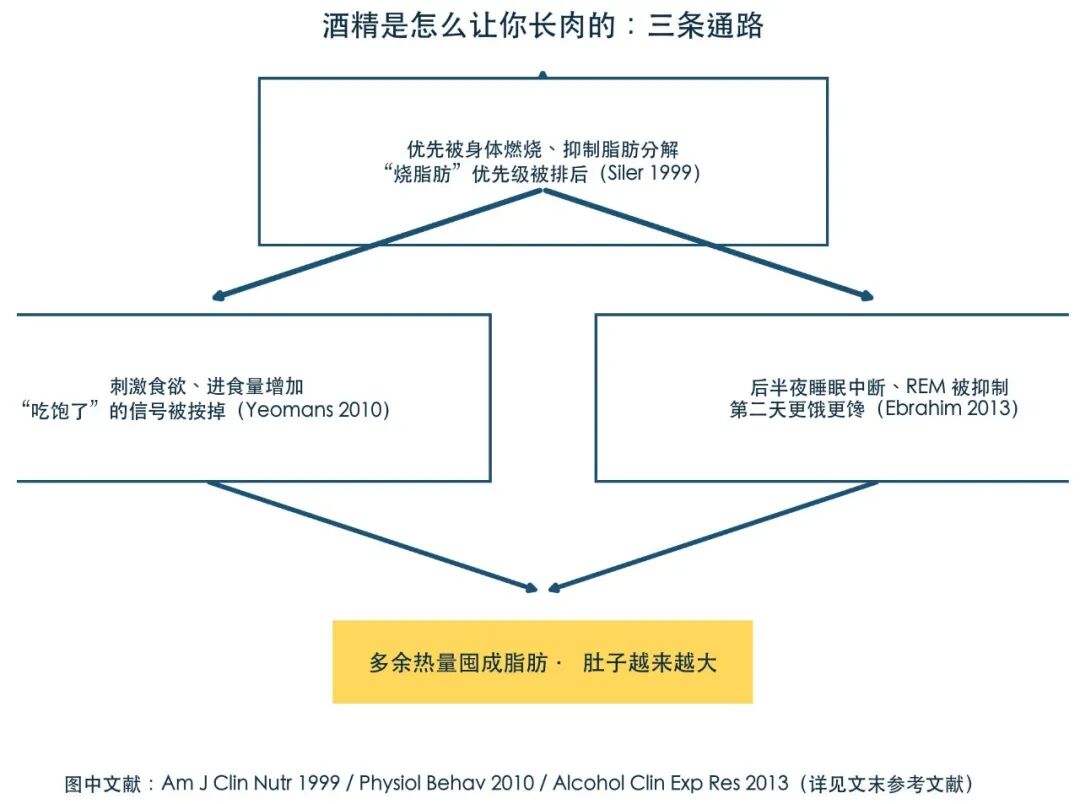
What's more critical is where it goes: research shows that after alcohol enters the body, it is preferentially burned as fuel, while also inhibiting fat breakdown and changing the body's choice of fuel—the body's priority for "burning fat" gets pushed to the back of the line[[3]].
In plain terms: once alcohol goes down, the body burns alcohol first and burns less fat, so fat is more willing to stick around. This is the metabolic truth behind "you can gain weight from drinking alone."
2. Alcohol is an "appetizer"—the more you drink, the more you want to eat
Why does drinking always seem to go with rich, heavy food? Short-term trials have repeatedly confirmed: alcohol stimulates appetite and increases food intake—have a drink before a meal, and you eat more at the main meal[[4]].
Add to that the cycle at drinking gatherings of "toast—eat—toast again," and the prefrontal cortex's restraint is noticeably weakened under the influence of alcohol, so "I'll just have two more bites" turns into "this whole plate is mine."
In plain terms: it's not that the food at the drinking table is too delicious; it's that alcohol mutes the signal that says "I'm full."
3. The "beer belly" bill—the key is the amount
So does drinking just a little make you gain weight? The literature is more restrained than you might imagine: the link between heavy drinking and weight gain is fairly consistent, while the evidence for light and moderate drinking is contradictory—in short-term trials, moderate drinking does not necessarily directly cause weight gain[[1]][[2]].
This gives us two reminders: first, don't believe that "drinking can help you lose weight" (there's no such thing); second, don't portray "one glass of red wine" as utterly unforgivable either. What determines that ring of fat around your belly is total amount and frequency—one big drinking session per week looks worse on the bill than one small glass per day.
In plain terms: an occasional drink doesn't need to cause anxiety; regular heavy drinking is the number one enemy of your belly.
4. Alcohol also steals your sleep, making you crave more the next day
Many people feel that "a little alcohol helps you fall asleep fast." Indeed, alcohol makes it faster to fall asleep, but at the same time it increases sleep interruptions in the second half of the night, and the larger the dose, the more obvious the suppression of rapid eye movement sleep (the dreaming stage)[[5]]—frequent awakenings in the second half of the night, sleeping less deeply.
What does poor sleep mean? Lack of sleep disrupts appetite hormones, making you hungrier the next day and more likely to want high-calorie foods. This one drink simultaneously overdrafts tonight's sleep and tomorrow's appetite control.
In plain terms: alcohol helps you "fall asleep," but steals "sleeping well," and the next day it comes back to collect double.
5. Do you flush after one drink? That's not good tolerance—it's your body raising the alarm
This is very common in East Asian populations: one drink goes down and your face flushes and your heart races. This isn't as simple as "getting red in the face"—it is often a sign of low aldehyde dehydrogenase activity, with acetaldehyde produced by alcohol metabolism accumulating in the body. Research warns: this "flushing when drinking" response is associated with a higher risk of esophageal cancer; it is the body raising an alarm, not proof that you "can hold your liquor"[[7]].
If you or a family member flushes after just one drink, the safest choice is: try not to drink.
In plain terms: flushing is the body saying "I can't handle this stuff." Don't force yourself, and don't pressure others to force themselves either.
What you can do tonight: 5 bottom lines for drinking gatherings
-
Lay a base first: at the start of the meal, eat protein and vegetables first; don't drink on an empty stomach;
-
Choose lower proof, smaller cups, and drink slowly: for the same volume, lower proof means less pure alcohol;
-
Pair one drink with one glass of water: this both dilutes the pace of intake and helps you drink less;
-
Draw a red line for yourself: according to the Dietary Guidelines for Chinese Residents (2022), adults should consume no more than 15 grams of alcohol per day (about 450 milliliters of beer / 150 milliliters of wine / 50 milliliters of 38-proof baijiu)[[8]];
-
The next day, eat normally and move normally: don't go on a "guilt-driven diet," and don't use "I drank yesterday" as an excuse to binge.
You can choose not to drink, but the bill should be calculated clearly—forward this article to family and friends who often attend social engagements, and before the Mid-Autumn drinking gatherings, take a look together at this "weight gain bill."
If this was helpful to you, give it a like or a "reading" mark, and you're also welcome to leave a comment telling us what topics you'd like to see.
✦ ✦ ✦
Disclaimer: This article is health education content and is for informational reference only. It does not constitute any medical advice or health promise. Individual circumstances vary greatly; if you have health concerns, please consult a professional doctor.
Conflict of interest statement: The content of this article is based on publicly published medical literature and reports from authoritative institutions, and the author has no conflict of interest with any institution mentioned in the article.
© 2026 Sun Saint Hua (Beijing) Medical Technology Co., Ltd.
References
-
Traversy G, Chaput JP. Alcohol Consumption and Obesity: An Update. Curr Obes Rep. 2015;4(1):122-130. PMID:25741455
-
Sayon-Orea C, Martinez-Gonzalez MA, Bes-Rastrollo M. Alcohol consumption and body weight: a systematic review. Nutr Rev. 2011;69(8):419-431. PMID:21790610
-
Siler SQ, Neese RA, Hellerstein MK. De novo lipogenesis, lipid kinetics, and whole-body lipid balances in humans after acute alcohol consumption. Am J Clin Nutr. 1999;70(5):928-936. PMID:10539756
-
Yeomans MR. Alcohol, appetite and energy balance: is alcohol intake a risk factor for obesity? Physiol Behav. 2010;100(1):82-89. PMID:20096714
-
Ebrahim IO, Shapiro CM, Williams AJ, et al. Alcohol and sleep I: effects on normal sleep. Alcohol Clin Exp Res. 2013;37(4):539-549. PMID:23347102
-
Bryazka D, Reitsma MB, Griswold MG, et al. Population-level risks of alcohol consumption by amount, geography, age, sex, and year: a systematic analysis for the Global Burden of Disease Study 2020. Lancet. 2022;400(10347):185-235. PMID:35843246
-
Brooks PJ, Enoch MA, Goldman D, et al. The alcohol flushing response: an unrecognized risk factor for esophageal cancer from alcohol consumption. PLoS Med. 2009;6(3):e50. PMID:19320537
-
Chinese Nutrition Society. Dietary Guidelines for Chinese Residents (2022). Beijing: People's Medical Publishing House, 2022.
-
World Health Organization. Global status report on alcohol and health 2024. Geneva: WHO, 2024.