Is Your Body "Inflamed"? Get These 5 Things Right First with an Anti-Inflammatory Diet
This article is for health education purposes only and is intended as general information; it does not constitute medical advice. Please consult a professional doctor if you have any health concerns.
✦ ✦ ✦
The day after a hot pot meal, your throat hurts, and many people habitually say, "I'm heaty again." But in modern medicine, there is another, more insidious kind of "fire" — chronic low-grade inflammation: it doesn't hurt or itch, only shows up on blood tests, yet it quietly damages blood vessels and disrupts metabolism. And your dining table may be its "fuel depot."
✦ ✦ ✦
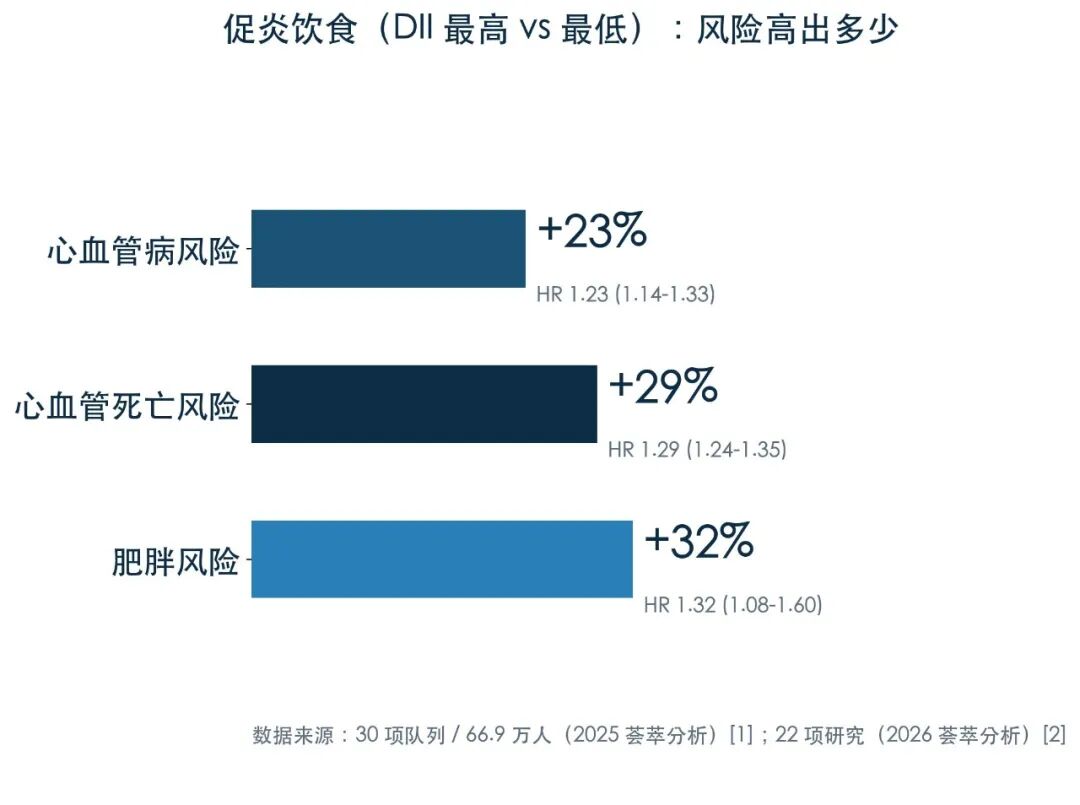
First, some new data. A 2025 meta-analysis pooling 30 cohorts and 669,000 people found that those with the highest dietary inflammatory index (DII, a score measuring how pro-inflammatory your diet is) had a 23% higher risk of cardiovascular disease and a 29% higher risk of cardiovascular death compared with those with the lowest scores[[1]]. Another 2026 meta-analysis of 22 studies further showed that a pro-inflammatory diet was associated with a 32% higher risk of obesity[[2]]. An umbrella review covering 90 meta-analyses published the same year pointed in the same direction: a pro-inflammatory diet is linked to adverse risks across a wide range of health outcomes, including cancer, metabolic disorders, and cognitive problems[[3]].
In other words: inflammation isn't just in your throat — it's in your blood vessels and on your bathroom scale — and a large part of it is "eaten" into existence.
✦ ✦ ✦
First, a Self-Check: Is Your Body "Inflamed"?
hs-CRP (high-sensitivity C-reactive protein) on your blood test report is the most commonly used marker for measuring chronic inflammation. According to the risk stratification standards of the American Heart Association (AHA) / Centers for Disease Control and Prevention (CDC): 3 mg/L indicates an elevated level[[4]].
If your hs-CRP is persistently elevated and acute infection has been ruled out, your dietary pattern is the first thing to examine — the 5 steps below are the starting point for "cooling the fire" in your body.
An Anti-Inflammatory Diet: Get These 5 Things Right First
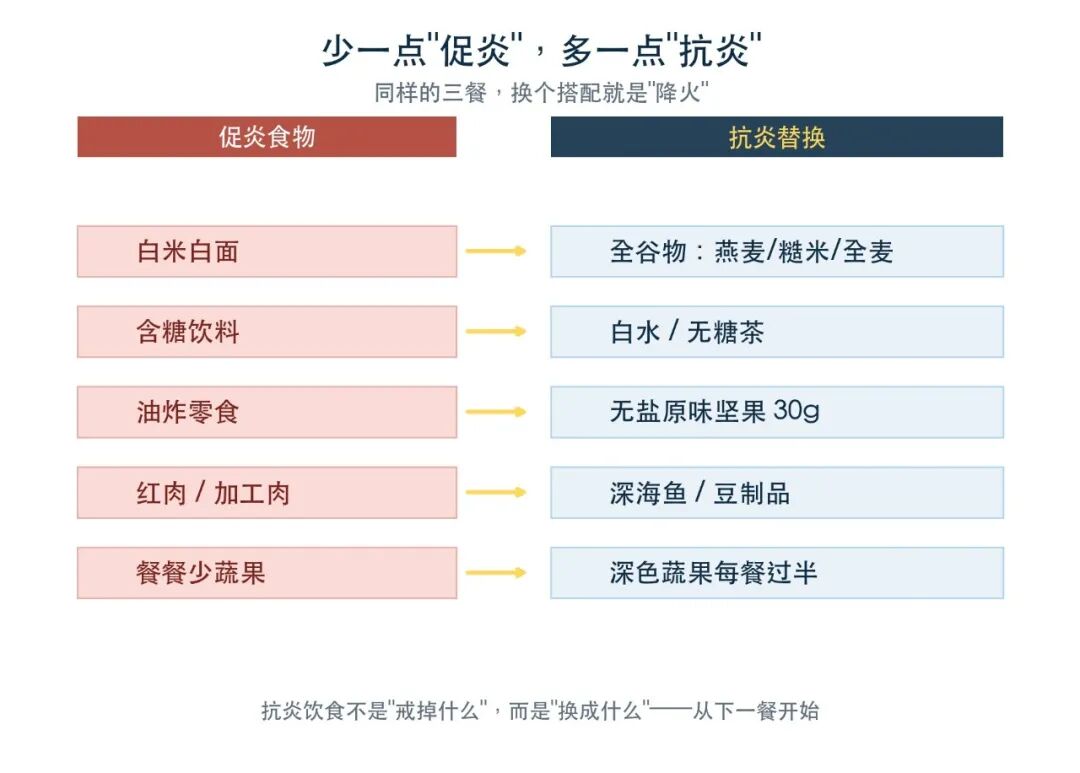
1. Swap Half Your Staple Grains for Whole Grains
White rice and white flour spike blood sugar quickly, easily pushing up post-meal blood glucose and inflammatory factors; swapping half your staple grains for oats, brown rice, whole wheat, or quinoa also provides dietary fiber that feeds beneficial gut bacteria. The Chinese Dietary Guidelines (2022) recommend that adults eat 50–150 grams of whole grains and mixed beans per day[[5]].
2. Eat Deep-Sea Fish Twice a Week
Salmon, mackerel, and sardines are rich in omega-3 fatty acids (EPA/DHA), which are natural "anti-inflammatory components." The American Heart Association recommends eating 2 servings of fish per week, especially fatty fish (about 113 grams per serving)[[6]].
3. A Small Handful of Nuts as a Daily Snack
Nuts are rich in monounsaturated fats and vitamin E, making them a classic anti-inflammatory food. About 30 grams of unsalted, plain nuts per day, replacing cookies or chips as an afternoon snack — just be careful not to choose salt-roasted or sugar-coated varieties.
4. Cut Down on Sugar and Fried Foods, and Learn to Read Ingredient Labels
Sugar-sweetened beverages, fried foods, and heavily processed foods are the biggest contributors to a pro-inflammatory diet[[3]]. When buying packaged foods, check the ingredient list first: if white sugar or high-fructose corn syrup appears in the top three ingredients, swap it out; replace "beverages" with plain water or unsweetened tea.
5. Dark-Colored Fruits and Vegetables: Make Them Half of Every Meal
Tomatoes, broccoli, spinach, blueberries, purple cabbage… the darker the color, the richer the polyphenols, anthocyanins, and other plant compounds, and the stronger the antioxidant and anti-inflammatory effects. Remember the "rainbow principle": eat fruits and vegetables of at least 5 colors every day.
✦ ✦ ✦
One-Sentence Action Tip
Starting tomorrow: swap half your staple grains for whole grains + add a serving of dark-colored vegetables to dinner + have nuts as an afternoon snack; if your blood test shows hs-CRP >3 mg/L and it remains persistently elevated, please first go to an internal medicine or health management department for evaluation, rather than taking "anti-inflammatory drugs" on your own.
Inflammation isn't built up in a day, nor can it be extinguished in a day — but it truly is "eaten" into existence, and it can also be "eaten" away. Consider forwarding this checklist to family members who always talk about being "heaty," and save it to follow along.
If you found this content helpful, feel free to hit "Like" or "Wow," and leave a comment telling us what topics you'd like to see.
✦ ✦ ✦
References
-
Ni Y, Yao Q, Xu T, Li X. Dietary inflammatory index and cardiovascular risk and mortality: an updated systematic review and meta-analysis. Front Cardiovasc Med. 2025;12:1626523. PMID: 41357093.
-
Gu R, Qi M, Lu H, Miao X, Wang Y, Lin X, et al. High dietary inflammatory index is associated with an increased risk of overweight and obesity in adults: a meta-analysis of observational studies. Front Nutr. 2026;13:1881176. PMID: 42453663.
-
Gkesou V, Theodoridis X, Papaemmanouil A, et al. The association of dietary inflammation index (DII) and health-related outcomes: an umbrella review of systematic reviews. Clin Nutr ESPEN. 2026;75:103590. PMID: 42435895.
-
American Heart Association / Centers for Disease Control and Prevention. hs-CRP risk stratification: 3.0 mg/L high. (Public education citation, not a research paper)
-
Chinese Nutrition Society. Chinese Dietary Guidelines (2022). Beijing: People's Medical Publishing House; 2022. (50–150 grams of whole grains and mixed beans per day)
-
American Heart Association. Fish and omega-3 fatty acids: eat at least two servings (about 227 g total) of fish per week, especially fatty fish. (Public education citation, not a research paper)
Disclaimer: This article is based on publicly published medical research and is intended for health education and general information only; it does not constitute medical advice. Please consult a professional doctor for your individual situation.
Conflict of Interest Statement: The author has no financial relationships with any organizations mentioned in this article.
© 2026 Sun Saint Hua (Beijing) Medical Technology Co., Ltd.