Does Running Hurt Your Knees? Data From 120,000 People Says the Opposite
This article is for health education purposes only and is intended for informational reference; it does not constitute medical advice. If you have health concerns, please consult a professional doctor.
When the weather turns cold, the number of people running on tracks and by the river drops noticeably. The reason people give for being put off is usually the same: running hurts your knees.
But a 2017 systematic review pooling 25 studies and 125,810 people reached the opposite conclusion: the detection rate of hip and knee osteoarthritis among recreational runners was 3.5%, compared with 10.2% among sedentary people[1]. People who don't move have roughly three times the rate of joint disease as amateur runners.
Put walking and running side by side, and the answer becomes even clearer: knees, lifespan, blood sugar, and rate of weight loss—the strengths of the two are simply not in the same place.
Detection rate of hip and knee osteoarthritis: recreational runners 3.5%, sedentary people 10.2%, competitive runners 13.3% (17 studies, 114,829 people included in the meta-analysis)[1].

Figure caption: Comparison of the detection proportions of hip and knee osteoarthritis across three groups; sedentary people are far higher than recreational runners, and only competitive runners exceed the sedentary group.
1. Knees: Sitting Still Harms More Than Jogging
In the same study, people who had been running for less than 15 years had a lower risk of joint disease than non-runners (odds ratio 0.6, 95% confidence interval 0.49 to 0.73)[1]. What actually pushes the risk up is the other direction: competitive runners at 13.3%, clearly higher than the sedentary group—long-term high mileage and high intensity are what really take a toll on the joints.
What needs to be made clear is that this is an association from observational research, not causation. Factors such as prior injury, body weight, and occupation are hard to fully rule out, so the accurate statement is: there is no evidence that amateur jogging destroys knees; conversely, people who don't move have more joint problems.
2. Lifespan and Cardiorespiratory Fitness: Running Pays Off More per Unit of Time
A study of 55,137 adults with an average follow-up of 15 years showed that runners had a 30% lower risk of all-cause mortality than non-runners, a 45% lower risk of cardiovascular death, and lived on average about 3 years longer[3].
Even more noteworthy is the dose. Running less than 51 minutes per week, less than 6 miles (about 9.7 kilometers), 1 to 2 times per week, at a pace slower than 6 miles per hour (about 9.7 kilometers per hour) still reduced mortality risk[3]. Converted, running 5 to 10 minutes a day is meaningful—the threshold is much lower than you'd think.
3. Blood Sugar, Blood Lipids, Blood Pressure: Same Energy Expenditure, Similar Results
This aspect is easily overlooked. Data from 33,060 runners and 15,945 walkers with a follow-up of 6.2 years showed that for each additional MET·h/day of energy expended, running reduced the risk of hypertension by 4.2%, high cholesterol by 4.3%, diabetes by 12.1%, and coronary heart disease by 4.5%; for walking, the figures were 7.2%, 7.0%, 12.3%, and 9.3% respectively[5]. Across all four indicators, the differences between the two modes were not significant.
In other words, running's advantage comes from greater energy expenditure per unit of time, not from some special magic inherent to running itself. Once energy expenditure is equalized, the benefits of walking and running essentially stand on the same line.
4. Weight Loss: Same Energy Expenditure, Running Sheds More Pounds
Another analysis of 15,237 walkers and 32,216 runners with a follow-up of 6.2 years found that among the quarter of the population with the highest BMI, running produced 90% more weight loss per unit of energy expended than walking[2]. At the same time, age-related weight gain was significantly attenuated in runners, while walking had this effect in only some people.
The study had another detail: during follow-up, runners' exercise volume declined more, yet they still lost more weight[2]. For people who want to save time, this is running's bargaining chip.

Figure caption: A comparison of walking and running across five dimensions—knee joints, lifespan, blood sugar and lipids, weight-loss efficiency, and threshold—each with its own strengths; the choice depends on knee condition and goals.
5. Walking: The Key Is Speed and the Upper Limit, Not 10,000 Steps
A meta-analysis of 47,471 adults from 15 international cohorts with a median follow-up of 7.1 years provided the answer on step counts: using 3,553 steps per day as the reference, 5,801 steps was associated with a 40% lower risk of all-cause mortality, 7,842 steps with 45% lower, and 10,901 steps with 53% lower[4]. The curve plateaued at 6,000 to 8,000 steps for people over 60, and at 8,000 to 10,000 steps for people under 60—10,000 steps is not a hard threshold.
Another variable on the same line is speed: a pooled analysis of 50,225 walkers showed that compared with slow walking, moderate-speed walking was associated with a 20% lower risk of all-cause mortality and fast walking with 24% lower; cardiovascular mortality risk was 24% and 21% lower, respectively[6]. When it comes to walking, walking to the point of slight sweating and slight breathlessness is worth more than simply accumulating steps.
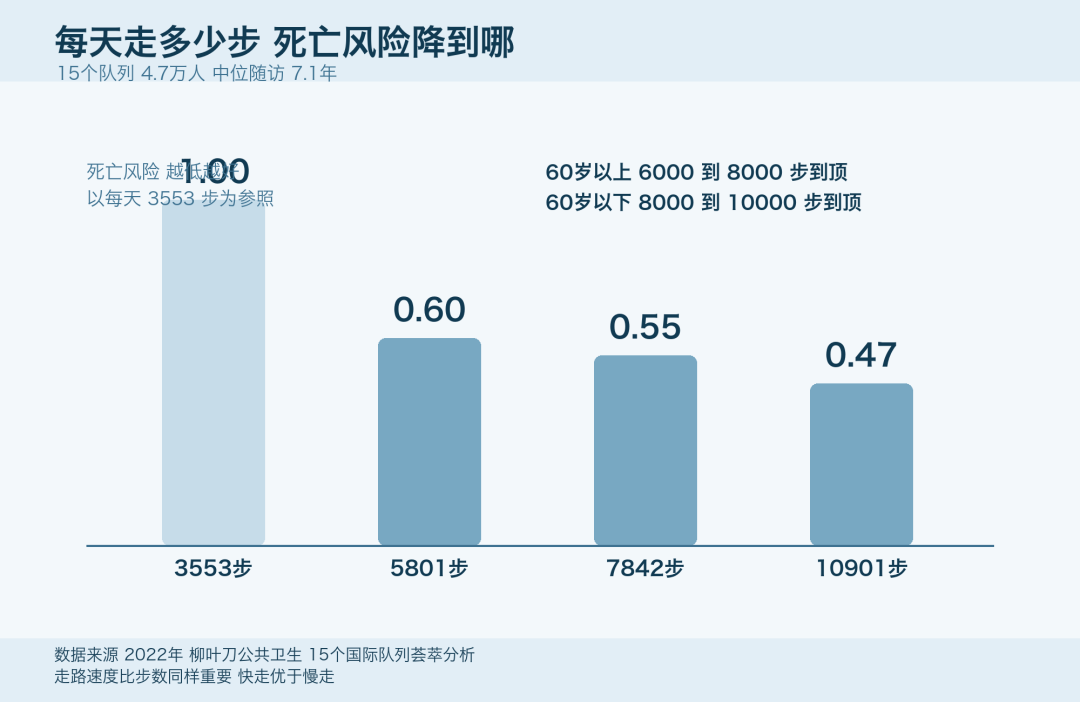
Figure caption: The dose-response relationship between daily step count and all-cause mortality risk; as steps increase from 3,553 to 10,901, risk steadily declines, plateauing after 6,000 to 8,000 steps for those over 60.
How to Choose: Three Sentences
-
Old knee injuries, higher body weight, just starting to exercise: Walk first, pick up the speed, and set a goal of 6,000 to 10,000 steps based on age—don't charge straight to 15,000.
-
Short on time, want to control weight: Add short bouts of jogging; even 5 to 10 minutes a day counts. Transition with walk-run intervals; you don't need to run a full half hour at once.
-
Those already running: Don't chase mileage and pace—the joint data for competitive runners is right there. Keep weekly totals steady, and limit single-session increases to within 10%.
Running doesn't destroy knees; sitting still is what harms joints. Walking is no worse than running—it just depends on whether you walk with enough speed. In the same hour, choose the one you can stick with until next winter.
If this article has been helpful to you, give it a like or a "Wow," and feel free to leave a comment telling us what topics you'd like to see. We also suggest forwarding it to that friend who says "running hurts your knees" every time winter comes.
✦
Disclaimer: This article is for health education purposes only and is intended for informational reference; it does not constitute medical advice. The data cited come from publicly published medical literature and cannot replace an in-person consultation and individualized assessment by a professional doctor.
Conflict of interest statement: This article does not involve any drug or product recommendations, and the author has no financial relationship with the research institutions mentioned in the text.
© 2026 Sun Sheng Hua (Beijing) Medical Technology Co., Ltd.
References
[1] Alentorn-Geli E, Samuelsson K, Musahl V, et al. The Association of Recreational and Competitive Running With Hip and Knee Osteoarthritis: A Systematic Review and Meta-analysis. J Orthop Sports Phys Ther. 2017;47(6):373-390. PMID: 28504066
[2] Williams PT. Greater weight loss from running than walking during a 6.2-yr prospective follow-up. Med Sci Sports Exerc. 2013;45(4):706-713. PMID: 23190592
[3] Lee DC, Pate RR, Lavie CJ, et al. Leisure-time running reduces all-cause and cardiovascular mortality risk. J Am Coll Cardiol. 2014;64(5):472-481. PMID: 25082581
[4] Paluch AE, Bajpai S, Bassett DR, et al. Daily steps and all-cause mortality: a meta-analysis of 15 international cohorts. Lancet Public Health. 2022;7(3):e219-e228. PMID: 35247352
[5] Williams PT, Thompson PD. Walking versus running for hypertension, cholesterol, and diabetes mellitus risk reduction. Arterioscler Thromb Vasc Biol. 2013;33(5):1085-1091. PMID: 23559628
[6] Stamatakis E, Kelly P, Strain T, et al. Self-rated walking pace and all-cause, cardiovascular disease and cancer mortality: individual participant pooled analysis of 50 225 walkers from 11 population British cohorts. Br J Sports Med. 2018;52(12):761-768. PMID: 29858463