The Busier You Are, the More Weight You Gain? Stress Is Rewriting Your Fat Distribution
This article is for health education purposes only and is intended as general information; it does not constitute medical advice. If you have health concerns, please consult a professional doctor.
The more overtime you work, the more you crave fried chicken and milk tea? It's not a lack of willpower—it's cortisol stacking the deck against your appetite. Stress is quietly rewriting your fat distribution, and it targets your belly specifically.

Gaining weight the busier you get may not be about eating too much—it may be stress directing fat straight to your belly. Four graphics break down the mechanism, followed by 3 action steps.

Step 1: When stress hits, cortisol rises first. A laboratory stress experiment with 59 women found that under the same stress task, women with a higher waist-to-hip ratio (fat concentrated in the middle) secreted significantly more cortisol; leaner individuals also failed to "habituate" to repeated stress—their cortisol stayed persistently elevated[[1]].

Step 2: People with high cortisol eat more on stressful days. High cortisol responders consumed more calories on stressful days than low responders, while intake was comparable on calm days; sweet food intake was significantly higher[[2]]—the greater the stress, the stronger the craving for sweets. It's a physiological response, not a lack of self-control.

Step 3: Long-term stress plus a high-calorie diet sends fat straight to the belly. Women in the high-stress group had higher BMI, larger waist and abdominal diameter, and more emotional eating[[3]]—chronic stress combined with a high-calorie diet causes fat to preferentially accumulate in the visceral area.
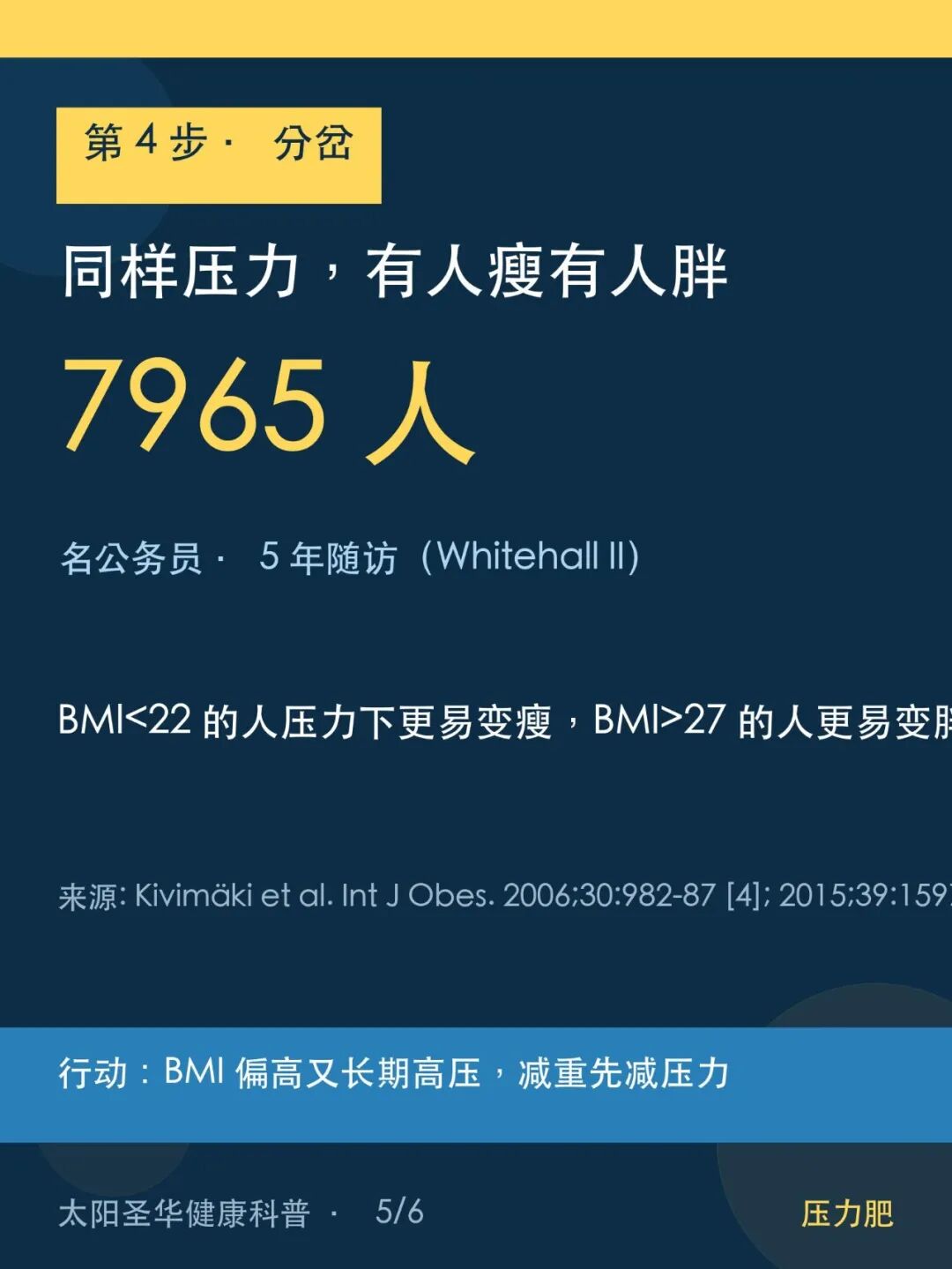
Step 4: Under the same stress, some people stay thin while others gain weight. The Whitehall II study followed 7,965 civil servants for 5 years: those with a baseline BMI of 27 were more likely to become obese (this effect was significant in men)[[4]]; an 8-cohort meta-analysis also showed that job stress alone had a very weak association with obesity (OR 1.04)[[5]]—the fork in the road isn't stress itself, but how you respond to it.
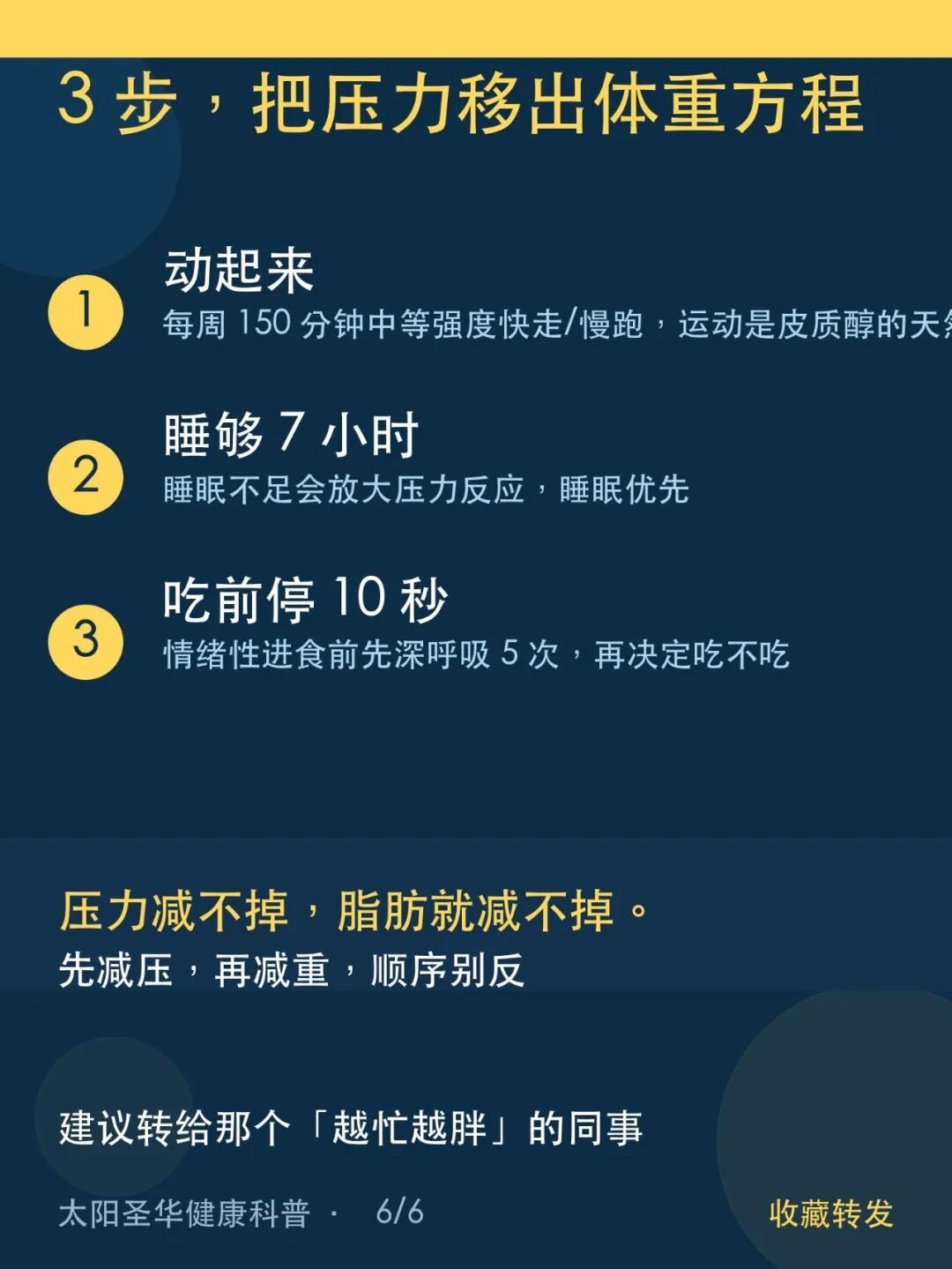
3 Steps to Take Stress Out of the Weight Equation
-
Get moving: 150 minutes of moderate-intensity brisk walking or jogging per week—exercise is a natural brake on cortisol;
-
Sleep at least 7 hours: insufficient sleep amplifies the stress response, so prioritize sleep;
-
Pause for 10 seconds before eating: before emotional eating, take 5 deep breaths, then decide whether to eat; swap snacks for fruit and nuts.
If you can't reduce stress, you can't reduce fat. Lower stress first, then lose weight—don't reverse the order. Consider forwarding this to that colleague who "gains weight the busier they get," and save this stress-weight self-check guide.
If you found this helpful, feel free to hit "Like" or "Wow," and leave a comment telling us what topics you'd like to see.
✦ ✦ ✦
References
-
Epel ES, McEwen B, Seeman T, et al. Stress and body shape: stress-induced cortisol secretion is consistently greater among women with central fat. Psychosom Med. 2000;62(5):623-632. PMID: 11020091.
-
Epel E, Lapidus R, McEwen B, Brownell K. Stress may add bite to appetite in women: a laboratory study of stress-induced cortisol and eating behavior. Psychoneuroendocrinology. 2001;26(1):37-49. PMID: 11070333.
-
Tomiyama AJ, Dallman MF, Epel ES. Comfort food is comforting to those most stressed: evidence of the chronic stress response network in high stress women. Psychoneuroendocrinology. 2011;36(10):1513-1519. PMID: 21906885.
-
Kivimäki M, Head J, Ferrie JE, et al. Work stress, weight gain and weight loss: evidence for bidirectional effects of job strain on body mass index in the Whitehall II study. Int J Obes (Lond). 2006;30(6):982-987. PMID: 16418750.
-
Kivimäki M, Singh-Manoux A, Nyberg S, et al. Job strain and risk of obesity: systematic review and meta-analysis of cohort studies. Int J Obes (Lond). 2015;39(11):1597-1600. PMID: 26041697.
© 2026 Sun Saint Hua (Beijing) Medical Technology Co., Ltd.