This article is for health education purposes only and is intended for informational reference. It does not constitute medical advice; if you have health concerns, please consult a professional doctor.
✦ ✦ ✦
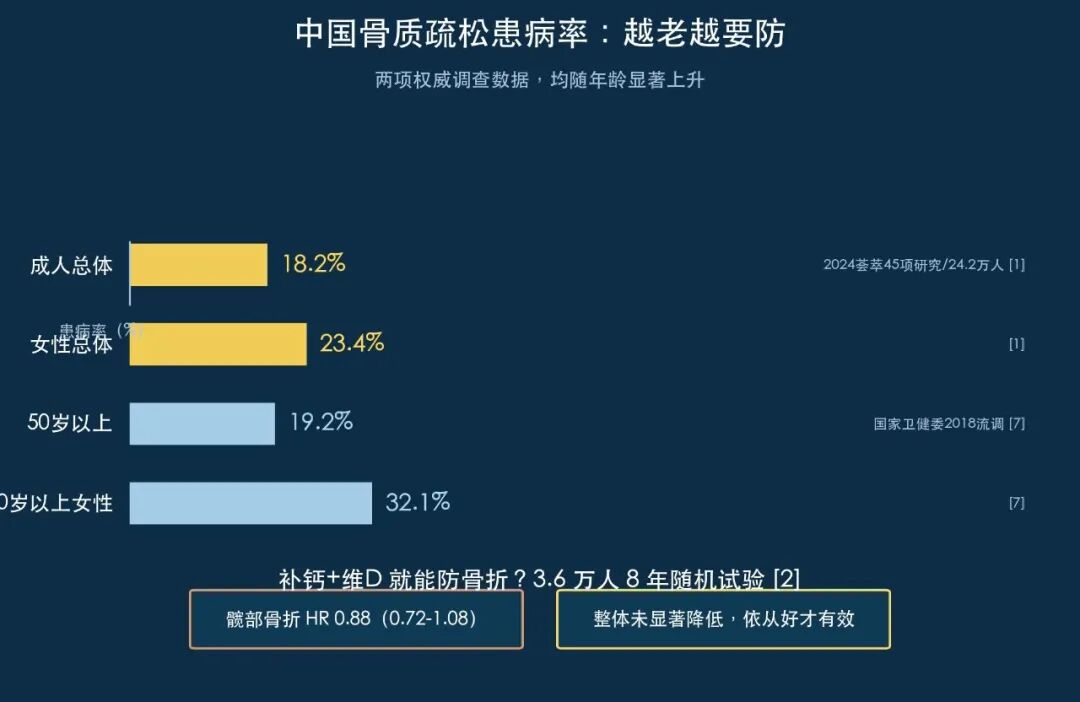
The prevalence of osteoporosis among Chinese adults is 18.2%, and among women over 50, 1 in every 3 is affected[[1]][[7]]. Yet too many people around us assume that "calcium supplements can prevent fractures"—they take handfuls of calcium tablets, but their bones remain just as brittle. Today we'll address 5 frequently asked questions about bone fragility all at once. We recommend sharing this with the elders in your family who are over 50.
✦ ✦ ✦
Q1: Is osteoporosis simply a calcium deficiency?
Not entirely. The essence of osteoporosis is bone loss + deterioration of bone microarchitecture, and calcium is only one of the raw materials.
Bone mass peaks around age 30 and then declines year by year. After menopause, estrogen drops sharply in women, and the rate of bone resorption accelerates significantly—which is why the prevalence is far higher in women than in men. In China, the prevalence of osteoporosis among people over 50 is 19.2%, with 32.1% in women and 6.0% in men[[7]]. The latest meta-analysis also shows a prevalence of 23.4% among Chinese women, rising steadily with age[[1]].
In plain terms: Bones are like a warehouse—the more you store when you're young (the higher your peak bone mass), the less likely you are to "run empty" when you're old. Calcium deficiency accelerates the emptying, but what matters more is peak bone mass and the rate of loss.
Q2: Can calcium supplements really prevent fractures?
They help, but "just taking calcium tablets" is far from enough—that's the conclusion of a randomized trial of 36,000 people over 8 years.
The U.S. WHI study randomly divided more than 36,000 postmenopausal women aged 50-79 into two groups: one group took 1000mg of calcium + 400IU of vitamin D daily, and the other took a placebo. After 7-8 years of follow-up: overall, there was no significant reduction in hip fracture risk (HR 0.88, 95%CI 0.72-1.08); only those who consistently adhered to the regimen showed significant benefit[[2]].
Vitamin D is also crucial, and the dose must be adequate: a meta-analysis showed that only ≥700-1000IU of vitamin D per day significantly reduced non-vertebral fractures by about 20%, while low doses were essentially ineffective[[3]].
In plain terms: Calcium and vitamin D are the "foundation," but laying only a foundation without building the house—without exercise, protein, and muscle strength—won't bring fracture risk down.
Q3: Can drinking bone soup supplement calcium?
No, this is the most widely circulated misconception.
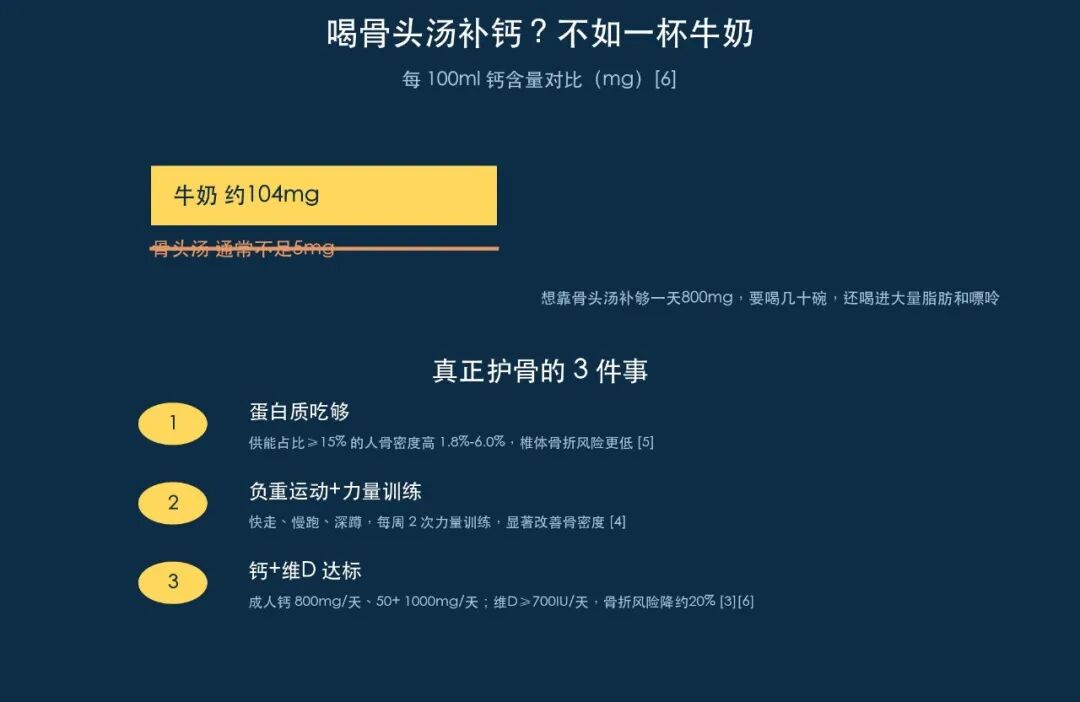
The calcium in bone soup comes mainly from bone tissue, and very little is dissolved out: each 100ml of bone soup typically contains only a few milligrams of calcium, whereas the same 100ml of milk contains about 104mg of calcium[[6]]. To get enough calcium for a day (800-1000mg) from bone soup alone, you'd have to drink dozens of bowls—and you'd also be consuming a large amount of fat and purines along the way.
In plain terms: The real calcium sources are dairy products, soy products (tofu, dried tofu), dark green vegetables (broccoli, bok choy), sesame paste, and small fish eaten with bones. One cup of milk per day (about 300ml) can contribute about one-third of your daily calcium[[6]].
Q4: How do you know if your bones are quietly becoming brittle?
Osteoporosis is a "silent disease," but the body does leave signals:
-
Getting shorter: Height loss of ≥3cm compared to your younger years
-
Hunched back, lower back pain: Signs of vertebral compression fractures
-
Fractures from minor bumps: For example, breaking a wrist or hip from a gentle fall
The gold standard for diagnosis is a bone density test (DXA). A T-score ≤ -2.5 on the report indicates osteoporosis[[7]]. It's recommended that people over 50—especially postmenopausal women—proactively add a bone density screening to their routine checkups.
In plain terms: Don't wait until you fracture a bone to find out your bones are brittle. After 50, ask at your checkup: "Can I add a bone density test?" It costs very little and is worth a great deal.
Q5: What are the most effective things for protecting bones?
Three things that work better than blindly taking calcium tablets:
① Get enough protein. A 5-year cohort study of 2,160 older adults in the U.S. showed that those whose protein provided ≥15% of energy intake had 1.8%-6.0% higher bone mineral density in the hip and lumbar spine than the low-protein group, and a lower risk of vertebral fractures[[5]]. Make sure to get 1-2 servings of quality protein from fish, poultry, eggs, dairy, and beans every day.
② Weight-bearing exercise + strength training. A Cochrane systematic review confirmed that exercise significantly improves bone mineral density in postmenopausal women[[4]]. Weight-bearing activities like brisk walking, jogging, dancing, and stair climbing + strength training twice a week (squats, light dumbbells) are the most bone-friendly.
③ Meet calcium + vitamin D targets. Adults need 800mg of calcium daily, and those over 50 need 1000mg—prioritize getting it from food. For vitamin D, rely on sunlight (15-30 minutes daily) or supplement as directed by a doctor[[6]].
✦ ✦ ✦
Action steps: Do two things tonight—① Take out the calcium supplement instructions at home and check whether the vitamin D dose reaches 700IU; ② Starting tomorrow morning, drink a cup of milk and take a 30-minute brisk walk every day. Stick with it for 3 months, and your bones will remember.
If you found this helpful, give it a like or a "reading" mark, and feel free to leave a comment telling us what topics you'd like to see. We recommend sharing this with the elders in your family over 50 to help them protect their "last bone."
✦ ✦ ✦
Disclaimer: This article is based on publicly available academic literature and is intended for health education reference only. It does not constitute medical advice; please consult a professional doctor for your individual situation.
Conflict of interest statement: The author has no conflicts of interest with the studies mentioned in this article.
© 2026 Sun Saint Hua (Beijing) Medical Technology Co., Ltd.
References
-
Prevalence rate of primary osteoporosis in China: a meta-analysis. BMC Public Health. 2024;24(1):1518. PMID:38844897
-
Calcium plus vitamin D supplementation and the risk of fractures. N Engl J Med. 2006;354(7):669-683. PMID:16481635
-
Prevention of nonvertebral fractures with oral vitamin D and dose dependency: a meta-analysis of randomized controlled trials. Arch Intern Med. 2009;169(6):551-561. PMID:19307517
-
Exercise for preventing and treating osteoporosis in postmenopausal women. Cochrane Database Syst Rev. 2011;(7):CD000333. PMID:21735380
-
Effect of Dietary Protein Intake on Bone Mineral Density and Fracture Incidence in Older Adults in the Health, Aging, and Body Composition Study. J Gerontol A Biol Sci Med Sci. 2021;76(12):2213-2222. PMID:33677533
-
Chinese Nutrition Society. Chinese Dietary Guidelines (2022). Beijing: People's Medical Publishing House; 2022.
-
Epidemiological Survey of Osteoporosis in China. National Health Commission; 2018.