Belly Fat First, Weight Loss Always Stalls? It Could Be Insulin Resistance
This article is for health education purposes only and does not constitute medical advice. Please consult a healthcare professional if you have any health concerns.
✦ ✦ ✦
You don't eat that much, yet your weight keeps creeping up. Your waistline grows first, and you get especially sleepy after meals.
Many people chalk all of this up to "getting older, slower metabolism." But there's a clue on your lab report worth looking at first: insulin resistance.
It's not a term exclusive to people with diabetes. A 2013 national survey in China showed that the prevalence of prediabetes among adults had reached 35.7%, and diabetes prevalence was 10.9%[1]—roughly 1 in every 3 adults already has blood sugar quietly creeping upward.
Take a look at this card to see the full picture:

1. What Is Insulin Resistance, in Plain Terms
Insulin is like a key that opens the door to your cells, letting blood sugar in to be converted into energy.
"Resistance" means the keyhole has become dull: the key is still there, but the door is hard to open. The pancreas has to secrete extra insulin to pick up the slack. Over time, with all that overtime work, blood sugar starts to creep up, and fat becomes more likely to accumulate in the belly, liver, and muscles[2].
What's worth remembering: this process can be improved in its early and middle stages—the sooner you adjust your lifestyle, the better your chances.
2. Signs That Warrant a Check-Up
-
Larger waistline: 90 cm or more for men, 85 cm or more for women
-
Sleepy after meals, hungry again quickly, with palpitations or shaky hands when hungry
-
A direct family member with diabetes
-
Blood pressure, blood lipids, or uric acid already elevated in one or more areas
-
Long-term sleep deprivation, prolonged sitting, very little exercise
These don't equal a diagnosis—they're just a hint that it may be worth talking to a doctor about whether to check fasting blood glucose, HbA1c, or insulin-related markers.
3. Strong Evidence: Lifestyle Can Stop It in Its Tracks
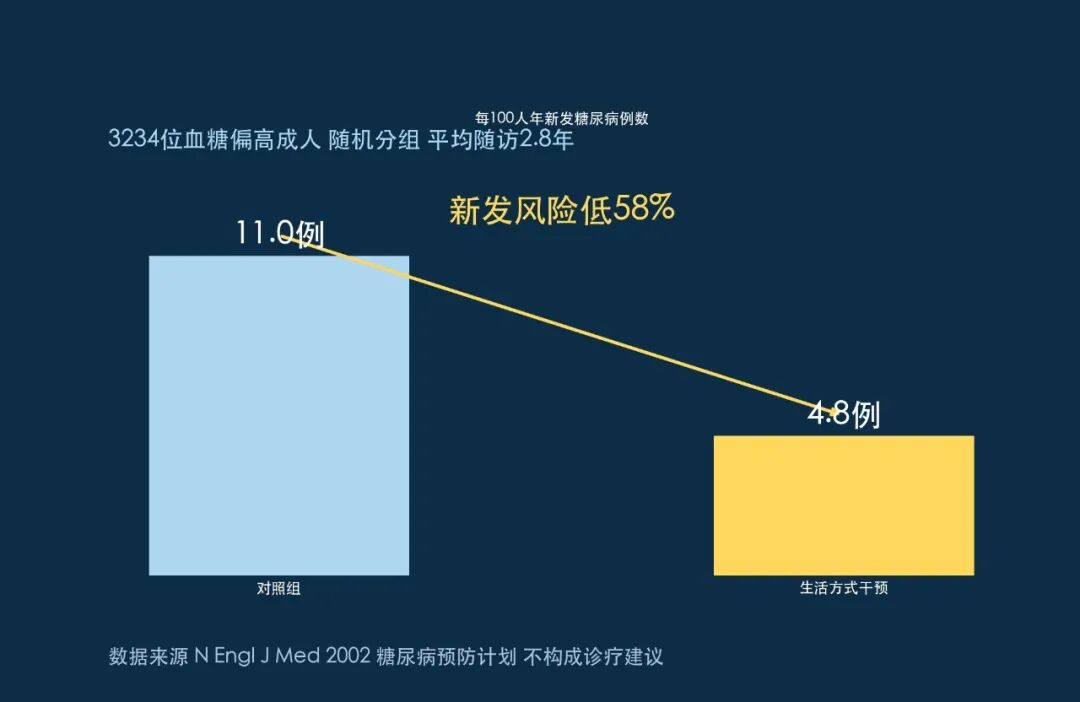
The U.S. Diabetes Prevention Program randomly assigned 3,234 adults with elevated blood sugar to groups, with only two intervention goals: lose at least 7% of body weight and exercise at least 150 minutes per week.
After an average follow-up of 2.8 years, the lifestyle group had 4.8 new cases of diabetes per 100 person-years, compared to 11.0 in the control group—a 58% lower risk[3].
China's own data is equally solid. The Da Qing Study enrolled 577 people with elevated blood sugar and conducted 6 years of diet and exercise intervention. At the 23-year follow-up: diabetes risk was about 45% lower, and cardiovascular mortality risk was about 41% lower[4].
One intervention, and the difference is still visible more than two decades later.
4. Not Enough Sleep Makes Insulin Dull Too
This point is often overlooked. A trial involving healthy adult men found that after just 1 week of sleeping only 5 hours per night, insulin sensitivity dropped by about 20%[5].
The time you gain by staying up late may be paid for with your metabolism.
5. Get Two Things Right: Fiber and Exercise
A nutrition survey of 6,374 adults showed that people with different dietary fiber intakes had differences in insulin resistance markers—those who consumed relatively more fiber had lower markers[6].
The reference amount is about 14 grams of fiber per 1,000 kcal per day. At 1,800 kcal per day, that's roughly 25 grams.
As for exercise, a meta-analysis of 11 studies involving 846 patients with type 2 diabetes found that structured exercise reduced fasting blood glucose by an average of about 5.1 mg/dL, with fasting insulin and insulin resistance markers also trending downward[7].
6. Lose It and Regain It, and the Benefits Are Canceled Out
An analysis published in 2026 offers a warning: among 220 participants in a calorie restriction trial, those who regained more than 5% of their lost weight saw the improvements in insulin-related markers reversed[8].
So the key to weight loss isn't how fast you lose it—it's whether you can keep it off. Even if you only lose 5% to 7%, keeping it off means the benefits are already there.
Three Things You Can Do Today
-
Eat vegetables and protein first at each meal, swap half your staple grains for whole grains, and gradually increase fiber to about 25 grams per day.
-
Get 150 minutes of moderate-intensity exercise like brisk walking each week, plus strength training twice a week.
-
Sleep at least 7 hours; use a soft tape to measure your waistline, write down the number, and measure once a month.
Insulin resistance won't alert you with pain, but it will show up in your waistline and on your lab report. Consider saving this self-check list, and feel free to share it with family and friends who always say they "gain weight just by drinking water."
If you found this helpful, give it a like or a "reading" mark, and feel free to leave a comment telling us what topics you'd like to see.
✦ ✦ ✦
References
[1] Wang L, Gao P, Zhang M, et al. Prevalence and Ethnic Pattern of Diabetes and Prediabetes in China in 2013. JAMA. 2017;317(24):2515-2523. PMID: 28655017
[2] Shulman GI. Ectopic fat in insulin resistance, dyslipidemia, and cardiometabolic disease. N Engl J Med. 2014;371(12):1131-1141. PMID: 25229917
[3] Knowler WC, Barrett-Connor E, Fowler SE, et al. Reduction in the incidence of type 2 diabetes with lifestyle intervention or metformin. N Engl J Med. 2002;346(6):393-403. PMID: 11832527
[4] Li G, Zhang P, Wang J, et al. Cardiovascular mortality, all-cause mortality, and diabetes incidence after lifestyle intervention for people with impaired glucose tolerance in the Da Qing Diabetes Prevention Study: a 23-year follow-up study. Lancet Diabetes Endocrinol. 2014;2(6):474-480. PMID: 24731674
[5] Buxton OM, Pavlova M, Reid EW, et al. Sleep restriction for 1 week reduces insulin sensitivity in healthy men. Diabetes. 2010;59(9):2126-2133. PMID: 20585000
[6] Tucker LA. Fiber Intake and Insulin Resistance in 6374 Adults: The Role of Abdominal Obesity. Nutrients. 2018;10(2):237. PMID: 29461482
[7] Sampath Kumar A, Maiya AG, Shastry BA, et al. Exercise and insulin resistance in type 2 diabetes mellitus: A systematic review and meta-analysis. Ann Phys Rehabil Med. 2019;62(2):98-103. PMID: 30553010
[8] Warmbrunn MV, Yang L, Kishore Biswas R, et al. Weight Regain Reverses Caloric Restriction-Induced Benefits on the Insulin-IGF-1 Nutrient-Sensing Pathway: Post Hoc Analysis From the CALERIE-2 Randomized Controlled Trial. Diabetes Care. 2026;49(5):783-791. PMID: 41838032
✦ ✦ ✦
Disclaimer: This article is for health education purposes only and does not constitute medical advice. Please consult a healthcare professional if you have any health concerns. Disclosure: This article does not recommend any medications and has no conflicts of interest with the research institutions mentioned. ? 2026 Sun Saint Hua (Beijing) Medical Technology Co., Ltd.