About 150 Million People Have Carotid Plaque: 5 Things That Slow Its Growth
This article is for health education purposes only and is intended for informational reference. It does not constitute medical advice; if you have health concerns, please consult a professional doctor.
When many people see the words "carotid intima-media thickening" or "plaque visible" on their physical examination report, it is the first time they have encountered them—and the first time they have started to worry.
Let's start with the conclusion: plaque is not a verdict. It is more like a reminder slip, telling you that your blood vessels are aging a little faster than your ID card suggests.
The following 5 things determine whether it stays unchanged for years or keeps growing every year.
First, Three Numbers
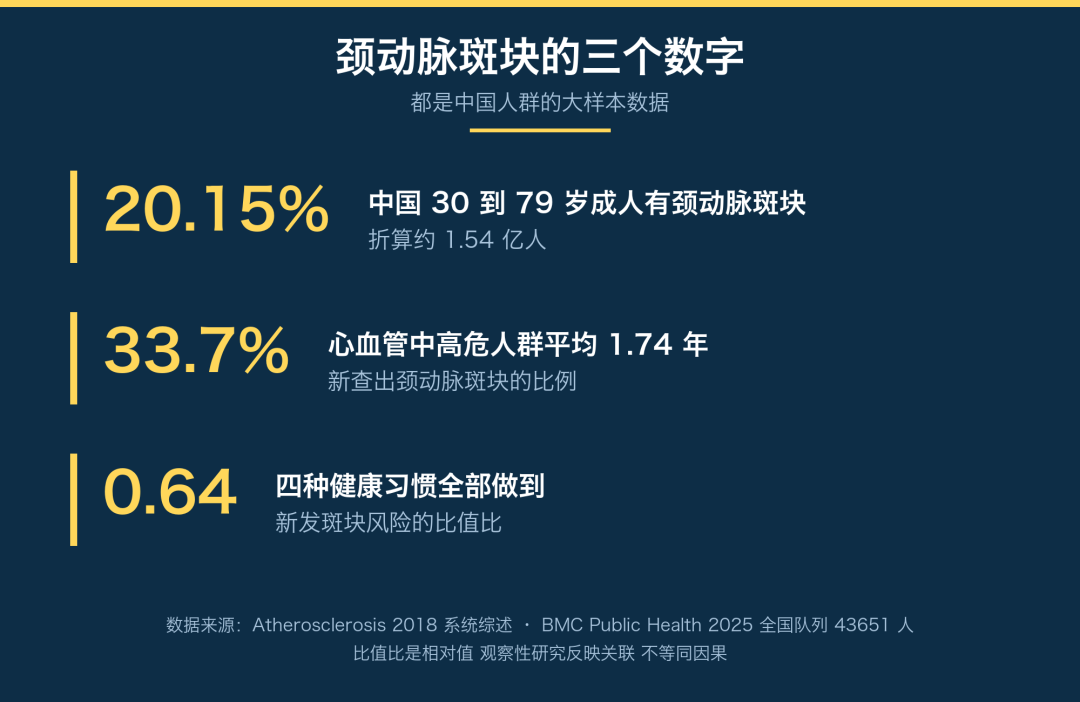
A 2018 systematic review estimated that among Chinese people aged 30 to 79, about 20.15% have carotid plaque—roughly 154 million people. When carotid intima-media thickening is included, the rate of carotid arteriosclerosis reaches 27.22%, or about 208 million people[1]. This is not a problem for a minority; it is a common finding on physical examinations after middle age.
Another Chinese cohort that tracked 43,651 people at moderate-to-high cardiovascular risk, with an average follow-up of 1.74 years, found that 33.7% of participants were newly found to have carotid plaque[2]. So plaque is not something that is "fixed once it appears"—it keeps changing, and the direction of that change depends on how you live over the next five years.
5 Things Beyond the Exam Report
1. Quit smoking—this one pays off quickly 🚬
Smoking is a clear risk factor for carotid arteriosclerosis[1]. In the above cohort of 43,651 people, non-smokers had about a 14% lower risk of new plaque than smokers, with an odds ratio of 0.86[2]. You do not need to wait for plaque to grow before deciding to quit.
2. Don't just watch the scale—look at waist circumference and metabolic indicators 📏
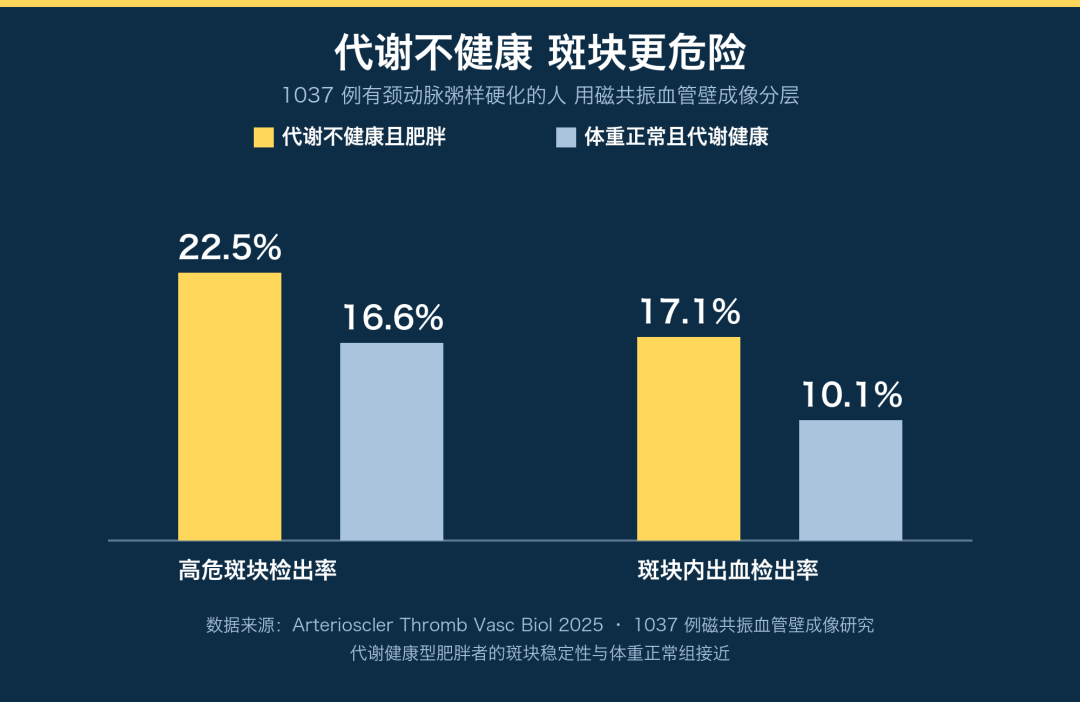
A total of 1,037 people with carotid atherosclerosis underwent magnetic resonance vessel wall imaging: in the metabolically unhealthy obesity group, high-risk plaque accounted for 22.5% and intraplaque hemorrhage for 17.1%; in the normal-weight, metabolically healthy group, the figures were 16.6% and 10.1%, respectively[5].
The reverse is even more noteworthy: among people described as "metabolically healthy obese," plaque stability was close to that of the normal-weight group[5]. So what determines vascular status is not just the number on the scale, but whether waist circumference, blood pressure, blood sugar, and blood lipids are normal.
3. Get enough exercise—don't just cram it in on weekends 🏃
In the same cohort of 43,651 people, those with sufficient leisure-time physical activity had about a 6% lower risk of new plaque, with an odds ratio of 0.94[2]. A prospective cohort of 8,379 people in Fujian found that those with "ideal" lifestyles had a 32% lower risk of rapid plaque progression than those with "poor" lifestyles, with a hazard ratio of 0.68[4].
4. Adjusting your dietary pattern is more practical than taking some kind of "supplement" 🥗
A healthy diet was associated with a lower risk of new plaque, with an odds ratio of 0.90[2]. Another community cohort of 1,938 people was followed for two years starting from the absence of plaque: the group with high cardiovascular health scores had 13.7% new plaque, while the group with low scores had 27.0%, with an adjusted odds ratio of 0.55[3].
When all four—not smoking, moderate alcohol consumption, sufficient exercise, and a healthy diet—were achieved at the same time, the odds ratio for new-onset risk was 0.64, and plaque appeared later, with a time ratio of 1.16[2].
5. Manage blood pressure and blood sugar well, and get follow-up checks as your doctor advises 🩺
Both hypertension and diabetes are risk factors for carotid arteriosclerosis[1]. In a general population cohort, each 1-point increase in carotid plaque score was associated with a 25% higher risk of ischemic stroke, with a hazard ratio of 1.25[6].
But don't let this set of numbers scare you: in the same study, among people with a score greater than 3, the positive predictive value for future ischemic stroke was only 2.5%, and the negative predictive value was 99.3%[6]. The vast majority of people will not actually have a stroke. What is warranted is serious management, not panic.
Four Things You Can Do Today
One, find the four numbers on your exam report: blood pressure, fasting blood glucose or HbA1c, low-density lipoprotein cholesterol, and waist circumference.
Two, if you smoke, put quitting on this month's schedule—this is a single action with clear benefit[1].
Three, following the World Health Organization's general recommendation, build up moderate-intensity activity to at least 150 minutes per week, and don't exercise to exhaustion all at once.
Four, leave the frequency of follow-up checks, whether medication is needed, and whether further evaluation of stenosis is needed to your doctor to judge based on your overall risk. Do not add or stop medications on your own.
In Closing
Plaque will not determine your later years based on a single physical examination, but every day over the next five years will.
Whether it grows depends more on how you eat, how you move, how long you sleep, and whether you keep smoking every day.
Share this article with the family member who "has plaque on their exam report for the first time," and save this checklist of four things to review at your next follow-up.
If this has been helpful to you, give it a like or a "Wow," and feel free to leave a comment telling us what topics you'd like to see.
✦
Disclaimer: This article is for health education purposes only and is intended for informational reference. It does not constitute medical advice; if you have health concerns, please consult a professional doctor.
Declaration of Interests: This article does not involve any drug or product recommendations and has no conflict of interest with the research institutions mentioned in the text.
© 2026 Sunshenghua (Beijing) Medical Technology Co., Ltd.
References
[1] Song P, Xia W, Zhu Y, et al. Prevalence of carotid atherosclerosis and carotid plaque in Chinese adults: A systematic review and meta-regression analysis. Atherosclerosis. 2018;276:67-73. PMID: 30036743
[2] Lin C, Zhang X, Fang X, et al. Healthy lifestyles and the incidence risk and time of carotid plaque: a nationwide cohort study. BMC Public Health. 2025;25(1):2462. PMID: 40665269
[3] Yu P, Wu DY, Fan XW, et al. Association of Life's Essential 8 Scores with Carotid Artery Plaque in Chinese Adults: A Prospective Cohort Study. J Atheroscler Thromb. 2025;32(9):1150-1163. PMID: 40074360
[4] Fang X, Zhang X, Yang Z, et al. Healthy lifestyles and rapid progression of carotid plaque in population with atherosclerosis: A prospective cohort study in China. Prev Med Rep. 2024;41:102697. PMID: 38560595
[5] Shao S, Sun Y, Shi H, et al. Metabolically Abnormal Obesity and Carotid Plaque Vulnerability: A Vessel Wall MRI Study Linking Obesity Phenotypes to Atherosclerotic Instability. Arterioscler Thromb Vasc Biol. 2025;45(11):2097-2108. PMID: 40964717
[6] Ihle-Hansen H, Vigen T, Berge T, et al. Carotid Plaque Score for Stroke and Cardiovascular Risk Prediction in a Middle-Aged Cohort From the General Population. J Am Heart Assoc. 2023;12(17):e030739. PMID: 37609981