Late-Summer Heat Can Strike at Night Too? One Hot Night, Cardiovascular Risk Lasts 5 Days
This article is for health education purposes only and is not intended as medical advice. Please consult a professional doctor if you have any health concerns.
It's late August, and the "autumn tiger" heat is still going strong: daytime temperatures hit 35°C, and at night it's so muggy you toss and turn unable to sleep. Many people think, "It's just hot—I'll tough it out and it'll pass"—but the latest 2026 meta-analysis and 5 years of monitoring data from a Chinese CDC team are both saying the same thing: heat, especially "hot nights," deals a much bigger blow to the cardiovascular system than people realize.
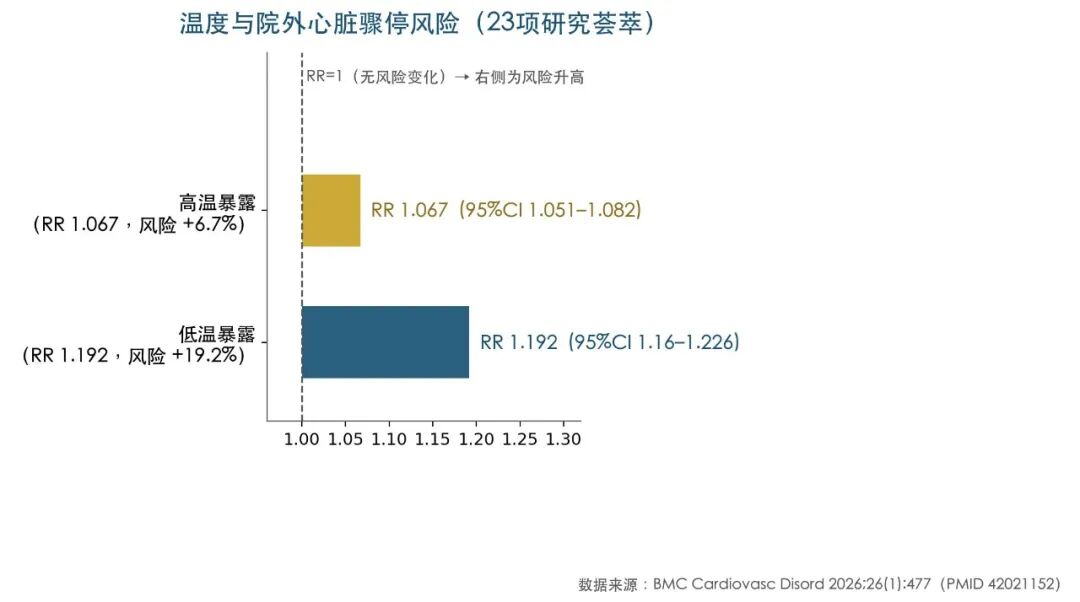
Globally, about 5.08 million deaths each year are linked to non-optimal temperatures, accounting for 9.43% of all deaths[[3]]. A 2026 meta-analysis pooling 23 studies (covering Asia, North America, and Europe) found that during high-temperature weather, the risk of out-of-hospital cardiac arrest rises by 6.7% (RR 1.067)[[1]].
✦ ✦ ✦
1. The Real Risk Is at Night
A 2025 study by a Chinese CDC team used data from national disease surveillance points for May–September each year from 2015 to 2019:
-
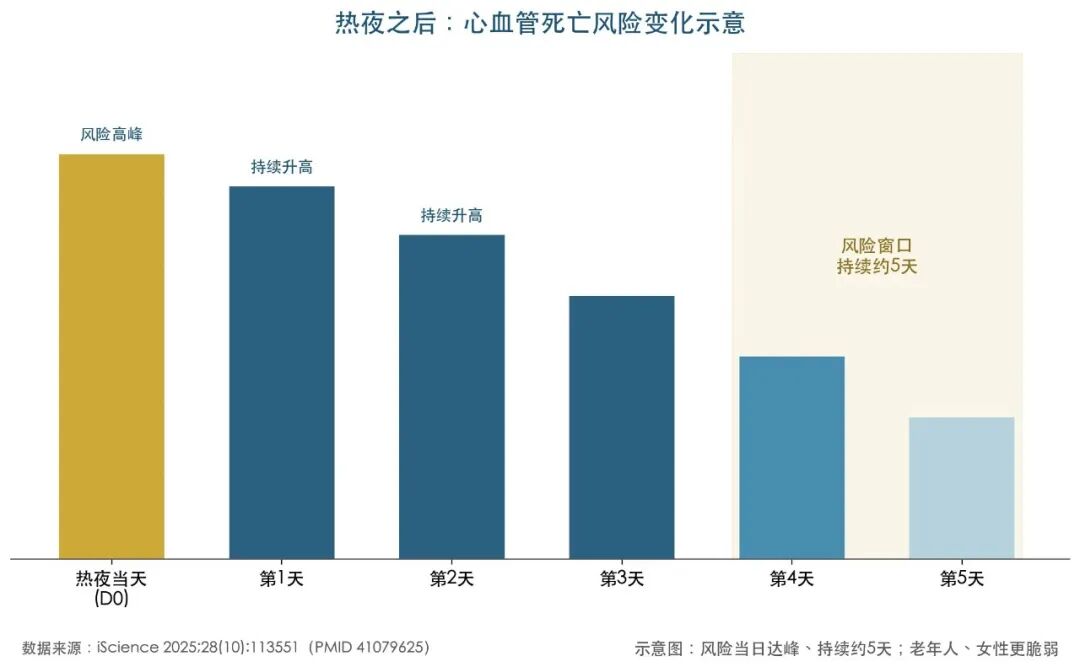
Hot nights (nights when the minimum temperature exceeds the local 95th percentile) significantly increase the risk of all-cause and cardiovascular death;
-
The risk peaks the same day and lasts about 5 days;
-
Older adults and women are especially vulnerable[[2]].
In plain terms: when it's hot during the day, everyone knows to seek shelter; but muggy heat at night is when people tend to let their guard down—and that's exactly when it quietly takes its toll.
2. How Does High Heat "Hurt" the Heart?
-
Heavy sweating and not drinking enough water → blood becomes thicker → the heart has to work harder to pump;
-
Blood vessels dilate and heart rate speeds up → increased cardiac workload;
-
Poor sleep from nighttime heat → sustained sympathetic nervous system activation and blood pressure fluctuations.
In plain terms: high heat puts the heart on "overtime," and poor sleep at night means it never gets a break—who can keep that up?
3. Why the "Autumn Tiger" Deserves Extra Caution
-
During the dog days of summer, people are highly vigilant, but by late August they let their guard down: "Summer's almost over anyway";
-
The autumn tiger brings heat both day and night—the heat load accumulated during the day gives the body no chance to "repay the debt" at night;
-
Global data show that of temperature-related excess deaths, more than half occur in Asia (51.5%)—it's not far from us at all[[3]];
-
The relationship between temperature and mortality risk follows a U-shaped curve: both extreme heat and extreme cold increase risk—in the same meta-analysis, the association with cold days was actually even stronger (risk +19.2%)[[1]]. Don't underestimate either end of the spectrum.
4. Five Things You Can Do Tonight
-
Cool your bedroom: Set the AC to 26–27°C, turn on sleep mode, and don't shut it off all night;
-
Drink water proactively: Small amounts, frequently—don't wait until you're thirsty, and have a glass of water when you wake up;
-
Reschedule exercise: Avoid 11 AM–3 PM; exercise in the early morning or evening instead;
-
Keep a close eye on high-risk groups: Check blood pressure morning and evening for elderly family members and those with hypertension/coronary heart disease; seek medical attention promptly if chest tightness, palpitations, or cold sweats occur;
-
Avoid sudden cold exposure: After heavy sweating, don't gulp ice water or immediately take a cold shower.
✦ ✦ ✦
The body pays the heat wave's bill at night. The autumn tiger hasn't left yet—don't let your heart work overtime for you.
Consider sharing this with elderly family members and those who work outdoors year-round, and save this "hot night protection checklist."
If you found this helpful, feel free to hit "Like" or "Wow," and leave a comment telling us what topics you'd like to see.
✦ ✦ ✦
Disclaimer: This article is based on published scientific research and is intended for health education reference only. It does not constitute medical advice. Individual circumstances vary—please consult a professional doctor for any health concerns.
Conflict of Interest Statement: The author of this article has no conflicts of interest with any of the studies or institutions mentioned.
© 2026 Sun Saint Hua (Beijing) Medical Technology Co., Ltd.
References
-
Maimaitiniyazi M, Maimaitiniyazi M, Maisuti M, et al. Association between ambient temperature and out-of-hospital cardiac arrest: a systematic review and meta-analysis. BMC Cardiovasc Disord. 2026;26(1):477. PMID: 42021152.
-
Wu J, Yu T, Liu S, et al. Mortality risk and vulnerability to hot nights in mainland China. iScience. 2025;28(10):113551. PMID: 41079625.
-
Zhao Q, Guo Y, Ye T, et al. Global, regional, and national burden of mortality associated with non-optimal ambient temperatures from 2000 to 2019: a three-stage modelling study. Lancet Planet Health. 2021;5(7):e415-e425. PMID: 34245712.
-
Gasparrini A, Guo Y, Hashizume M, et al. Mortality risk attributable to high and low ambient temperature: a multicountry observational study. Lancet. 2015;386(9991):369-375. PMID: 26003380.