This article is for health education and informational purposes only and does not constitute medical advice; if you have health concerns, please consult a professional doctor.
✦ ✦ ✦
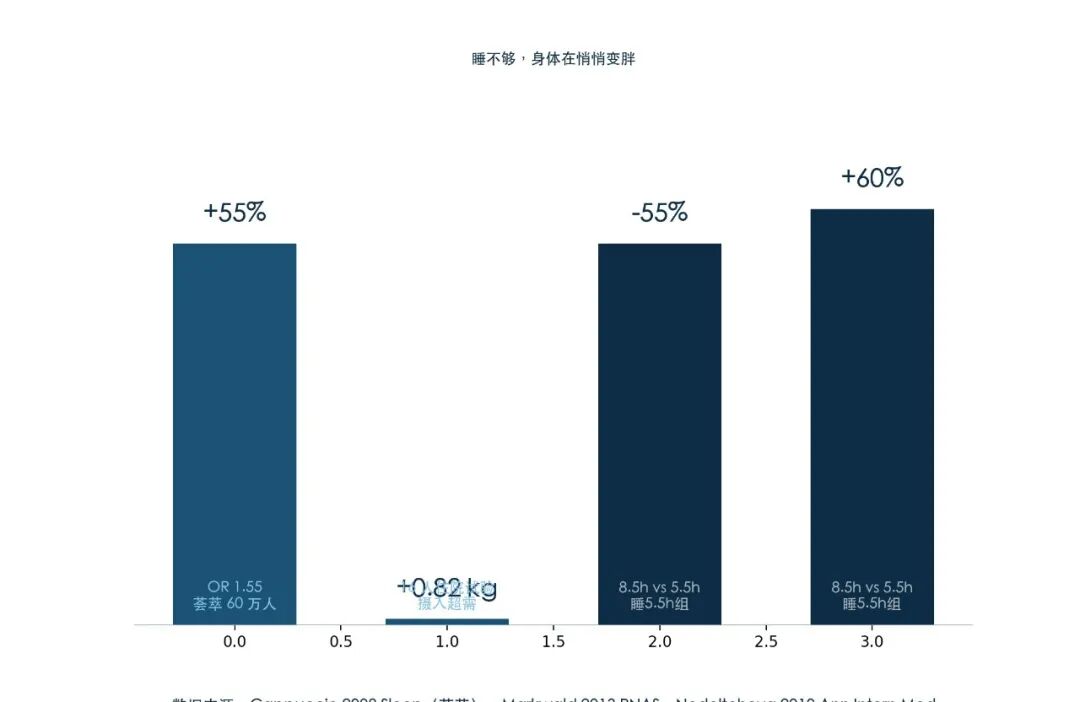
Why is it so hard for night owls to lose weight? It's not a lack of willpower—it's that sleep is stealing your metabolism. Consider two sets of data: a global meta-analysis of 600,000 people found that adults who don't get enough sleep have about a 50% higher risk of obesity[[2]]; and in an inpatient trial, 5 consecutive days of insufficient sleep led to a weight gain of 0.82 kg[[4]].
What's even more frustrating is that many people are dieting and exercising but remain stuck at a plateau—the problem may not lie in what they eat or how they train at all, but in those few hours of sleep each night. Today's article will thoroughly explain the relationship between "sleep and weight gain": why insufficient sleep makes you hungry, makes you crave, and makes you lose muscle—and whether catching up on sleep actually helps.
✦ ✦ ✦
Not Enough Sleep, Hungrier Faster: Two Hormones Are Causing Trouble
The first thing insufficient sleep disrupts is two sets of hormones that control appetite. A crossover trial at the University of Chicago found that after 2 consecutive days of insufficient sleep, healthy young men experienced an 18% decrease in leptin (which suppresses appetite) and a 28% increase in ghrelin (which promotes appetite), with subjective hunger and appetite rising significantly[[5]].
In plain terms: the day after not sleeping enough, your body "pretends to be hungry." This isn't just cravings—it's hormones telling you to go find food.
Not Enough Sleep, Eating More: Especially That Late-Night Bite
Eating more isn't the whole story—the extra intake specifically targets the evening. Another inpatient trial had 16 participants sleep insufficiently for 5 consecutive days (equivalent to staying up late on workdays): total energy expenditure increased by only about 5%, but intake far exceeded expenditure, resulting in a net weight gain of 0.82 kg over 5 days—with almost all the extra intake occurring after dinner[[4]].
This study also had an interesting finding: women are more likely to "crack" when sleep-deprived—when they sleep enough, their weight stays stable, but once they don't sleep enough, their dietary restraint drops noticeably and their weight starts climbing[[4]]. That late-night takeout order after staying up isn't a coincidence—it's physiology pushing you to order it.
That late-night snack, that cup of milk tea—these are exactly where you're most vulnerable when sleep-deprived. The period from after dinner to bedtime is the window when willpower is weakest all day, and insufficient sleep conveniently stretches that window by several more hours.
Not Enough Sleep, Fat Loss Becomes Muscle Loss: Same Diet, Double the Difference
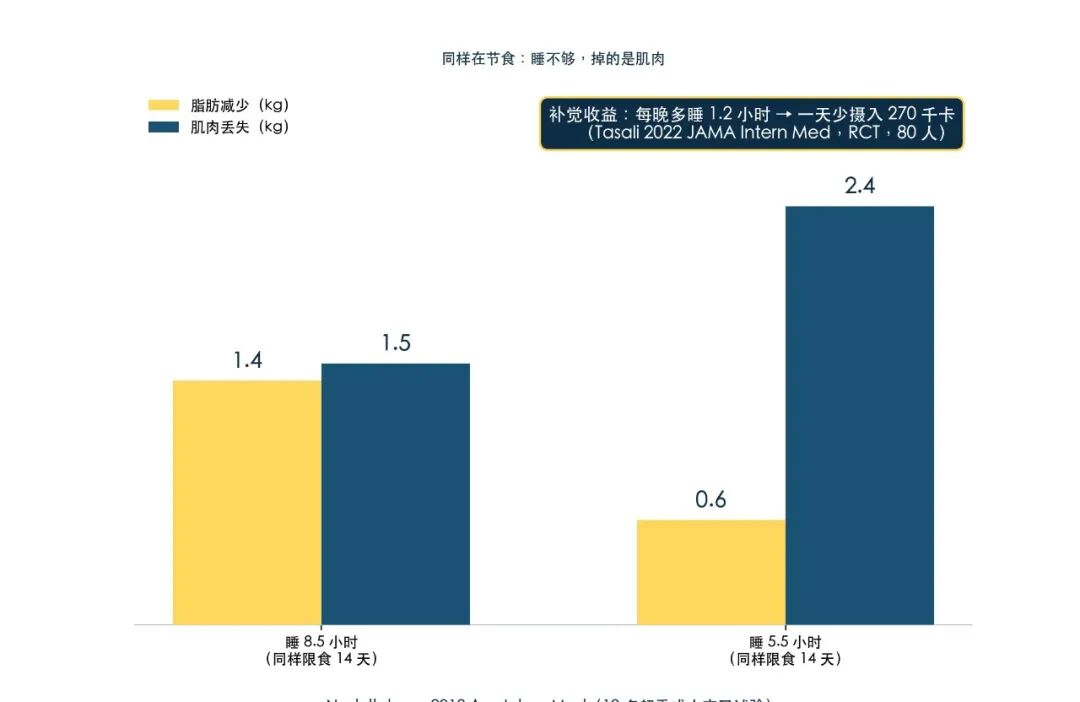
If you're dieting to lose weight, the cost of insufficient sleep is even more direct. A randomized crossover trial had 10 overweight adults undergo the same 14-day calorie restriction, with the only difference being that one group slept 8.5 hours and the other slept 5.5 hours[[3]].
Results: The 5.5-hour sleep group lost 55% less fat (0.6 kg vs 1.4 kg) and lost 60% more muscle (2.4 kg vs 1.5 kg)[[3]]. Same hunger, but those who slept less lost muscle and kept fat—the scale looks good after weight loss, but body fat percentage barely budged, and basal metabolism actually dropped.
The Reverse Is Also True: Catching Up on Sleep Really Does Reduce Intake
The good news is that this road runs both ways. A 2022 randomized controlled trial in a JAMA subsidiary journal: 80 overweight adults who habitually slept less than 6.5 hours were assigned to either receive sleep hygiene counseling to sleep about 1.2 hours more per night, with no dieting or exercise required[[1]].
Results: The sleep extension group consumed 270 fewer calories per day (95% CI 147-393), with sleep duration showing a significant negative correlation with intake[[1]]. What does 270 calories mean? About one full-sugar milk tea plus two cookies. Cutting 270 calories a day adds up to 8,000 calories a month—enough to lose about 1 kg of pure fat.
The inpatient trial mentioned earlier also confirmed this: after switching from insufficient sleep to recovery sleep, participants' energy intake dropped significantly, with the largest reductions in fat and carbohydrates[[4]]. In other words, "sleeping enough naturally makes you not want to eat as much" isn't psychological comfort—it's your body genuinely adjusting your appetite.
Does weekend catch-up sleep help? Yes, but don't overdo it. Catching up on sleep can recover some of the deficit, but sleeping until noon disrupts your biological clock and actually makes it harder to fall asleep the following week. Recommendation: sleep in no more than 1 hour later than usual on weekends, and spread the deficit by sleeping 15-30 minutes more each day—this is more stable than one big catch-up session.
Action Steps: 5 Things You Can Do Tonight
The "Healthy China Action (2019-2030)" recommends an average of 7-8 hours of sleep per day for adults[[6]]. If you can't hit that immediately, that's okay—start with these 5 small things:
-
Fix your wake-up time: This works better than fixing your bedtime. Set your alarm for the same time on workdays, with no more than 1 hour difference on weekends;
-
No screens 1 hour before bed: Put your phone in the living room to charge, and reserve the bedroom for sleep only;
-
No coffee or strong tea after 2 PM: Caffeine has a half-life of 5-6 hours—an afternoon cup is still active at night;
-
Make the bedroom dark and cool: Use blackout curtains, keep room temperature at 18-22°C—cooler temperatures make it easier to fall asleep;
-
Get 20 minutes of sunlight during the day: This helps calibrate your biological clock, so you naturally feel sleepy earlier at night.
If you're in a weight-loss phase, treat "sleeping 7 hours" as equally important as "watching what you eat and moving more"—it doesn't cost a penny, yet it's the most easily overlooked piece for many people stuck at a plateau.
Why is sleep always ignored? Because its effects are a "slow variable": skip a meal, and the scale responds the next day; sleep an extra hour, and it takes one to two weeks to see results. But it's precisely this invisible variable that determines whether the results of dieting and exercise are preserved or wasted. Watching what you eat is cutting expenses, moving more is increasing income, and sleeping enough is what keeps the first two from being wasted—remove any one of these three legs, and the stool of weight loss won't stand steady.
✦ ✦ ✦
If this was helpful, give it a like or a "reading" mark, and feel free to leave a comment telling us what topics you'd like to see. Share it with that friend who's always staying up late—tell them to go to bed early tonight.
✦ ✦ ✦
Disclaimer: This article is based on publicly available academic literature and authoritative institutional materials, provided for health education reference only, and does not constitute medical advice; please consult a professional doctor for individual circumstances.
Conflict of Interest Statement: The author has no conflicts of interest with the studies mentioned in this article.
© 2026 Sun Saint Hua (Beijing) Medical Technology Co., Ltd.
References
-
Tasali E, Wroblewski K, Kahn E, et al. Effect of Sleep Extension on Objectively Assessed Energy Intake Among Adults With Overweight in Real-life Settings: A Randomized Clinical Trial. JAMA Intern Med. 2022;182(4):365-374. PMID:35129580
-
Cappuccio FP, Taggart FM, Kandala NB, et al. Meta-analysis of short sleep duration and obesity in children and adults. Sleep. 2008;31(5):619-626. PMID:18517032
-
Nedeltcheva AV, Kilkus JM, Imperial J, et al. Insufficient sleep undermines dietary efforts to reduce adiposity. Ann Intern Med. 2010;153(7):435-441. PMID:20921542
-
Markwald RR, Melanson EL, Smith MR, et al. Impact of insufficient sleep on total daily energy expenditure, food intake, and weight gain. Proc Natl Acad Sci USA. 2013;110(14):5695-5700. PMID:23479616
-
Spiegel K, Tasali E, Penev P, et al. Brief communication: Sleep curtailment in healthy young men is associated with decreased leptin levels, elevated ghrelin levels, and increased hunger and appetite. Ann Intern Med. 2004;141(11):846-850. PMID:15583226
-
State Council. Healthy China Action (2019-2030). 2019.