This article is for health education and informational purposes only. It does not constitute medical advice. Please consult a professional doctor if you have any health concerns.
✦ ✦ ✦
China now has over 500 million online food delivery users[[5]], and more and more people rely on takeout for all three meals a day. But a large cohort study of 35,000 people offers a reminder: how often you eat out may be linked to how long you live. After reading this card, share the 4 takeout tips with someone who orders delivery every day.
✦ ✦ ✦
One Card to See: What Exactly Are You Eating More of When You Eat Out
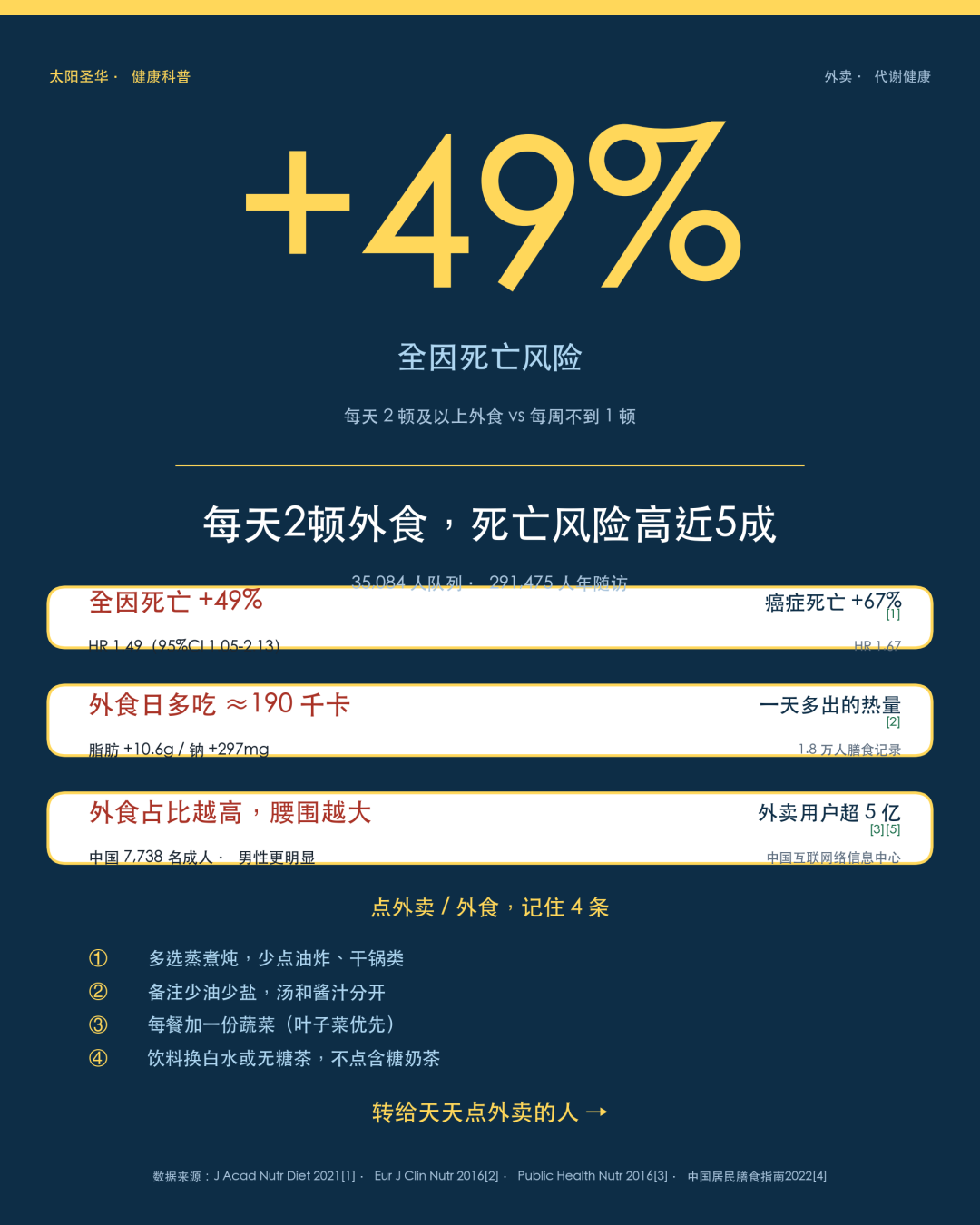
People who eat out 2 or more meals a day have a 49% higher risk of all-cause death[[1]].
The US National Health and Nutrition Examination Survey (NHANES 1999-2014) tracked 35,084 adults over a cumulative 291,475 person-years and found that people who ate out (including takeout and dine-in) ≥2 meals per day had a 49% higher risk of all-cause death (HR 1.49, 95% CI 1.05-2.13) and a 67% higher risk of cancer death (HR 1.67) compared with those who ate out less than once a week[[1]].
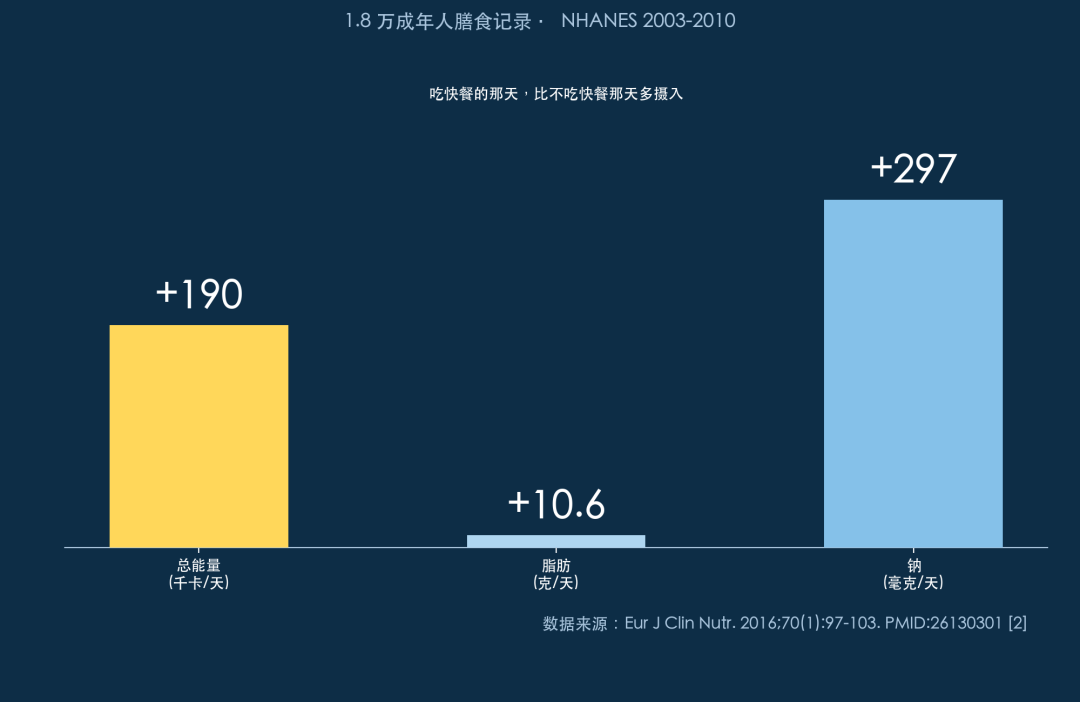
On days eating out versus eating at home, people consume on average about 190 more kcal and about 297 mg more sodium per day[[2]].
Dietary records from 18,000 people showed that on days when they ate fast food, total daily energy intake was on average 190 kcal higher than on days without fast food, with 10.6 g more fat and 297 mg more sodium; on days eating at full-service restaurants, sodium intake was even higher[[2]].
The higher the proportion of eating out, the wider the waistline—Chinese data shows the same[[3]].
The China Health and Nutrition Survey (7,738 adults) showed that the higher the proportion of energy provided by eating out, the higher the BMI and waist circumference, and this association was more pronounced in men[[3]].
An extra 190 kcal per day adds up to about 70,000 kcal a year—roughly the calories of about 9 kg of body fat, accumulating around your waist, along with excessive oil and salt[[2]][[4]].
✦ ✦ ✦
Ordering Takeout / Eating Out: Remember These 4 Tips
-
Choose steamed, boiled, or stewed dishes more often; order fried or dry-pot dishes less—the same ingredients prepared differently can differ in calories by nearly double;
-
Request less oil and less salt; ask for soup and sauce on the side—a single takeout meal's sodium often hits the entire day's recommended limit (<5 g/day)[[4]];
-
Add a serving of vegetables to every meal (leafy greens first)—takeout combos often include just a few token pieces of vegetables;
-
Swap sugary drinks for plain water or unsweetened tea; skip sugary milk tea—one cup of milk tea contains sugar close to the entire daily added sugar limit.
✦ ✦ ✦
Action tip: Keep eating out to no more than 3 times this week; when ordering takeout, first check if there are vegetables—if not, add a serving. Stick with it for a month, and you'll see the payoff on your scale and your health check report.
If you found this helpful, give it a like or a "reading" tap, and feel free to leave a comment telling us what topics you'd like to see. Share it with family and friends who order takeout every day to help them avoid a few pitfalls.
✦ ✦ ✦
Disclaimer: This article is based on publicly available academic literature and is for health education reference only. It does not constitute medical advice; please consult a professional doctor for your individual situation.
Conflict of interest statement: The author has no conflicts of interest with the studies mentioned in this article.
© 2026 Sun Saint Hua (Beijing) Medical Technology Co., Ltd.
References
-
Association Between Frequency of Eating Away-From-Home Meals and Risk of All-Cause and Cause-Specific Mortality. J Acad Nutr Diet. 2021;121(9):1741-1749. PMID:33775622
-
Fast-food and full-service restaurant consumption and daily energy and nutrient intakes in US adults. Eur J Clin Nutr. 2016;70(1):97-103. PMID:26130301
-
Gender difference in the association between food away-from-home consumption and body weight outcomes among Chinese adults. Public Health Nutr. 2016;19(16):2984-2990. PMID:27225341
-
Chinese Dietary Guidelines (2022). Chinese Nutrition Society.
-
China Internet Network Information Center (CNNIC). The 55th Statistical Report on China's Internet Development. 2025-01.