Every 1 kg Lost Takes 4 kg Off Your Knees: Knee Protection Starts with Weight Loss
This article is for health education purposes only and does not constitute medical advice. Please consult a professional doctor if you have any health concerns.
For people with knee pain, the most common advice they hear is "walk less, climb fewer stairs."
But when you look at it from a biomechanical perspective, another overlooked fact emerges: what presses down on your knees every day isn't just the stairs—it's also your own body weight. Every extra bit of weight means your knees bear more with every step.
Let's start with two sets of numbers that surprise many people.
Number one: Among people over 40 worldwide, the prevalence of knee osteoarthritis is about 22.9%—that's 1 in every 5 people. In 2020, approximately 654 million people globally had the condition; women's risk is 1.69 times that of men[2].
Number two: The age-standardized prevalence of knee osteoarthritis in China rose from about 4.7% in 1990 to about 5.0% in 2021, with population aging and high body mass index as the main drivers, and women affected more noticeably[3].
There are two key words for this disease: one is "age," and the other is "weight." You can't change age, but weight is one of the few things you can actually do something about.
✦ ✦ ✦
1. Every step you take, your knees bear several times your body weight
The knee joint carries a heavy load-bearing responsibility in the human body. When you walk, the force it bears is far more than just your body weight—it's several times your body weight.
A gait study that followed 142 overweight or obese patients with knee osteoarthritis over 18 months found that for every 1 kg of body weight lost, the compressive force on the knee joint decreased by an average of 40.6 newtons, and the resultant force decreased by 38.7 newtons. In plain terms—for every 1 kg lost, your knees bear about 4 kg less load with every step[1].
Read that sentence in reverse, and that's the key: for every 1 kg of extra body weight, your knees bear about 4 kg more with every step. Over thousands of steps a day, that adds up to a difference of tens of tons.
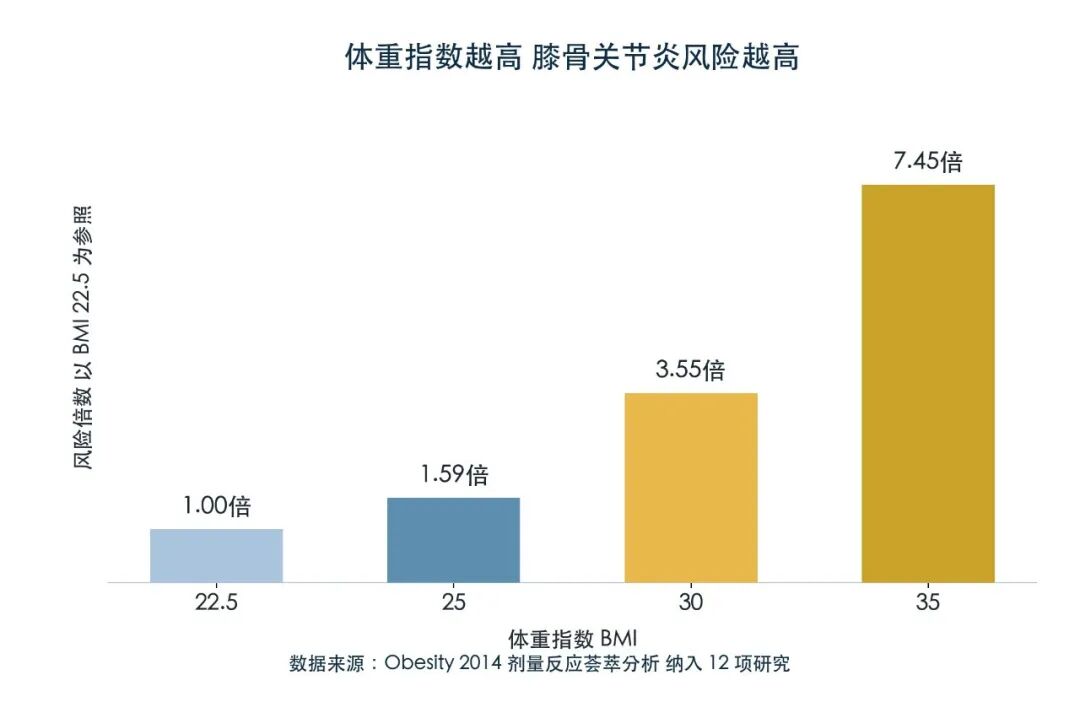
2. The higher your BMI, the faster the risk rises—not gradually, but accelerating
A dose-response meta-analysis of 12 studies provides a striking comparison: using a BMI of 22.5 as the reference, at BMI 25 the risk of knee osteoarthritis rises to 1.59 times, at BMI 30 it rises to 3.55 times, and at BMI 35 it rises to 7.45 times[4].
Another meta-analysis of 14 prospective studies reached a similar conclusion: overweight individuals have about 2.45 times the risk of normal-weight individuals, and obese individuals about 4.55 times; for every 5-point increase in BMI, risk rises by about 35%[5].
In other words, the relationship between weight and knees isn't "a little extra weight means a little extra suffering"—rather, in the higher range, every bit of weight gets amplified into an even greater joint burden.
✦ ✦ ✦
3. Can weight loss really protect your knees? Yes
This isn't theoretical speculation—it's supported by long-term population data.
The classic Framingham Study followed 796 women: over 10 years, those whose BMI dropped by more than 2 units (about 5.1 kg) had their risk of developing "symptomatic knee osteoarthritis" cut by more than half (odds ratio 0.46)[6]. Those who already had a higher baseline BMI (≥25) benefited as well, with an odds ratio of 0.41[6].
4. So how much do you need to lose for it to count?
It's not about losing a tiny bit and calling it a "consolation prize." A community weight-loss program with 1,383 participants over 18 weeks found a clear dose-response relationship between the amount of weight lost and improvements in pain and function—the more weight lost, the more noticeable the symptom improvement; to achieve a clinically meaningful improvement in "daily function," an average weight loss of about 7.7% was needed (confidence interval 5.2% to 13.3%)[7].
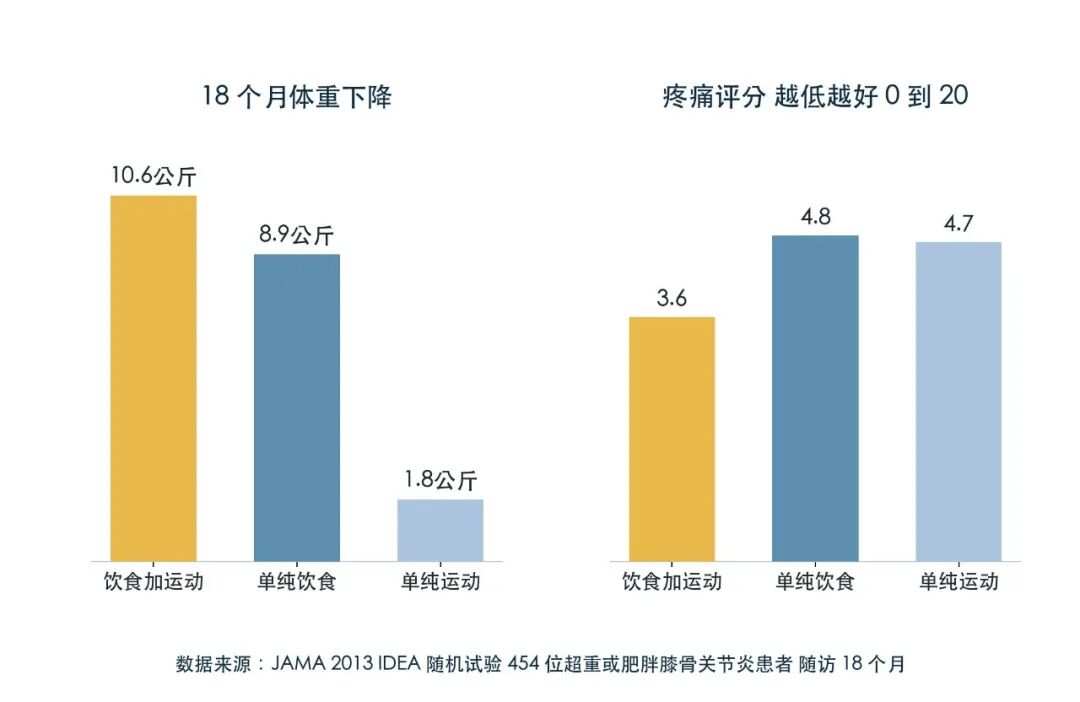
Even more convincing is the IDEA randomized trial: 454 overweight or obese patients with knee osteoarthritis, followed for 18 months[8]—
-
The diet-plus-exercise group lost an average of 10.6 kg (about 11.4%), with a pain score of 3.6—the lowest of the three groups;
-
The diet-only group lost an average of 8.9 kg, with a pain score of 4.8;
-
The exercise-only group lost an average of only 1.8 kg, with a pain score of 4.7.
At the same time, the weight-loss groups had significantly lower knee joint compressive forces than the exercise-only group (2,487 newtons vs. 2,687 newtons—a difference of 200 newtons), and lower levels of the inflammatory marker IL-6[8].
The conclusion is clear: exercise alone without weight loss won't reduce the load on your knees; weight loss alone without exercise won't restore function well enough. Doing both together gives the most complete results.
5. Don't be afraid to move, but don't push through pain
"Exercise will wear out your knees" is a common concern, but the evidence is more nuanced than that. A 2025 network meta-analysis pooled 217 randomized controlled trials with 15,684 patients and found that for people with knee osteoarthritis, aerobic exercise produced relatively greater short- and medium-term pain improvement and ranked high in composite rankings across multiple outcomes[9].
In other words, for most people, appropriate exercise is "treatment," not "wear and tear." What truly harms the knees is often three things: long-term excess body weight, weak leg muscles, and suddenly ramping up intensity and pushing through.
✦ ✦ ✦
3 things you can do today
1. Start with a small 5% goal. For example, if you weigh 80 kg, aim to lose 4 kg first—based on the conversion above, the load on your knees with every step will come down accordingly. Small goals are easier to stick with than "lose 20 kg at once."
2. Schedule low-impact aerobic exercise. Brisk walking, cycling, and swimming are relatively knee-friendly. Aim for 150 minutes per week, broken into 20 to 30 minutes a day for easier scheduling. When your knees are actively hurting, it's best to reduce the amount and not push through.
3. Do leg strength training twice a week. Wall sits, straight leg raises, and seated knee extensions put less stress on the knees; your thigh muscles are your knees' built-in "protective gear"—stronger muscles mean more stable joints.
If your knee becomes noticeably swollen, locks up, hurts even when walking on flat ground, or if your weight changes significantly in a short period, it's best to visit a hospital's orthopedics or rehabilitation department for an evaluation rather than toughing it out on your own.
✦ ✦ ✦
Your knees have been keeping a tab all along—they just don't speak up at first. Losing weight isn't just about looking good; it's also about saving your knees from bearing the burden of every step. Consider sharing this article with an older family member who has knee pain, or save it and think of it next time you climb stairs.
If you found this helpful, give it a like or a "reading" mark, and feel free to leave a comment telling us what topics you'd like to see.
✦ ✦ ✦
References
[1] Messier SP, Gutekunst DJ, Davis C, et al. Weight loss reduces knee-joint loads in overweight and obese older adults with knee osteoarthritis. Arthritis Rheum. 2005;52(7):2026-32. PMID: 15986358
[2] Cui A, Li H, Wang D, et al. Global, regional prevalence, incidence and risk factors of knee osteoarthritis in population-based studies. EClinicalMedicine. 2020;29-30:100587. PMID: 34505846
[3] Li M, Xia Q, Nie Q, et al. Burden of knee osteoarthritis in China and globally: 1990-2045. BMC Musculoskelet Disord. 2025;26(1):582. PMID: 40598022
[4] Zhou ZY, Liu YK, Chen HL, et al. Body mass index and knee osteoarthritis risk: a dose-response meta-analysis. Obesity (Silver Spring). 2014;22(10):2180-5. PMID: 24990315
[5] Zheng H, Chen C. Body mass index and risk of knee osteoarthritis: systematic review and meta-analysis of prospective studies. BMJ Open. 2015;5(12):e007568. PMID: 26656979
[6] Felson DT, Zhang Y, Anthony JM, et al. Weight loss reduces the risk for symptomatic knee osteoarthritis in women. The Framingham Study. Ann Intern Med. 1992;116(7):535-9. PMID: 1543306
[7] Atukorala I, Makovey J, Lawler L, et al. Is There a Dose-Response Relationship Between Weight Loss and Symptom Improvement in Persons With Knee Osteoarthritis? Arthritis Care Res (Hoboken). 2016;68(8):1106-14. PMID: 26784732
[8] Messier SP, Mihalko SL, Legault C, et al. Effects of intensive diet and exercise on knee joint loads, inflammation, and clinical outcomes among overweight and obese adults with knee osteoarthritis: the IDEA randomized clinical trial. JAMA. 2013;310(12):1263-73. PMID: 24065013
[9] Yan L, Li D, Xing D, et al. Comparative efficacy and safety of exercise modalities in knee osteoarthritis: systematic review and network meta-analysis. BMJ. 2025;391:e085242. PMID: 41093618
✦ ✦ ✦
Disclaimer: This article is for health education purposes only and does not constitute medical advice. Please consult a professional doctor if you have any health concerns. Conflict of interest statement: This article does not involve any drug recommendations and has no financial relationship with the research institutions mentioned. ? 2026 Sun Saint Hua (Beijing) Medical Technology Co., Ltd.