1 in 5 Children Overweight or Obese? Read This Data Before School Starts
This article is for health education and informational purposes only and does not constitute medical advice; please consult a professional doctor for any health concerns.
✦ ✦ ✦
During the first week of school, many schools organize weigh-ins. If your child's number has gone up a few pounds since before the break, don't rush to blame yourself—research shows that summer vacation is precisely when children gain weight fastest, and the problem is often not "eating too much" but subtle changes in daily routine, screen time, and dietary patterns[[1]][[2]].
✦ ✦ ✦
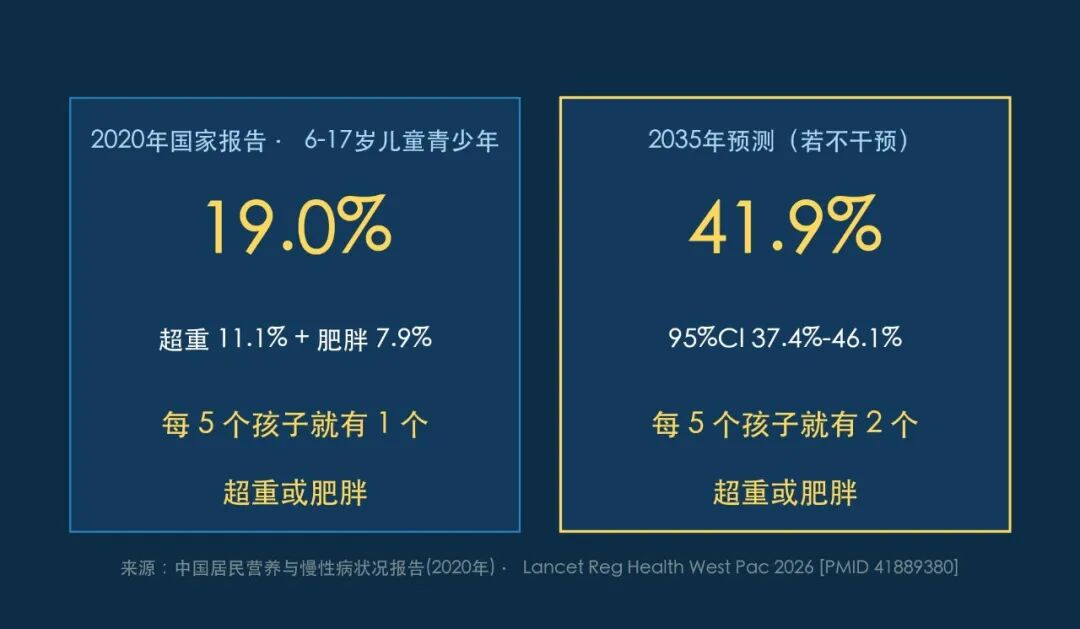
First, some data: among children and adolescents aged 6-17 in China, the overweight rate is 11.1% and the obesity rate is 7.9%, totaling 19.0%—equivalent to 1 in every 5 children being overweight or obese [National Health Commission, Report on the Nutrition and Chronic Disease Status of Chinese Residents (2020)]. Without intervention, a systematic review of obesity risk factors in China published in The Lancet Regional Health – Western Pacific in March 2026 predicts that by 2035, the overweight and obesity rate among children and adolescents will reach 41.9% (95% CI 37.4%-46.1%)—that is, 2 out of every 5 children[[2]].
Even more alarming is that childhood weight problems are easily carried into adulthood: the same review shows that the overweight and obesity rate among Chinese adults has already reached 57% and is projected to rise to 72.2% (95% CI 69.7%-74.7%) by 2035[[2]]. Spending two months now helping your child adjust their habits is far more worthwhile than spending ten years trying to lose weight later in life.
✦ ✦ ✦
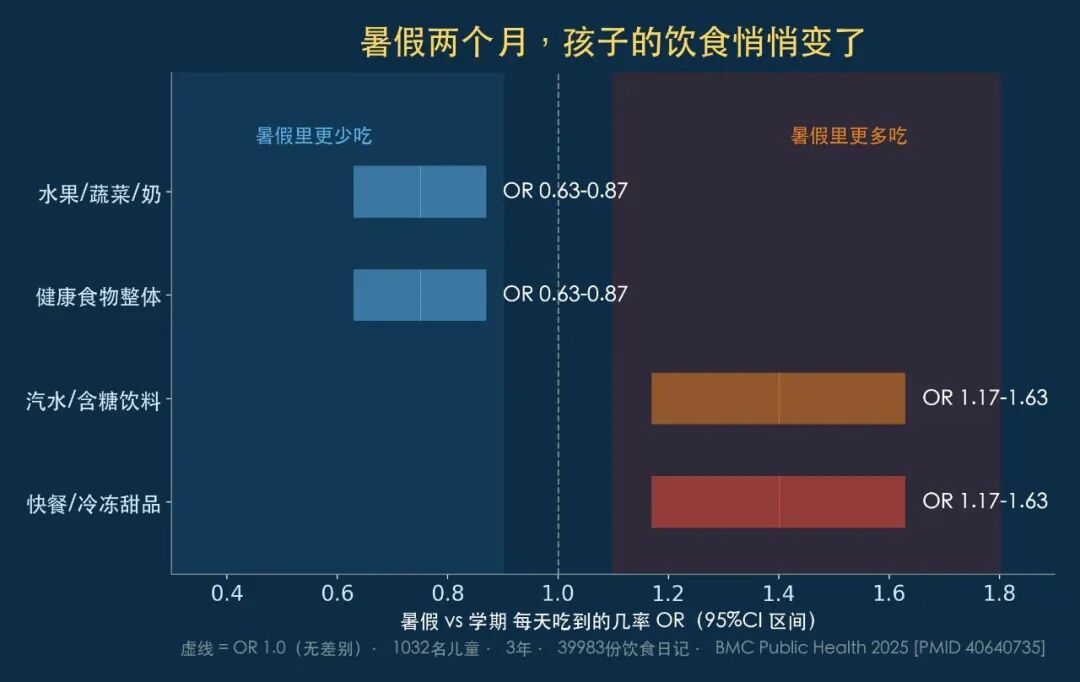
Even more noteworthy is the summer vacation that just passed. A US cohort study that tracked 1,032 children aged 5-14 over 3 consecutive years, accumulating nearly 40,000 dietary diaries, found that during summer vacation, children's odds of eating fruits, vegetables, and milk were 13%-37% lower than during the school term, while their odds of drinking sugar-sweetened beverages and soda and eating fast food and frozen desserts were 17%-63% higher[[1]]. Without the structure of school, overall diet quality declines—which also reminds us: the start of school is a rare annual window for a "habit reset."
✦ ✦ ✦
Before School Starts, Focus on Getting These 5 Things Right
1. First, Shift Sleep Back to "School Mode"
The link between insufficient sleep and childhood overweight is stronger than many people imagine. A 2026 umbrella review in the journal Clinical Obesity summarizing 18 systematic reviews showed that insufficient sleep increases the risk of overweight/obesity by 39% in younger children (RR 1.39, 95% CI 1.27-1.53), by 121% in older children (RR 2.21, 95% CI 1.59-3.07), and by 36% in adolescents (RR 1.36, 95% CI 1.22-1.51); while children who get enough sleep actually have a protective effect (RR 0.86, 95% CI 0.78-0.95)[[3]].
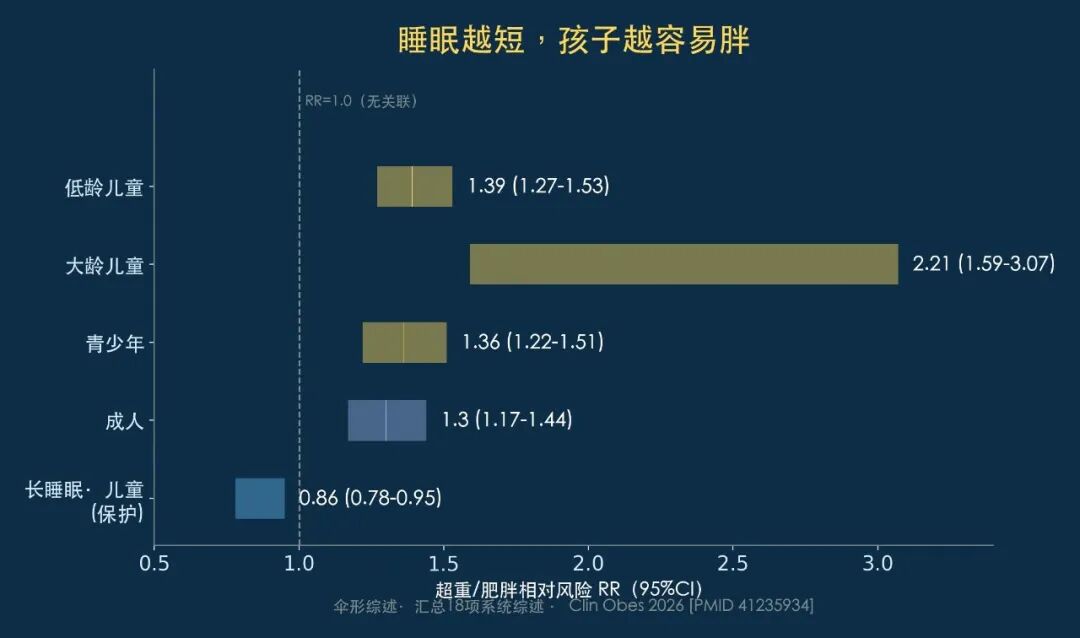
Recommendation: Starting two weeks before school begins, move bedtime earlier by 15-20 minutes each day to gradually align with the school schedule; children aged 6-13 should get 9-11 hours of sleep per night, and screens should be put away 1 hour before bed[[4]]. And this doesn't only affect children—in the same umbrella review, short sleep in adults also increased overweight/obesity risk by 30% (RR 1.30, 95% CI 1.17-1.44)[[3]]. The whole family going to bed early benefits everyone.
2. Eat Breakfast at Home, and "Quit Sugar-Sweetened Beverages Before Leaving the House"
A systematic review and meta-analysis of 23 longitudinal studies showed that sugar-sweetened beverage intake is positively associated with BMI at follow-up in children (β 0.16 kg/m², 95% CI 0.09-0.23)[[5]]; in Chinese populations, sugar-sweetened beverage intake is also a significant risk factor for overweight/obesity (OR 1.90, 95% CI 1.10-3.29)[[2]]. Of the 10 prospective studies included in that meta-analysis, 8 pointed to the same conclusion[[5]].
Recommendation: After school starts, try to have breakfast at home as much as possible (milk/eggs/whole-grain staples); fill a water bottle with plain water, and don't give children "beverage allowance" to spend freely.
3. Set a Screen Time Limit: No More Than 2 Hours Per Day
Data from Chinese populations show that screen time is associated with central obesity (OR 1.09, 95% CI 1.05-1.14)[[2]]. The international "24-hour movement guidelines" also list screen time ≤2 hours per day as one of the targets for children[[4]].
Recommendation: Establish a "screen agreement" with your child—only watch after homework is done, stand up and move around and look into the distance every 20 minutes, and the whole family puts screens away together 1 hour before bed.
4. 60 Minutes of Moderate-to-Vigorous Physical Activity Daily—Walk Whenever You Can Instead of Taking a Car
Guidelines recommend at least 60 minutes of moderate-to-vigorous physical activity per day for children[[4]]; in Chinese data, those with insufficient physical activity have a 24% higher risk of overweight/obesity (OR 1.24, 95% CI 1.02-1.51)[[2]]. And a study of 910 children found that only 23% of children met all three guidelines simultaneously ("exercise + sleep + screen"), and the more guidelines met, the better the body fat indicators[[4]].
Recommendation: Walk part of the way to and from school whenever possible, get 30 minutes of outdoor activity after school before doing homework, and plan one family activity together on weekends.
5. Change Together as a Family—Don't "Manage" the Child Alone
The Cochrane 2024 systematic review pooled 172 studies involving nearly 190,000 children aged 5-11 and found that school education alone has limited effect; only multi-component interventions combining diet, activity, and family involvement can bring small but real benefits[[6]]. Holiday intervention studies also show that organized, structured holiday activities can reduce children's BMI z-score by 0.06 (95% CI -0.10 to -0.01)[[7]].
Recommendation: Set sleep schedule, breakfast, screen time, and exercise as "family rules," with parents modeling first—children are not objects to be "managed" but people resetting habits together with the whole family.
6. Also Remember Three "Don'ts"
-
Don't put your child on a diet: Children are in a growth and development period; extreme calorie restriction may affect height and nutritional intake, and weight management must be conducted under a doctor's guidance.
-
Don't focus only on the weight number: Look at BMI percentile compared with peers and the trend of the growth curve; a single fluctuation in numbers does not represent a problem.
-
Don't use "punishment exercise": Make exercise fun—jump rope, cycling, ball games—so children are willing to stick with it long-term.
If you're unsure, bring your questions directly to a pediatrician or child health care doctor at the school-start physical exam.
✦ ✦ ✦
One-Sentence Action Advice
Two weeks before school starts: adjust sleep → change breakfast → set screen limits → 1 hour outdoors daily; during the first week of school, weigh your child once and record it. If your child is already overweight (BMI above the 85th percentile for peers), please take your child to a child health care department or pediatrics for evaluation rather than putting your child on a "diet" yourself—children are in a growth and development period, and weight management must be conducted under a doctor's guidance.
✦ ✦ ✦
Weight is the result; habits are the cause. The start of school is a great time for the whole family to reset habits together. Consider sharing this article with family members who have school-age children and saving this "back-to-school checklist."
If you found this content helpful, feel free to hit "Like" or "Wow," and leave a comment telling us what topics you'd like to see.
✦ ✦ ✦
References
-
Beets MW, et al. Differences in children's food and beverage consumption between school and summer: three-year findings from the what's UP with summer observational cohort study. BMC Public Health. 2025;25(1):2431. PMID: 40640735.
-
Hu J, et al. Major risk factors of obesity in China and recommendations for future prevention and control efforts: a systematic review and meta-analysis. Lancet Reg Health West Pac. 2026;68:101833. PMID: 41889380.
-
Benfica MA, et al. Relationship between sleep duration and overweight/obesity: a comprehensive overview of meta-analyses. Clin Obes. 2026;16(1):e70051. PMID: 41235934.
-
Katzmarzyk PT, et al. Association between meeting 24-hour movement behavior guidelines and adiposity among Portuguese children. Pediatr Exerc Sci. 2026. PMID: 42618031.
-
Bature F, et al. The association between consumption of foods/food groups and the risk of overweight/obesity and metabolically unhealthy obesity in children and adolescents: a systematic review and meta-analysis. Life (Basel). 2026;16(6):934. PMID: 42355461.
-
Spiga F, et al. Interventions to prevent obesity in children aged 5 to 11 years old. Cochrane Database Syst Rev. 2024;5(5):CD015328. PMID: 38763517.
-
Guerrero-Magaña DE, et al. Interventions for the prevention of weight gain during festive and holiday periods in children and adults: a systematic review. Obes Rev. 2025;26(1):e13836. PMID: 39275907.
Disclaimer: This article is based on publicly published medical research and is intended for health education and informational purposes only; it does not constitute medical advice. Please consult a professional doctor for individual circumstances.
Conflict of Interest Statement: The author has no conflicts of interest with any institution mentioned in this article.
© 2026 Sun Saint Hua (Beijing) Medical Technology Co., Ltd.