Morning Exercise or Evening Exercise? 100 People Trained for 12 Weeks, Body Weight Differed by Only 0.4 kg
This article is for health education purposes only and is intended for informational reference; it does not constitute medical advice. If you have health concerns, please consult a professional physician.
Does fasted running in the morning burn more fat, or does evening training help you sleep better?
These two camps have been arguing on social media for years, and each has its own "tested on myself, it works" witnesses.
I laid out five sets of studies I had on hand and ran the numbers. The conclusion does not side with either camp, but there are indeed several specific differences worth knowing.
First, a set of hard data: 100 people, 12 weeks, randomized groups
The University of Queensland in Australia randomly divided 100 previously inactive overweight adults into three groups: morning training (06:00 to 09:00), evening training (16:00 to 19:00), and a non-exercising control group. Both exercise groups completed the same 250 minutes per week of self-selected intensity aerobic exercise for 12 weeks [1].
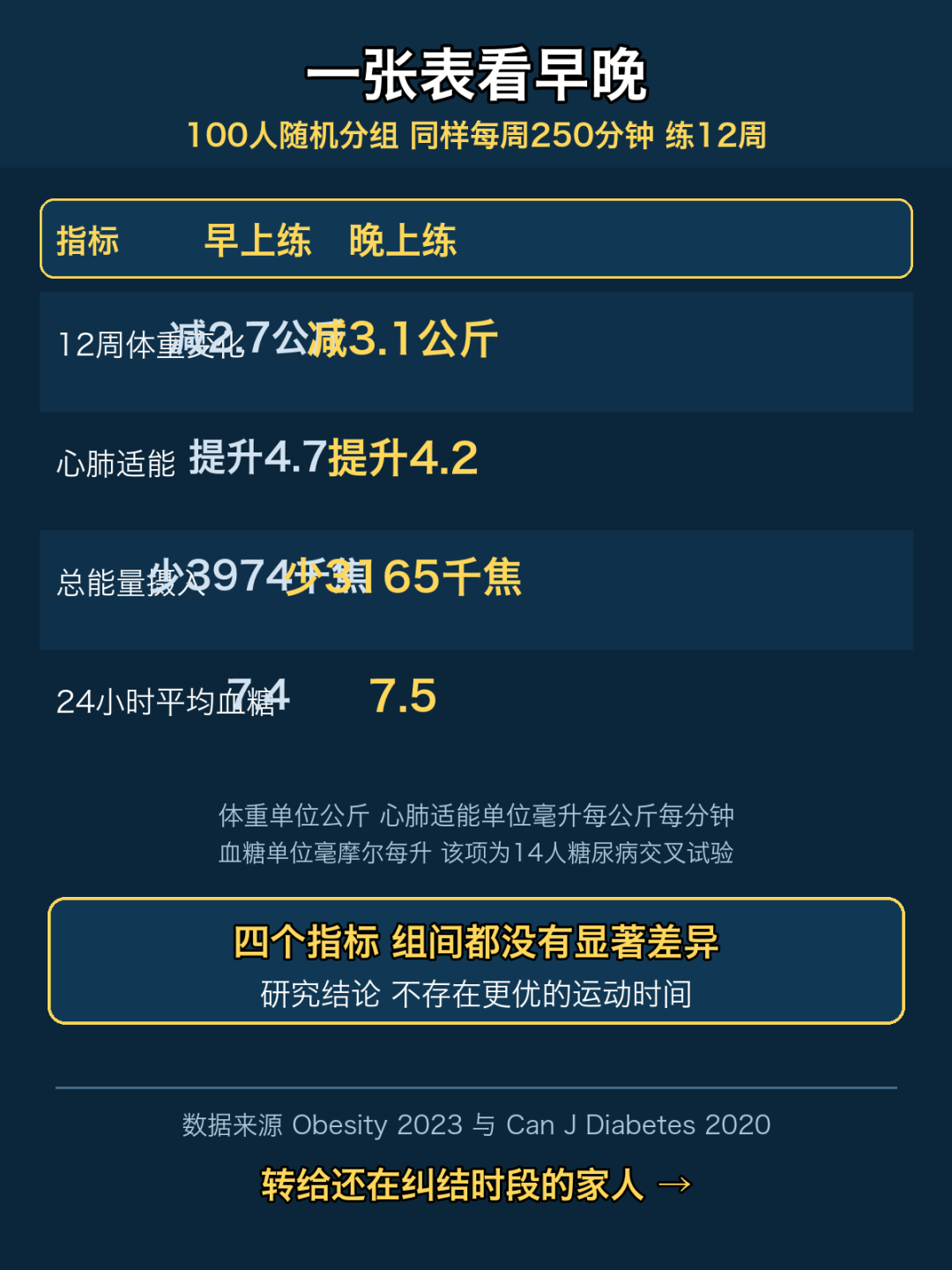
Results: the morning group lost an average of 2.7 kg, and the evening group lost an average of 3.1 kg. Both groups benefited, but there was no statistically significant difference between the groups.
Cardiorespiratory fitness was similar too: the morning group improved by 4.7 and the evening group by 4.2, both clearly better than the inactive control group, yet no difference could be distinguished between them. Even resting metabolic rate and total energy intake were comparable between the two groups.
The researchers stated plainly in their conclusion: exercise in overweight populations produces modest weight loss, but there is no superior exercise timing [1].
That sentence sets the tone for the whole matter.
So is "fasted morning exercise burns more fat" wrong?
Not wrong, but only half right.
A team from the University of Alberta in Canada asked 14 people with type 2 diabetes to wear continuous glucose monitors and complete four conditions in a crossover design: fasted morning walking, afternoon walking, evening walking, and prolonged sitting, each lasting 50 minutes at 5 km/h [4].
During the fasted morning session, the respiratory exchange ratio was lower—meaning that for the same amount of exercise, the proportion of energy supplied by fat was higher.
But what about the 24-hour average blood glucose? Morning 7.4, afternoon 7.3, evening 7.5, sitting 7.5—there was no significant difference among the four conditions [4].
So "fasted exercise burns more fat" is true, but it refers to the fuel mix during that one exercise session, not to how much fat you will lose over a day. Fat loss ultimately depends on how many calories go in and out over the day.
The afternoon advantage shows up on the "living longer" line
The real timing difference appears in mortality risk.
A study based on the UK Biobank of 92,139 people, with wrist-worn accelerometers and more than 7 years of follow-up (cumulative 638,000 person-years), found that as long as people did moderate-to-vigorous exercise, all-cause, cardiovascular, and cancer mortality risks were all lower—this held true at any time of day [2].
When comparing time periods under the premise of comparable exercise volume: using people whose daily exercise was concentrated in the morning as the reference, those whose exercise was concentrated from midday to afternoon (11:00 to 17:00), as well as those with mixed timing, had lower all-cause and cardiovascular mortality risks; the evening-to-night group (17:00 to 24:00) showed no significant difference [2].
This difference was more pronounced in people over 60, men, those who usually exercised little, and those with existing cardiovascular disease [2].
Note that this is an observational cohort, not a randomized trial: the body's circadian rhythm may be at work, or it may be that "people who have time to exercise in the afternoon" simply have more regular daily routines. It can suggest a direction, but it cannot support causation.
People with diabetes: timing is not important, dose is
A prospective cohort of 904 people with type 2 diabetes offered another answer: moderate-to-vigorous exercise volume showed a curvilinear inverse relationship with all-cause mortality risk, but the interaction between exercise volume and timing was not significant (P=0.11); moving evening exercise to the morning also produced no detectable change in mortality risk [3].
In other words, getting moving is worth more than when you move. This is especially true for people with elevated blood glucose—do not give up today's session because you think you "missed the golden window."
Does evening training really affect sleep?
A three-level meta-analysis of 13 randomized trials and 81 effect sizes showed that in direct comparisons between time periods, differences in sleep quality were not statistically significant (g=0.15, P=0.209), and morning, afternoon, and evening showed no stable advantage; the researchers' conclusion was that exercise itself may matter more than timing [5].
Of course, this is a group average. Some individuals really do sleep poorly if they train too late—then move it earlier; there is no need to force it.

Applying it to yourself: four judgments
-
If you only want to lose weight: choose the time period you can stick with long term. In the 12-week experiment, the morning and evening groups differed by less than 0.5 kg; consistency is worth more than timing [1].
-
If you are over 40 and have hypertension, high blood sugar, high blood lipids, or a family history of cardiovascular disease: shift part of your exercise to midday to afternoon; in the cohort, risk was lower during this period [2].
-
If your blood glucose is elevated: first get your weekly exercise volume up to target, and arrange the timing as you like; a walk 1 hour after a meal is also a valid option [3][4].
-
If you are used to training in the evening: do not force yourself to push intensity on an empty stomach for the sake of "fasted fat burning," and do not make up for the calories burned with a late-night snack afterward.
When to ask a doctor first
If you have chest pain or chest tightness, palpitations at rest, blood pressure that is not yet well controlled, or you have just had surgery or have joint pain, do not increase your exercise on your own first—make an appointment and go over your exercise plan with a doctor.
Timing is just a decimal point on the pace chart; getting moving is the main text.
If this article helped you agonize one less time, give it a like or a "reading" click, and feel free to leave a comment telling us what topics you want to see.
Disclaimer: This article is for health education purposes only and is intended for informational reference; it does not constitute medical advice. If you have health concerns, please consult a professional physician.
Declaration of interests: This article does not involve any drug or product recommendations and has no conflicts of interest with the research institutions and journals mentioned in the text.
© 2026 Sunshenghua (Beijing) Medical Technology Co., Ltd.
References
[1] Brooker PG, Gomersall SR, King NA, et al. The efficacy of morning versus evening exercise for weight loss: A randomized controlled trial. Obesity (Silver Spring). 2023;31(1):83-95. PMID: 36502286
[2] Feng H, Yang L, Liang YY, et al. Associations of timing of physical activity with all-cause and cause-specific mortality in a prospective cohort study. Nat Commun. 2023;14(1):930. PMID: 36805455
[3] Ma T, Xie YJ, Bennett T, et al. Time-of-day moderate-to-vigorous physical activity and all-cause mortality in individuals with type 2 diabetes. J Sports Sci. 2022;40(6):614-620. PMID: 34818995
[4] Munan M, Dyck RA, Houlder S, et al. Does exercise timing affect 24-hour glucose concentrations in adults with type 2 diabetes? A follow up to the exercise-physical activity and diabetes glucose monitoring study. Can J Diabetes. 2020;44(8):711-718.e1. PMID: 32878737
[5] Hu X, Chen P. Time-of-day effects of acute and regular exercise on sleep quality and mood: a three-level meta-analysis. Front Psychol. 2026;17:1933599. PMID: 42857179