Diet Soda Making You Fatter? 5 Questions About Artificial Sweeteners Answered
This article is for health education purposes only and is intended for informational reference. It does not constitute medical advice; if you have health concerns, please consult a professional physician.
That can of zero-sugar soda in the fridge—many people treat it as a weight-loss staple: they want something sweet without gaining weight.
But six months later, the number on the scale has barely budged.
The problem may not be the drink itself, but what you expect from it.
✦ First, two sets of conflicting studies
A 2019 systematic review in the BMJ pooled 56 studies (including 35 observational studies). Among overweight and obese adults who were actively losing weight, no additional weight loss from artificial sweeteners was observed; the only slight BMI difference came from two small trials totaling 174 people, with very low certainty of evidence[1].
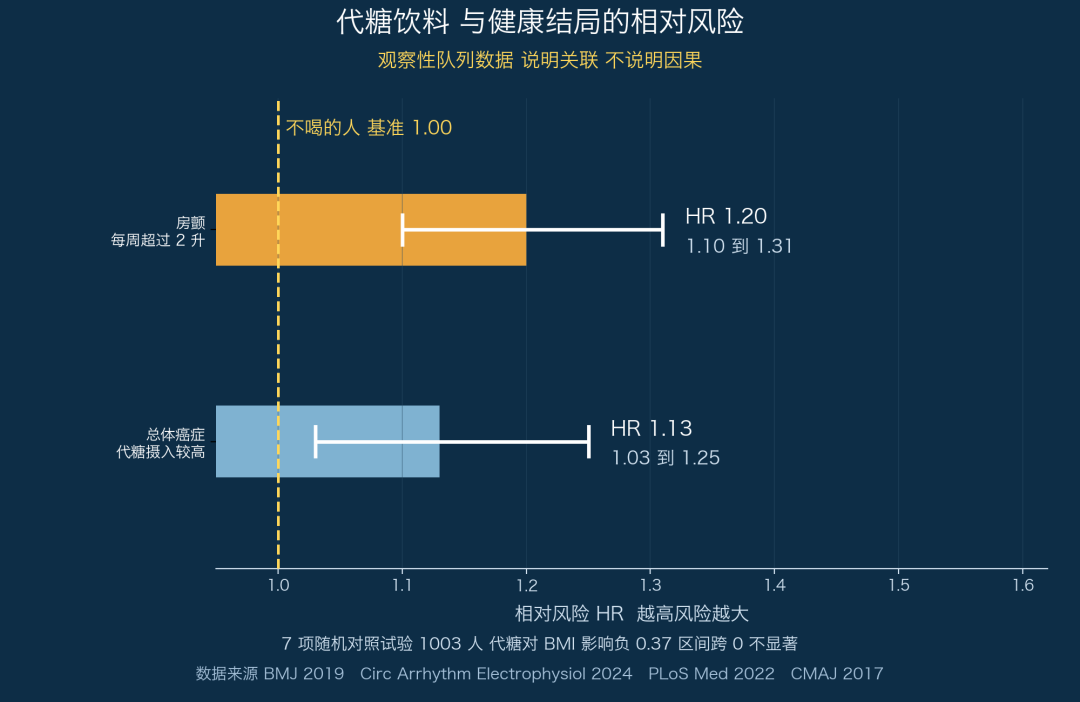
A 2024 cohort study of 202,000 people followed for nearly 10 years showed another side: those who drank more than 2 liters of artificially sweetened beverages per week had a 20% higher risk of atrial fibrillation (HR 1.20)[3].
In one sentence: it didn't help you lose weight, and it's not a "harmless glass of water" either.
✦ Question 1: Zero sugar, zero calories—is it really calorie-free?
"0 sugar, 0 calories" is labeled according to national standards: if energy is below 17 kJ per 100 mL, it can be labeled as 0, and the sweeteners themselves contribute negligible calories.
But "no calories" doesn't mean "drink as much as you want." The acids, phosphoric acid, and caffeine are all still there; and once you're used to sweetness, plain water becomes harder to swallow.
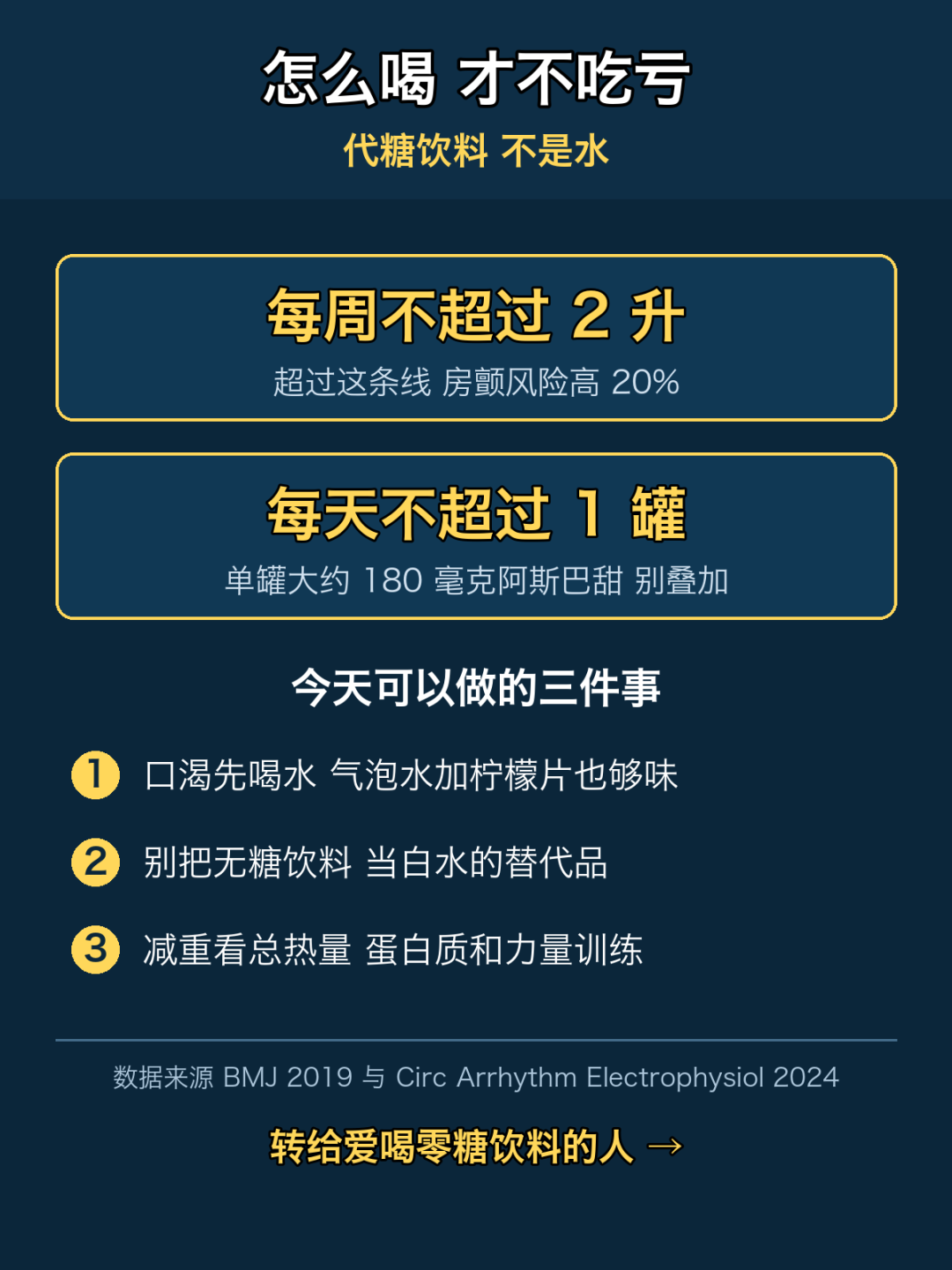
A 330 mL can of diet cola contains roughly 180 mg of aspartame. A single can is far below the safety threshold—the problem lies in the accumulation of five or six cans a day, and the psychological relaxation that comes with "it's zero calories anyway."
✦ Question 2: Do artificial sweeteners raise blood sugar?
A 2022 randomized controlled trial of 120 people published in Cell: after two weeks of consuming saccharin and sucralose, some participants showed worse blood glucose responses, and this change tracked with their gut microbiome[4].
Two caveats to remember: the doses were within the safe range; and individual differences are large—some people showed no change at all. It's not that "everyone's blood sugar goes up," but it's also not accurate to say it has "absolutely no effect."
✦ Question 3: Do they make you crave sweets more?
This one is hotly debated. Across multiple studies, artificial sweeteners show no consistent conclusion regarding sweet preference or eating behavior[1].
In observational studies, people who regularly consume artificial sweeteners have slightly higher BMI[2]. But this is more likely reverse causation: people who are already watching their weight and trying to lose it are the ones buying diet drinks.
In the same cohort data, no consistent evidence was found that "artificial sweeteners inevitably make people eat more"[2]. So don't simply blame sweeteners for a weight-loss plateau.
✦ Question 4: So do they actually help me lose weight?
The evidence from randomized controlled trials is clear-cut: 7 trials, 1,003 people—the effect of artificial sweeteners on BMI was −0.37, with a confidence interval crossing 0, not significant[2].
In the same study, 30 cohort studies (406,000 people, followed for about 10 years) showed: regular consumers had slightly higher body weight, waist circumference, obesity, type 2 diabetes, and cardiovascular events[2].
The conclusion is simple: artificial sweeteners can save you from sugar, but they can't make you eat less. If the calorie balance doesn't add up, nothing you drink will matter.
✦ Question 5: Can I still drink them? How should I drink them?
Yes, you can—but treat them as a "transition," not as "water." There are two reference thresholds for dosing.
First, exceeding 2 liters per week, atrial fibrillation risk begins to rise noticeably[3]. Second, a 2022 French cohort of 102,000 people: those with higher artificial sweetener intake had a 13% higher overall cancer risk (HR 1.13), with the aspartame subgroup at 15%[5].
This is association, not causation—no need to panic, but don't ignore it either. In 2023, the International Agency for Research on Cancer classified aspartame as Group 2B (limited evidence), while reaffirming that the acceptable daily intake remains 40 mg per kilogram of body weight—a 70 kg person would need to drink over a dozen cans a day to approach that line.
✦ Who should be extra cautious
People with phenylketonuria should avoid aspartame, as it contains phenylalanine. For children and pregnant women, prioritize plain water and light tea; it's not recommended to make artificially sweetened beverages a daily drink.
People with irritable bowel syndrome or sensitive digestion should watch out for sugar alcohols (xylitol, erythritol, sorbitol): consuming too much at once can easily cause bloating and diarrhea.
✦ Three things you can do today
① Limit diet drinks to no more than 1 can per day, and no more than 2 liters per week.
② When you want something sweet, transition with sparkling water plus lemon slices, light tea, or black coffee—don't go through five or six cans a day.
③ Focus weight loss efforts on total calories, adequate protein, and strength training—drinks are just a supporting player.
When it comes to weight, it was never something that could be solved by switching to a different sweetener.
What really works is whether you're willing to slowly hand over that sweet tooth to fruit and natural flavors.
Share this with that friend whose fridge is stuffed with diet cola.
If this was helpful, give it a like or a "reading" —and feel free to leave a comment telling us what topics you'd like to see.
Disclaimer: This article is for health education purposes only and is intended for informational reference. It does not constitute medical advice; if you have health concerns, please consult a professional physician.
Conflict of interest statement: This article does not involve any drug or product recommendations and has no financial relationship with the institutions or study authors mentioned.
© 2026 Sunsheng Hua (Beijing) Medical Technology Co., Ltd.
References
[1] Toews I, Lohner S, Küllenberg de Gaudry D, et al. Association between intake of non-sugar sweeteners and health outcomes: systematic review and meta-analyses of randomised and non-randomised controlled trials and observational studies. BMJ. 2019;364:k4718. PMID: 30602577
[2] Azad MB, Abou-Setta AM, Chauhan BF, et al. Nonnutritive sweeteners and cardiometabolic health: a systematic review and meta-analysis of randomized controlled trials and prospective cohort studies. CMAJ. 2017;189(28):E929-E939. PMID: 28716847
[3] Sun Y, Yu B, Yu Y, et al. Sweetened Beverages, Genetic Susceptibility, and Incident Atrial Fibrillation: A Prospective Cohort Study. Circ Arrhythm Electrophysiol. 2024;17(3):e012145. PMID: 38440895
[4] Suez J, Cohen Y, Valdés-Mas R, et al. Personalized microbiome-driven effects of non-nutritive sweeteners on human glucose tolerance. Cell. 2022;185(18):3307-3328. PMID: 35987213
[5] Debras C, Chazelas E, Srour B, et al. Artificial sweeteners and cancer risk: Results from the NutriNet-Santé population-based cohort study. PLoS Med. 2022;19(3):e1003950. PMID: 35324894