Can Stretching Slim Your Legs? 5 Questions That Explain What Stretching Really Does
This article is for health education purposes only and is intended as general information. It does not constitute medical advice. If you have health concerns, please consult a professional doctor.
"Stretch for ten minutes a day and your legs will get thinner." "Stretching before bed is the same as exercising for half an hour." You've definitely come across claims like these.
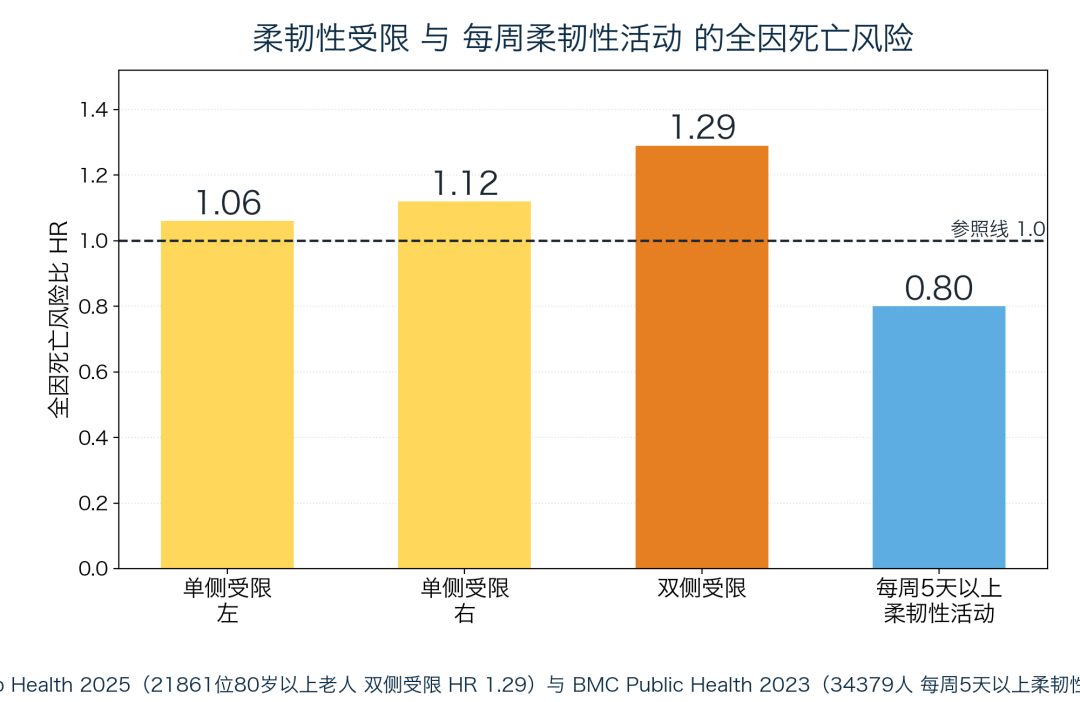
They put stretching on a pedestal, but conveniently leave out the part of stretching that is actually backed by data: in a ten-year follow-up of 21,861 elderly adults, those with limited flexibility in both upper limbs had a 29% higher risk of death.
What does stretching actually do, and what doesn't it do? Five questions will make it clear.

First, Two Sets of Numbers: Flexibility Is More Than Just "Can You Touch Your Toes"
One set of data comes from the Chinese Longitudinal Healthy Longevity Survey: 21,861 adults aged 80 and above, with a cumulative 72,586 person-years of follow-up and 18,570 deaths. After adjusting for age, disease history, and lifestyle habits, limited flexibility in one upper limb was associated with a higher risk of all-cause mortality, while those with limited flexibility in both limbs had a 29% higher risk (HR 1.29) [1].
Another set of data comes from 34,379 Korean adults: those who did flexibility activities more than 5 days per week had a 20% lower risk of all-cause mortality (HR 0.80) [2].
In other words, whether you can stretch your body out is itself a repeatedly validated indicator of "body age."
Q1: Can Stretching Make Your Legs Thinner?
You can't rely on it to reduce leg fat.
Fat won't be "burned on the spot" just because you stretch it. In a controlled trial of 24 people, participants did abdominal training 5 days a week for 6 consecutive weeks, and the results showed no change in abdominal subcutaneous fat, waist circumference, or skinfold thickness—only abdominal muscle endurance improved significantly (47 reps vs 32 reps) [7].
There are also two common misunderstandings about why legs don't look smaller: first, muscle tension and lower-limb edema can make legs look "puffy," and after stretching and relaxing, they may indeed look slightly better visually; second, posture (such as anterior pelvic tilt) can make legs look shorter and thicker.
So: stretching can make your legs look "smoother," but making your legs "smaller" depends on a whole-body calorie deficit and overall exercise.
Q2: So What's Wrong With "Just Stretch and You'll Lose Weight"?
The mistake is attributing the benefits of flexibility activities to fat loss.
Stretching itself burns very limited calories and barely improves cardiorespiratory fitness—brisk walking, jump rope, and strength training are the main drivers of fat loss and cardiorespiratory health. The value of flexibility activities lies on a different track: the two cohort studies above show that it is associated with a lower risk of all-cause mortality [1][2].
So stretching is not a fat-loss tool—it's an entry in the anti-aging ledger.
Q3: Can Stretching Lower Blood Pressure?
Yes, but with two conditions: you have to do enough of it, and you can't stop.
An Italian study of 24 patients with hypertension: after 6 consecutive weeks of passive lower-limb stretching, systolic blood pressure dropped by an average of 4.9%, diastolic blood pressure by 6.9%, and mean arterial pressure by 3.7%—a magnitude close to the immediate blood-pressure-lowering effect of a single session of mild aerobic exercise; but once the intervention stopped during the follow-up period, all these improvements returned to baseline [3].
Another randomized crossover trial in middle-aged and older adults around age 72: a single session of passively assisted trunk stretching (5 rounds, each with 6 movements of 30 seconds) reduced central systolic blood pressure by 3 mmHg and diastolic blood pressure by 2 mmHg, while the control group sitting for the same duration showed no such change [4].
In one sentence: the blood-pressure-lowering effect of stretching is real, but it's like a "debt you have to repay every day"—stop practicing and it goes back to zero.
Q4: Should You Stretch Before Exercise or Not?
It depends on which kind you're doing.
A meta-analysis by Simic et al. of 104 studies found that using static stretching as the main component of a warm-up led to an average 5.4% decrease in strength and a 2.0% decrease in explosive power afterward; a single stretch lasting under 45 seconds had the least negative impact [5].
So the safer approach is:
-
Before exercise: do a dynamic warm-up—leg swings, high knees, and 3 minutes of jogging to raise body temperature, rather than prolonged static stretching;
-
After exercise or in a separate session: then do static stretching, with the goal of lengthening muscles, not "warming up."
Q5: How Long Do You Need to Stretch Each Day for It to Work?
Much less than you think.
A 2025 meta-analysis in Sports Med covering 189 studies and 6,654 adults provided a clear dose: static stretching can effectively improve flexibility, but the benefits basically max out at 4 minutes per session and 10 minutes per week, with no additional benefit from adding more time; the stiffer your baseline, the more noticeable the improvement [6].
In other words, 10 minutes per week, spread over 5 days, with 30 seconds for each major area per day, is enough.

Three Things You Can Do Today
-
Pick 5 movements: one each for the back of the thighs, calves, front of the hips, chest and shoulders, and back. Stretch each for 30 seconds to make up a 4-minute session.
-
Stretch to "tight but not painful": you should feel tension but still be able to breathe and talk normally; stop immediately if you feel sharp pain or numbness.
-
Set a fixed time, more than 5 days per week: place it after exercise or before bed, and just accumulate 10 minutes per week. Don't chase the idea that "the harder you stretch, the better."
Stretching isn't responsible for making your legs thinner—it's responsible for helping your body last longer. Your blood vessels, joints, and posture will all remember this for you. Share it with that friend who talks about "stretching to slim legs" every day but keeps pulling a muscle.
If this was helpful to you, give it a like or a "reading" click, and feel free to leave a comment telling us what topics you'd like to see.
Disclaimer: This article is for health education purposes only and is intended as general information. It does not constitute medical advice. If you have health concerns, please consult a professional doctor.
Conflict of Interest Statement: This article does not recommend any drugs, devices, or health products, and has no financial relationship with the research institutions mentioned in the text.
© 2026 Sun Saint Hua (Beijing) Medical Technology Co., Ltd.
References
[1] Zhang Y, Zhang C, Hu J, et al. Associations between upper limb flexibility and all-cause mortality in the oldest-old. J Glob Health. 2025;15:04224. PMID: 41039874 [2] Cho Y, Jang H, Kwon S, et al. Aerobic, muscle-strengthening, and flexibility physical activity and risks of all-cause and cause-specific mortality: a population-based prospective cohort of Korean adults. BMC Public Health. 2023;23(1):1148. PMID: 37316812 [3] Toninelli N, Maloberti A, Cè E, et al. Six weeks stretching of lower limbs lowers blood pressure in hypertensive individuals. Eur J Appl Physiol. 2026. PMID: 42470495 [4] West K, Spears K, Joyner B, et al. The acute effect of passively assisted trunk stretching on central arterial stiffness and blood pressure in middle-aged to older adults. Eur J Appl Physiol. 2024;124(6):1683-1692. PMID: 38217670 [5] Simic L, Sarabon N, Markovic G. Does pre-exercise static stretching inhibit maximal muscular performance? A meta-analytical review. Scand J Med Sci Sports. 2013;23(2):131-148. PMID: 22316148 [6] Ingram LA, Tomkinson GR, d'Unienville NMA, et al. Optimising the Dose of Static Stretching to Improve Flexibility: A Systematic Review, Meta-analysis and Multivariate Meta-regression. Sports Med. 2025;55(3):597-617. PMID: 39614059 [7] Vispute SS, Smith JD, LeCheminant JD, et al. The effect of abdominal exercise on abdominal fat. J Strength Cond Res. 2011;25(9):2559-2564. PMID: 21804427