High Uric Acid? Can You Still Eat Hot Pot? The Answer May Surprise You
This article is for health education purposes only and does not constitute medical advice. Please consult a professional doctor if you have health concerns.
The "uric acid" line on medical checkup reports has become increasingly common in recent years. One in every 6 Chinese adults has elevated uric acid (16.4%) [[1]], and this proportion is climbing year by year. As autumn brings hot pot gatherings and seafood feasts — can people with high uric acid still indulge? Today we'll address the 5 most frequently asked questions all at once.
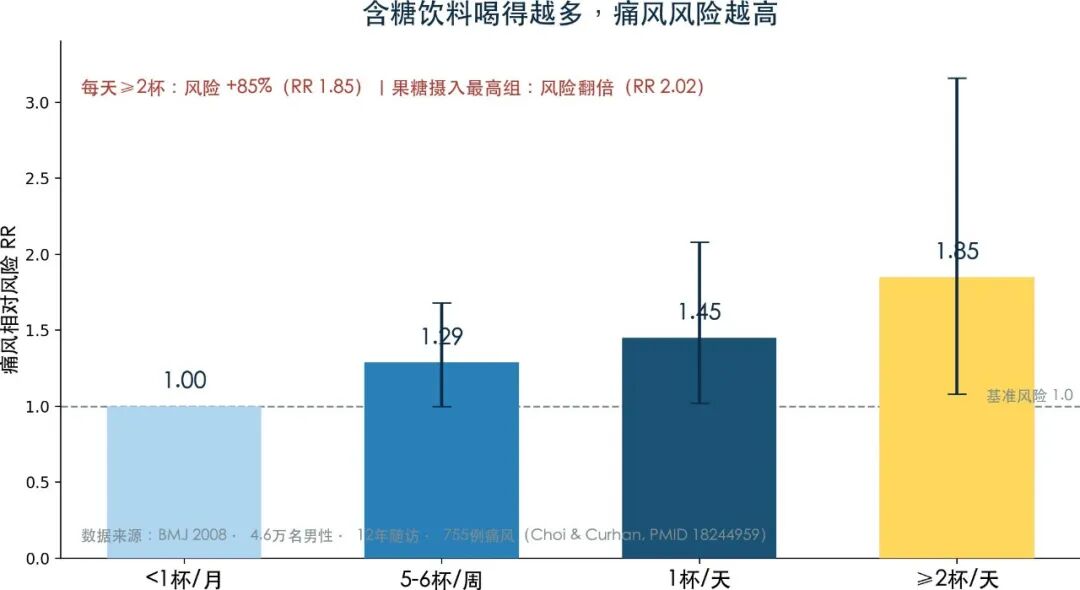
First, some numbers: a meta-analysis including 177 studies and 2.27 million Chinese people showed that the prevalence of hyperuricemia among adults has reached 16.4%, rising from 8.5% in 2001 to 18.4% in 2017[[1]], with even higher rates in southern cities. And the more insidious "uric acid booster" — even more so than seafood — is sugar-sweetened beverages: drinking 2 or more cups per day is associated with an 85% increased risk of gout[[3]].
✦ ✦ ✦
Q1: Can I still eat soy products if my uric acid is high?
Yes, and you don't need to avoid them. Purines from plant-based foods have low absorption rates. A study following 120,000 people showed that those who adhered to a healthy plant-based diet (rich in whole grains, legumes, vegetables, and fruits) had a 21% lower risk of gout[[4]]. A 2026 Chinese 12-week randomized controlled trial also found that a plant-based calorie-restricted diet achieving 6.6 kg of weight loss led to a more significant drop in uric acid than a conventional weight-loss diet[[6]]. What you really need to limit are animal organs, rich meat broths, and shellfish.
Rather than focusing on individual foods, your overall dietary pattern matters more: the DASH diet (high in fruits and vegetables, whole grains, and low-fat dairy) lowered uric acid by an average of 0.25 mg/dL (about 15 μmol/L) over 8 weeks, with greater reductions in those who had higher baseline levels — those with a baseline ≥8 mg/dL dropped an average of 0.73[[2]].
✦ ✦ ✦
Q2: Do I have to give up hot pot and seafood entirely?
Not entirely, but you should "choose wisely." Shellfish, animal organs, and rich broths are purine powerhouses — during acute gout attacks, strictly follow your doctor's orders; moderate amounts of fish and shrimp are fine. For hot pot, choose a clear broth base, cook vegetables first and meat last, and don't drink the broth at the end. What you need to give up more than hot pot are sugar-sweetened beverages and fruit juice — drinking 2 or more sugary drinks per day increases gout risk by 85%[[3]]; those who consume the most fructose have double the risk (RR 2.02)[[3]].
✦ ✦ ✦
Q3: Does losing weight really lower uric acid?
Yes, and it works better than many people think. A 12-week calorie-restricted weight-loss program achieving 6.6 kg of loss led to a significant simultaneous drop in uric acid[[6]]. But a word of caution: with extreme dieting and rapid weight loss, uric acid may temporarily spike in the early stages — take it gradually and don't chase "lightning-fast slimdowns." For overweight/obese individuals, losing 5-10% of body weight is a foundational uric acid-lowering approach recommended by Chinese guidelines[[7]].
✦ ✦ ✦
Q4: Can I drink coffee, tea, and milk?
Coffee is fine: a 2025 meta-analysis including 13 studies and 937,000 people showed that coffee consumption was associated with a 27% lower risk of high uric acid/gout (OR 0.73)[[5]]. Tea has not shown a protective effect so far[[5]]. Low-fat dairy is actually a bonus: 1 serving of dairy per day is associated with a 14% lower risk of gout[[4]]. Be careful with fruit juice — 1 serving per day increases risk by 6%[[4]].
✦ ✦ ✦
Q5: How high does uric acid need to be before I should worry? When should I see a doctor?
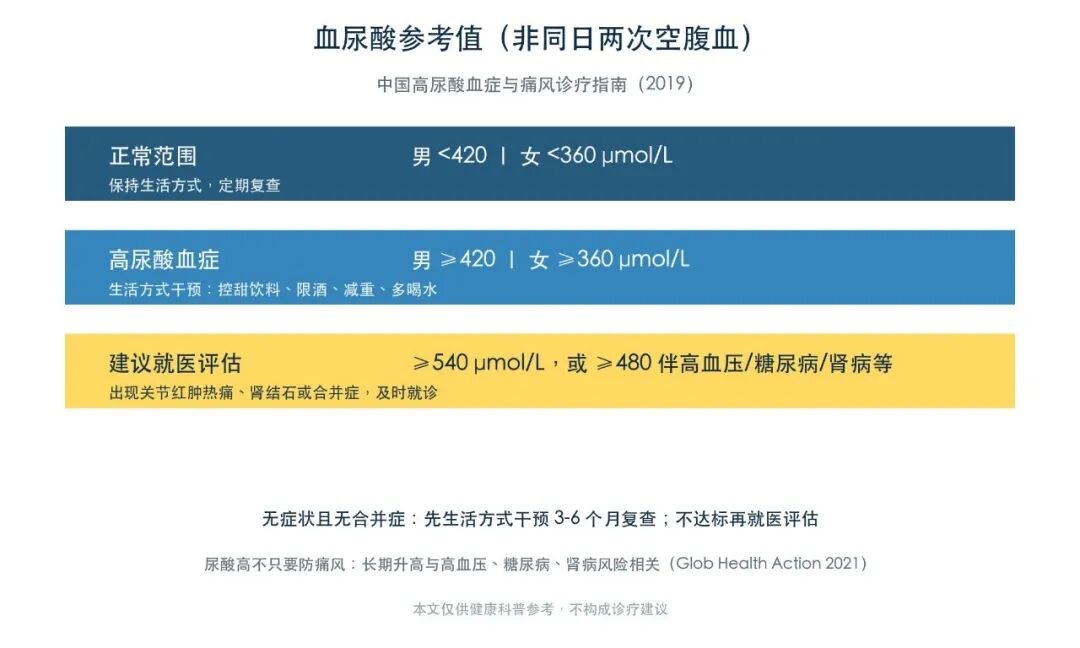
According to Chinese guidelines, if two separate fasting blood uric acid tests on different days show levels >420 μmol/L for men or >360 μmol/L for women, it is defined as hyperuricemia[[7]]. It's not just a "gout warning": long-term elevation is associated with risks of hypertension, diabetes, and kidney disease[[1]][[7]]. You should see a doctor if: ① joints become red, swollen, hot, and painful; ② uric acid ≥540, or ≥480 with coexisting hypertension, diabetes, kidney disease, etc.; ③ recurrent kidney stones. If lifestyle adjustments for 3-6 months still don't bring levels to target upon recheck, you should also seek medical evaluation[[7]].
✦ ✦ ✦
Action Guide: A "Can / Limit / Avoid" List
-
Can: whole grains, legumes, vegetables, low-fat dairy, coffee; drink about 2000 ml of water daily
-
Limit: moderate amounts of fish and shrimp; minimize alcohol, especially beer
-
Avoid: sugar-sweetened beverages, fruit juice, animal organs, rich meat broths, shellfish (strictly avoid during acute attacks)
-
For overweight/obese individuals: treat "losing 5-10% of body weight" as treatment — it may be more effective than dietary restrictions[[7]]
Managing your weight may be more effective than giving up seafood; cutting out sugary drinks may be more important than avoiding hot pot. We suggest saving this "Can / Limit / Avoid" list and sharing it with family and friends during checkup season.
If you found this article helpful, feel free to hit "Like" or "Wow," and leave a comment telling us what topics you'd like to see.
Disclaimer: This article is for health education purposes only and does not constitute medical advice. Please consult a professional doctor if you have health concerns. Conflict of interest statement: The author declares no conflicts of interest related to this content. © 2026 Sun Saint Hua (Beijing) Medical Technology Co., Ltd.
References
-
Li Y, Shen Z, Zhu B, et al. Demographic, regional and temporal trends of hyperuricemia epidemics in mainland China from 2000 to 2019: a systematic review and meta-analysis. Glob Health Action. 2021;14(1):1874652. PMID: 33475474.
-
Juraschek SP, Yokose C, McCormick N, et al. Effects of dietary patterns on serum urate: results from a randomized trial of the effects of diet on hypertension. Arthritis Rheumatol. 2021;73(6):1014-1020. PMID: 33615722.
-
Choi HK, Curhan G. Soft drinks, fructose consumption, and the risk of gout in men: prospective cohort study. BMJ. 2008;336(7639):309-312. PMID: 18244959.
-
Rai SK, Wang S, Hu Y, et al. Adherence to healthy and unhealthy plant-based diets and the risk of gout. JAMA Netw Open. 2024;7(5):e2411707. PMID: 38771576.
-
Hong SH, Kim JM. Effects of coffee and tea consumption on hyperuricemia and gout: a systematic review and meta-analysis. Nutr Res Pract. 2025;19(5):649-663. PMID: 41098399.
-
Mutailipu K, Yang L, Fang Y, et al. Plant-based caloric restriction diets versus conventional calorie-restricted diets for weight loss and metabolic health in obese adults: a 12-week randomized, open-label, non-inferiority trial. Front Nutr. 2026;13:1805225. PMID: 42051342.
-
Chinese Society of Endocrinology, Chinese Medical Association. Guidelines for the diagnosis and treatment of hyperuricemia and gout in China (2019). Chinese Journal of Endocrinology and Metabolism. 2020;36(1):1-13.