Flushing After Drinking Doesn't Mean You Can Hold Your Liquor: Upper Digestive Tract Cancer Risk About 12 Times Higher
This article is for health education purposes only and is intended for informational reference. It does not constitute medical advice; if you have health concerns, please consult a professional doctor.
Two sips into a meal and your face turns red. Someone next to you says, "Flushing means you can hold your liquor," and your glass gets filled again.
Flushing has nothing to do with alcohol tolerance. It's acetaldehyde building up in the blood before it's been cleared. And the reason it can't be cleared is written in your genes.
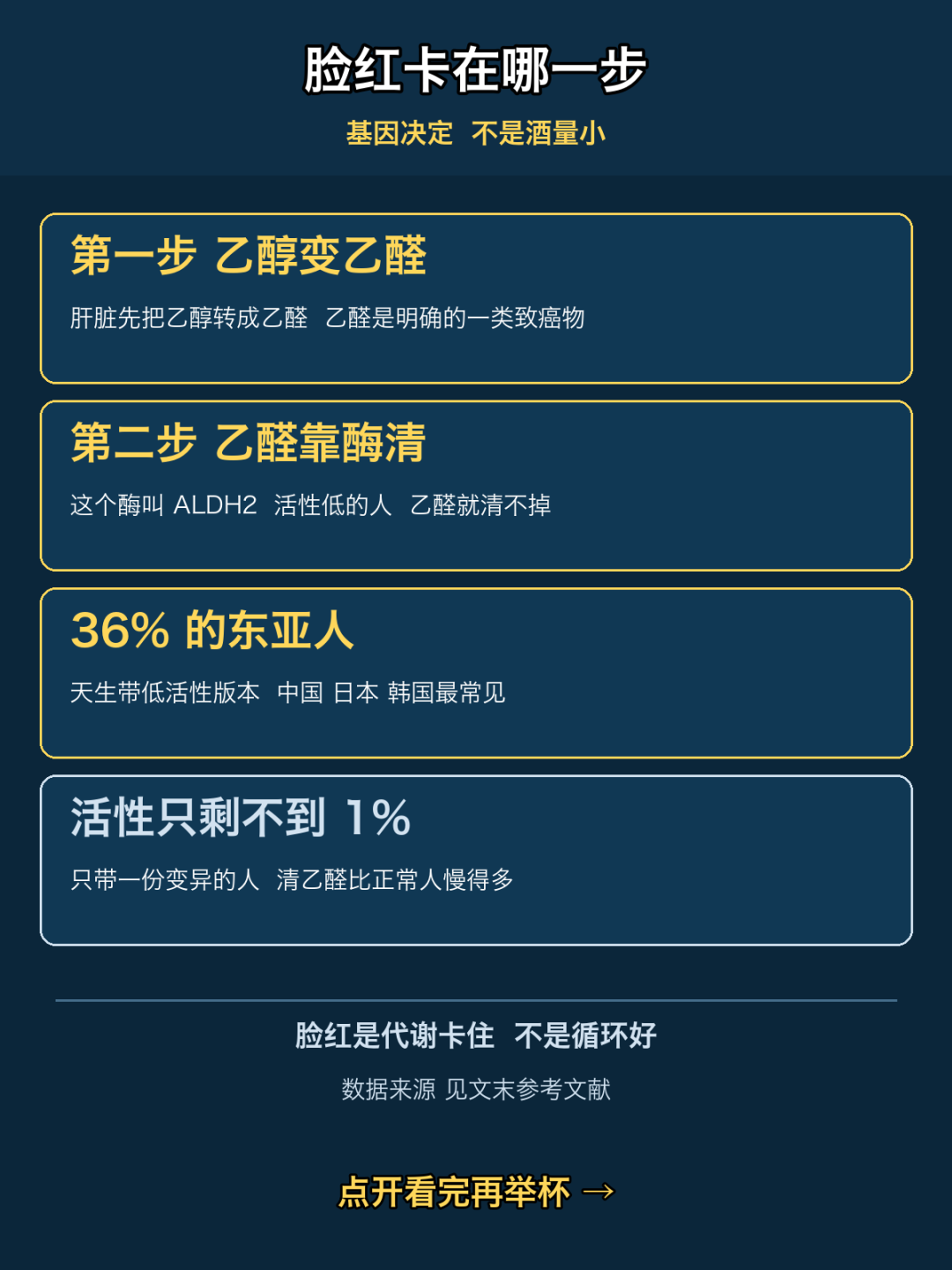
About 36% of East Asians are born with a low-activity version of this enzyme[1]. For the same amount of drinking, people with low enzyme activity have about a 12-fold higher risk of upper digestive tract cancer[1]. Case-control studies from Japan and Taiwan report odds ratios for esophageal squamous cell carcinoma ranging from 3.7 to 18.1[1].
1. Where the Flushing Gets Stuck
Alcohol enters the body, is first converted to acetaldehyde in the liver, then converted to acetate by the enzyme ALDH2 and excreted. The second step is where things get stuck.
Acetaldehyde is a confirmed carcinogen that damages DNA[1]. People who carry just one copy of the variant have less than one percent of normal enzyme activity[1]. Acetaldehyde clears slowly, so the face flushes, the heart races, and nausea sets in.
These reactions aren't a sign of low tolerance—they're the body raising an alarm.
2. How Much Higher Is the Risk, Really
In a follow-up study of heavy drinkers, people with low enzyme activity had about a 12-fold higher risk of developing upper digestive tract cancer (oral cavity, pharynx, larynx, esophagus) later on[1].
A meta-analysis of Chinese populations points in the same direction: among people who drink, those carrying this variant had an esophageal cancer odds ratio of 4.12[2]. In another Asian population meta-analysis, when two variants were combined, the odds ratio reached 13.46, though the sample was small and the confidence interval wide[3].
Smoking compounds the risk—it's not simply additive[1]. People who flush and smoke and drink together are the worst-off combination.
3. Can You "Train" Your Tolerance?
No. The amount of enzyme is determined by your genes. Drinking more just makes you numb to the flushing and heart palpitations—the acetaldehyde still piles up[1].
What people call "building up tolerance" translates to: the body has stopped raising the alarm, but the damage hasn't stopped.
4. Is Drinking Less Okay?
A prospective study of 500,000 Chinese people: based on genetically predicted alcohol intake, the more people drank, the higher their risk of cerebral hemorrhage (relative risk 1.58 per 280 grams of alcohol per week), and ischemic stroke risk rose similarly (1.27)—no "light drinking is safer" inflection point was observed[5].
In another 12-year analysis of 510,000 people and 207 diseases, alcohol consumption was associated with elevated risk for 61 diseases[4].
The five-year survival rate for esophageal cancer is only 12% to 16%[1]. So the key issue isn't how much you can drink—it's minimizing the chance of it happening at all.

What to Do
If you can avoid drinking, don't drink—that's the simplest path. Treat flushing, heart palpitations, and nausea as red lights: put down the glass.
If pressured to drink, you can say directly: I'm missing an enzyme—this isn't me being polite. Smokers especially shouldn't stack the risks.
Alcohol tolerance isn't a skill—it just means your body hasn't deteriorated enough to stop raising the alarm.
If this was helpful, give it a like or a "reading" click, and feel free to leave a comment telling us what topics you'd like to see.
✦
Disclaimer: This article is for health education purposes only and is intended for informational reference. It does not constitute medical advice; if you have health concerns, please consult a professional doctor.
Conflict of Interest Statement: This article does not involve any drug or product recommendations and has no financial relationship with the research institutions mentioned in the text.
© 2026 Sunshenghua (Beijing) Medical Technology Co., Ltd.
References
-
Brooks PJ, Enoch MA, Goldman D, Li TK, Yokoyama A. The alcohol flushing response: an unrecognized risk factor for esophageal cancer from alcohol consumption. PLoS Med. 2009;6(3):e50. PMID: 19320537
-
Duan F, Song C, Cui S, Wang L, Zhen Q, Qu H, et al. Genetic polymorphisms of ADH1B and ALDH-2 associated with risk of esophageal cancer: a meta-analysis. Wei Sheng Yan Jiu. 2012;41(5):723-729. PMID: 23213683
-
Zhang G, Mai R, Huang B. ADH1B Arg47His polymorphism is associated with esophageal cancer risk in high-incidence Asian population: evidence from a meta-analysis. PLoS One. 2010;5(10):e13679. PMID: 21048924
-
Im PK, Wright N, Yang L, Chan KH, Chen Y, Guo Y, et al. Alcohol consumption and risks of more than 200 diseases in Chinese men. Nat Med. 2023;29(6):1476-1486. PMID: 37291211
-
Millwood IY, Walters RG, Mei XW, Guo Y, Yang L, Bian Z, et al. Conventional and genetic evidence on alcohol and vascular disease aetiology: a prospective study of 500 000 men and women in China. Lancet. 2019;393(10183):1831-1842. PMID: 30955975