Eating Light but Still High Blood Lipids? 41 Grams of Oil Hiding in These 5 Places
This article is for health education purposes only and is intended for informational reference; it does not constitute medical advice. If you have health concerns, please consult a professional doctor.
The triglycerides on your lab report have crept up another notch. Many people instinctively feel that they eat quite lightly and don't touch fatty meat at all. But the problem often isn't the fatty meat—it's that extra spoonful of oil every day over the course of a year or more.
From 2022 to 2023, the National Institute for Nutrition and Health of the Chinese Center for Disease Control and Prevention surveyed 9,249 adults across 10 provinces, using the weighing method to record oil and salt: an average of 41.1 grams of cooking oil and 8.6 grams of cooking salt per day [1]. Yet the recommended cooking oil intake in the Dietary Guidelines for Chinese Residents (2022) is 25 to 30 grams per day. At 9 kilocalories per gram of oil, 41 grams equals about 370 kilocalories; the extra 11 to 16 grams above the recommendation amounts to 100 to 140 extra kilocalories per day—roughly half a bowl to a bit more than half a bowl of rice.
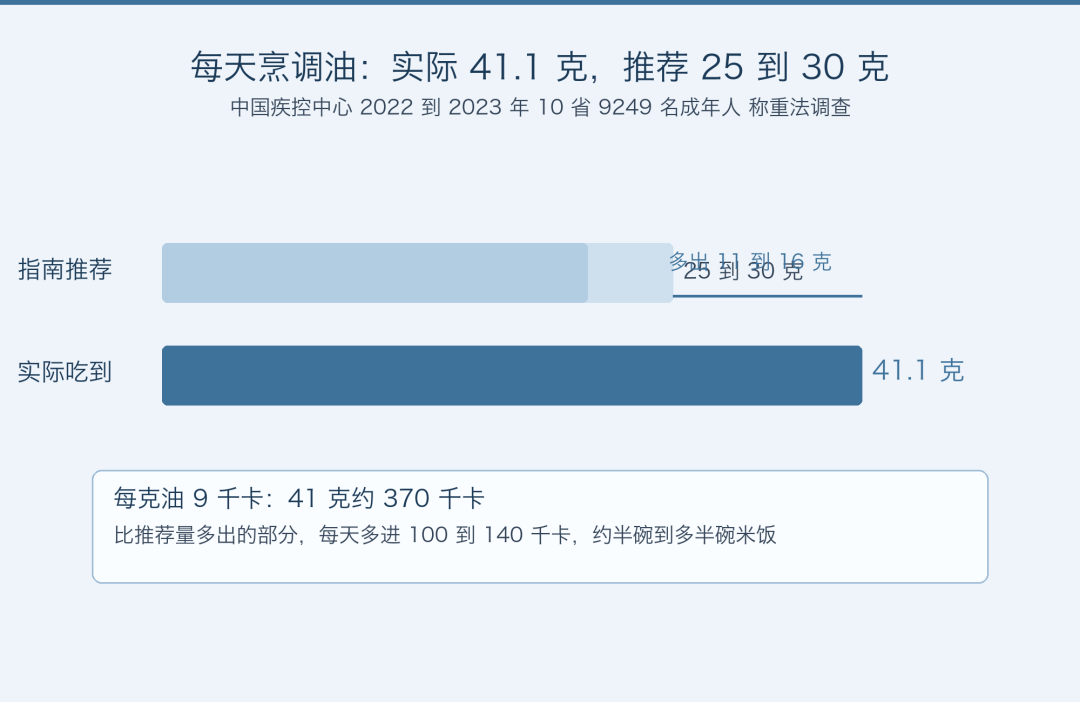
Caption: Comparison of actual cooking oil intake among adults in 10 provinces of China versus the guideline recommendation; the excess, converted to calories, equals roughly more than half a bowl of rice per day.
1. That "just a little more"—one spoonful is 90 kilocalories
A common white porcelain soup spoon at home holds about 10 grams of oil per level spoonful—exactly 90 kilocalories. If you pour an extra half-spoon into each of two dishes, that's an extra 90 kilocalories a day; over a year that adds up to more than 30,000 kilocalories, which at roughly 7,700 kilocalories per kilogram of fat works out to a theoretical value approaching 4 kilograms. The body does compensate to some degree and won't store it all as fat, but the direction is clear: oil is a type of calorie that's very easy to pour too much of.
What to do about this one: Switch to a graduated oil bottle or oil sprayer, and measure out oil per meal as "number of people × 2 grams"—don't go by feel.
2. That dish when eating out—the oil amount isn't up to you
The same stir-fried seasonal vegetables, made at home versus at a restaurant, often use oil on completely different orders of magnitude; for cooking styles like dry pot, water-boiled, red-braised, and disanxian (potato, eggplant, and pepper stir-fry), the oil starts at half a wok. It's very common for a single meal eaten out to use up your entire day's allowance.
What to do about this one: When ordering, prioritize steamed, boiled, blanched, and cold-tossed dishes; don't mix the broth from soup dishes into your rice—both oil and salt settle in the broth.
3. The "vegetable oil" in the ingredient list is the invisible big contributor
In pastry, cookies, instant noodles, potato chips, spicy strips, salad dressing, sesame paste, and ground meat filling, "vegetable oil" often ranks in the top three on the ingredient list. You don't feel like you're eating oil, but oil accounts for a very high proportion of the calories. A simple way to judge from the ingredient list: the higher vegetable oil is listed, the more oil the food contains.
What to do about this one: When buying packaged foods, first look at the order of the ingredient list; a small handful of nuts per day (about 10 grams) is enough—don't treat them as a healthy snack you can refill endlessly.
4. Switching oils helps, but it's not "eat as much as you want"
The China Health and Nutrition Survey followed 15,022 adults for 14 years, recording which oil each person ate: the groups that ate more lard, peanut oil, and refined blended oil had a 31%, 36%, and 42% higher risk of type 2 diabetes, respectively, compared with those who didn't eat that oil; soybean oil, rapeseed oil, and sesame oil showed no significant association [2]. In the same cohort's 14-year follow-up with 1,006 deaths, replacing animal fat with vegetable oil—one spoonful (8 grams) per day—was associated with a 4% lower risk of all-cause mortality [3].
The difference lies in "what you replace it with," not in "whether you can pour more." All oils have about 900 kilocalories per 100 grams—olive oil is no exception.
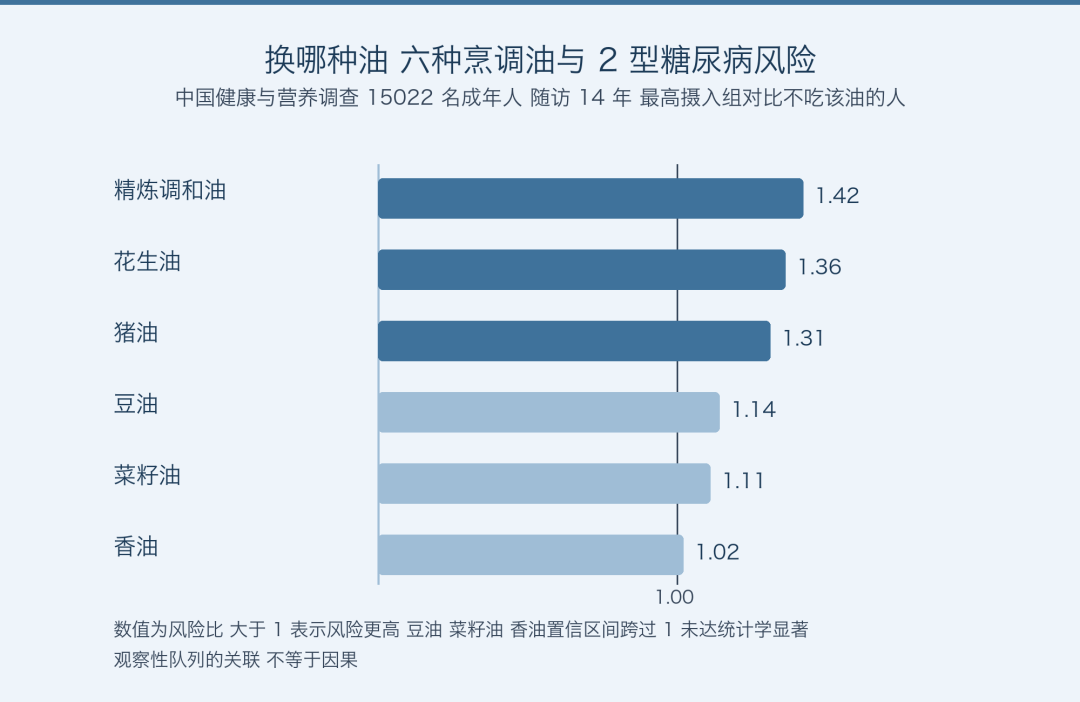
Caption: Association between six cooking oils and type 2 diabetes risk in the same cohort; animal fat and refined blended oil trend upward, while the confidence intervals for soybean oil, rapeseed oil, and sesame oil cross 1, not reaching statistical significance.
5. After cutting back on oil, replenish with the right things
Using less oil doesn't mean not eating oil—dietary fat also carries fat-soluble vitamins and affects satiety. There are two substitution directions genuinely supported by randomized trials: first, reducing saturated fat (lard, fatty meat, butter, coconut oil)—a Cochrane 2020 review pooling 15 randomized trials with about 59,000 people found that reducing saturated fat for more than two years lowered composite cardiovascular events by 21% [4]; second, replacing part of the fat with olive oil and nuts—the PREDIMED trial followed 7,447 people at high cardiovascular risk for 4.8 years, and the olive oil group had a 31% lower risk of major cardiovascular events than the control group [5].

Caption: How to allocate 25 grams a day and three oil-reduction actions you can carry out tonight.
Three things you can do tonight
-
Measure your oil: 25 grams a day—5 grams at breakfast, 10 grams each at lunch and dinner—measured out with a graduated bottle.
-
Change your cooking methods: Make at least two meals a day steamed, boiled, or tossed; use a non-stick pan for stir-frying to save a third of the oil.
-
Change the type, not the amount: Cut back on lard and refined blended oil; rotate soybean oil, rapeseed oil, and olive oil—keep the total amount unchanged.
The oil ledger was never about "whether you eat oil," but about "a dozen or so extra grams every day that no one noticed."
Share this with that family member who says they eat very lightly yet whose blood lipids climb year after year.
If this was helpful to you, give it a like or a "reading," and feel free to leave a comment telling us what topics you'd like to see.
✦
Disclaimer: This article is for health education purposes and does not constitute medical advice. For specific dietary plans, please consult a professional doctor or clinical dietitian.
Conflict of interest statement: This article does not involve any product or brand recommendations and has no conflict of interest with the research institutions mentioned in the text.
© 2026 Taiyang Shenghua (Beijing) Medical Technology Co., Ltd.
References
[1] Zhang J, Wang H, Du W, et al. Food intake among adult residents in 10 provinces (autonomous regions) of China in 2022-2023. Wei Sheng Yan Jiu. 2024;53(6):870-873. PMID: 39719332
[2] Zhuang P, Mao L, Wu F, et al. Cooking Oil Consumption Is Positively Associated with Risk of Type 2 Diabetes in a Chinese Nationwide Cohort Study. J Nutr. 2020;150(7):1799-1807. PMID: 32364230
[3] Wu F, Mao L, Zhuang P, et al. Plant-sourced cooking oil consumption is associated with lower total mortality in a longitudinal nationwide cohort study. Clin Nutr. 2020;39(12):3703-3710. PMID: 32359931
[4] Hooper L, Martin N, Jimoh OF, et al. Reduction in saturated fat intake for cardiovascular disease. Cochrane Database Syst Rev. 2020;5(5):CD011737. PMID: 32428300
[5] Estruch R, Ros E, Salas-Salvadó J, et al. Primary Prevention of Cardiovascular Disease with a Mediterranean Diet Supplemented with Extra-Virgin Olive Oil or Nuts. N Engl J Med. 2018;378(25):e34. PMID: 29897866