This article is for health education purposes only and is provided for informational reference; it does not constitute medical advice. If you have any health concerns, please consult a professional physician.
After Semaglutide, This "Dual-Hormone" Injection Helps You Lose 15 More Pounds
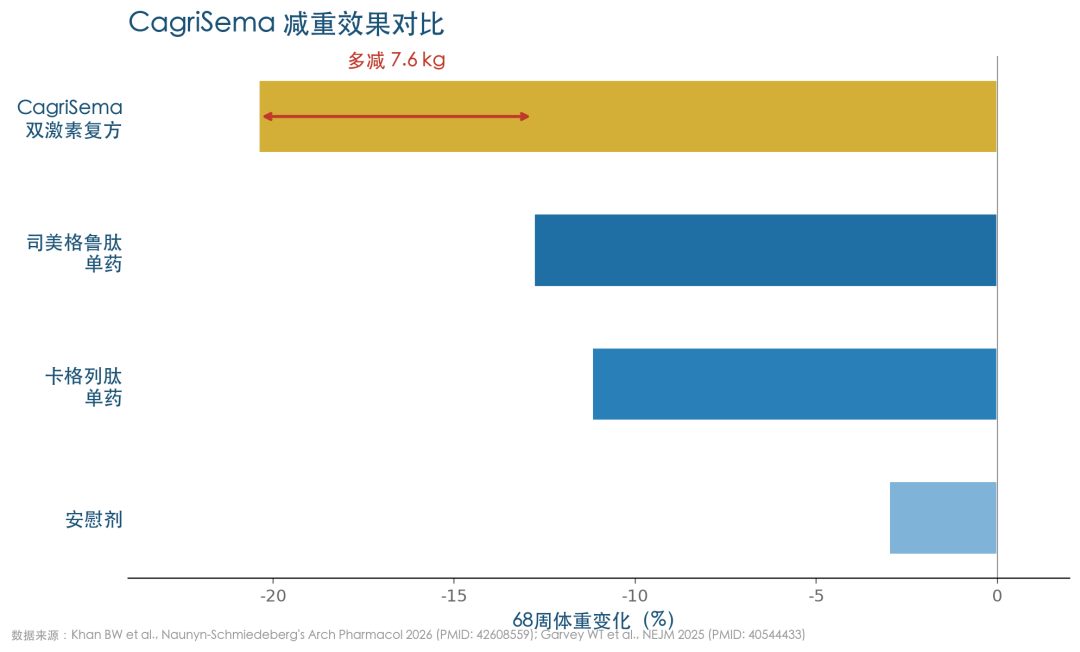
Semaglutide has been popular for three years, and the public is no longer unfamiliar with it. But what if someone told you: there is a new drug that, on top of semaglutide, can help you lose about 7.6 kilograms more—equivalent to nearly 8 additional percentage points of body weight reduction—would you think "that's just too competitive"? This is not hypothetical. A systematic review and GRADE meta-analysis published online on August 17, 2026, pooled data from 7 randomized controlled trials involving a total of 8,069 overweight or obese participants and reached a conclusion that has drawn attention in the metabolic field: the weight-loss effect of CagriSema (cagrilintide + semaglutide fixed-dose combination) is significantly superior to semaglutide monotherapy[1]. ✦ ✦ ✦
1. Just How Impressive Are the Data?
The meta-analysis showed that, compared with semaglutide monotherapy, CagriSema produced an additional weight loss of 7.58 kilograms (95% CI -10.30 to -4.86, p<0.00001); compared with cagrilintide monotherapy, an additional 9.24 kilograms; and compared with placebo, an additional 13.99 kilograms[1]. These numbers do not stand alone. As early as August 2025, the New England Journal of Medicine published two phase III trials, REDEFINE 1 and REDEFINE 2, in the same period. In overweight/obese populations without diabetes (n=3417), after 68 weeks of CagriSema treatment, body weight decreased by an average of 20.4%, while the placebo group decreased by only 3.0%[2]. More than one-fifth of participants achieved a weight reduction of 25% or more—something almost unimaginable in prior non-surgical weight loss.
2. Why Is the "Dual-Hormone" Approach Stronger Than Monotherapy?
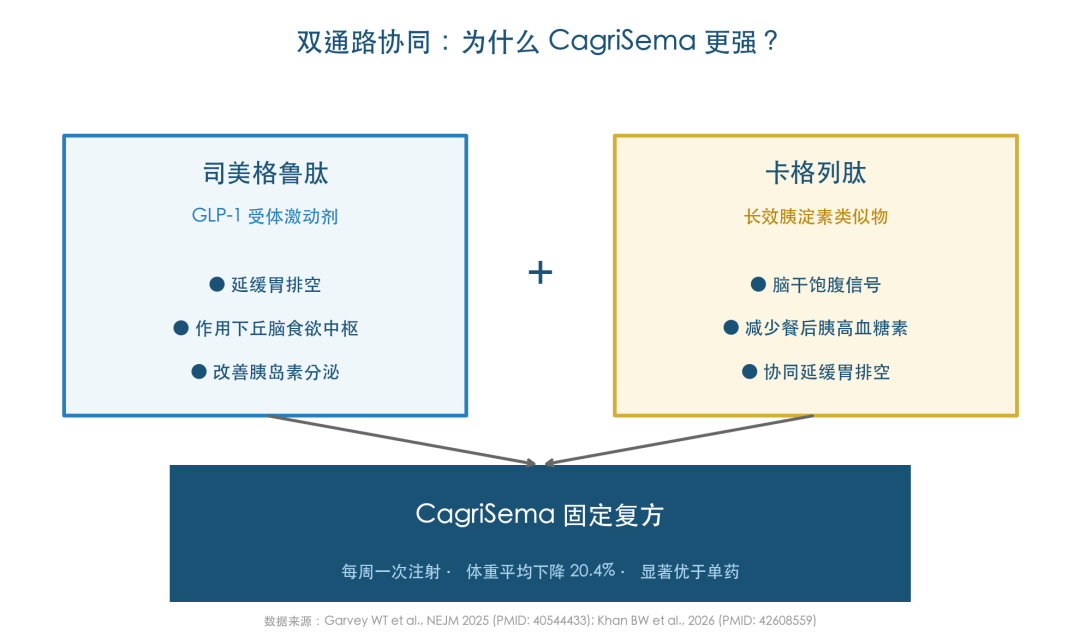
The key to understanding CagriSema is that it acts simultaneously on two independent appetite-regulation pathways. Semaglutide is a GLP-1 (glucagon-like peptide-1) receptor agonist that slows gastric emptying and acts on the hypothalamic appetite center, and it is already widely known. Cagrilintide, meanwhile, is a long-acting amylin analogue—amylin is a hormone co-released by pancreatic β cells along with insulin, and it can reduce food intake through the brainstem and hypothalamic regions, slow gastric emptying, and regulate postprandial blood glucose. Simply put, GLP-1 and amylin are like two pedals of the appetite brake system; pressing one is already effective, and pressing both together provides stronger braking. This also explains why the weight-loss magnitude of CagriSema is not a simple "1+1," but rather an additive effect with clinical significance.
3. Don't Focus Only on the Weight Numbers
The significance of CagriSema lies not only in "losing more." The REDEFINE 2 trial also verified efficacy in an obese population with type 2 diabetes[2], and the meta-analysis also observed improvements in lipid parameters[1]. Even more noteworthy, a prespecified secondary analysis of SELECT published online in Circulation on August 18, 2026, showed that among 17,604 overweight/obese patients with cardiovascular disease, semaglutide reduced high-sensitivity C-reactive protein (hsCRP) by 37.8%, and the decline in inflammatory markers occurred earlier than significant weight loss and was also present in those who did not lose substantial weight[3]. The researchers believe that the anti-inflammatory effect may be part of the mechanism underlying the cardiovascular protection of GLP-1 drugs. This suggests that the competitive dimension of next-generation weight-loss drugs is expanding from "who helps you lose more" to "who provides better comprehensive improvement in cardiorenal and metabolic health."
4. A Calm Perspective: Not Everyone Needs the "Strongest Injection"
First, gastrointestinal adverse reactions remain common. In the CagriSema group, 79.6% experienced nausea, vomiting, diarrhea, or constipation (39.9% in the placebo group), mostly mild to moderate and transient[2], but individual tolerability cannot be overlooked. A meta-analysis showed no significant increase in serious adverse events[1]. Second, long-term safety still requires verification. Existing RCTs have a follow-up of approximately 68 weeks; post-discontinuation rebound and the safety of long-term use still require larger-scale data. The authors themselves also noted that "large-scale trials are needed to confirm long-term safety and durability"[1]. Third, medication is not the endpoint. All groups simultaneously received lifestyle guidance—dietary and exercise habits always remain the foundation. ✦ ✦ ✦
Final Thoughts
From GLP-1 monotherapy to GLP-1/amylin dual-target combination therapy, the pace of iteration in weight-loss drugs has exceeded expectations. The data are encouraging, but metabolic health is not "one injection and you're set for life." Readers considering medication for weight loss are advised to: ① visit a endocrinology or weight-management clinic at a reputable hospital to assess BMI, comorbidities, and contraindications; ② use medications under a doctor's guidance and attend regular follow-ups; ③ simultaneously build sustainable dietary and exercise habits. Medication is a tool, not a shortcut. If this content has been helpful to you, feel free to hit "Like" or "Wow," and leave a comment telling us what topics you'd like to see. ✦ ✦ ✦
References
Khan BW, Agha SA, Qamar I, et al. Maximizing weight loss with cagrisema: a systematic review and GRADE-assessed meta-analysis of randomized controlled trials. Naunyn Schmiedebergs Arch Pharmacol. 2026 Aug 17. doi:10.1007/s00210-026-05809-5. PMID: 42608559.Garvey WT, Blüher M, Contreras CKO, et al. Coadministered Cagrilintide and Semaglutide in Adults with Overweight or Obesity. N Engl J Med. 2025;393(7):635-647. doi:10.1056/NEJMoa2502081. PMID: 40544433.Plutzky J, Bogdański P, Colhoun HM, et al. Effect of Semaglutide on the Inflammatory Biomarker High-Sensitivity CRP in Patients With Established Cardiovascular Disease and Overweight or Obesity in SELECT: A Prespecified Secondary Analysis. Circulation. 2026 Aug 18. doi:10.1161/CIRCULATIONAHA.125.074482. PMID: 42610271.✦ ✦ ✦Disclaimer: This article is for health science popularization and information sharing only and does not constitute any diagnostic or treatment advice or medication guidance. The drugs mentioned in this article may not yet be approved for weight-loss indications in all countries/regions; please consult a professional doctor for specific medication plans. Conflict of interest statement: The content of this article is based on publicly published academic literature, and Taiyang Shenghua (Beijing) Medical Technology Co., Ltd. has no commercial interest association with the product manufacturers mentioned in the article. © 2026 Taiyang Shenghua (Beijing) Medical Technology Co., Ltd.