Napping More Than 1 Hour Linked to 30% Higher Cardiovascular Risk
This article is for general health education and informational purposes only. It does not constitute medical advice. Please consult a healthcare professional if you have any health concerns.
Once the End of Heat solar term passes, many people start running low on energy during the day: eyelids drooping in the afternoon, zoning out in meetings, surviving on coffee. Autumn fatigue is your body's way of telling you it's time to catch up on sleep. But how you do it matters a great deal: napping more than 1 hour may do more harm than good.
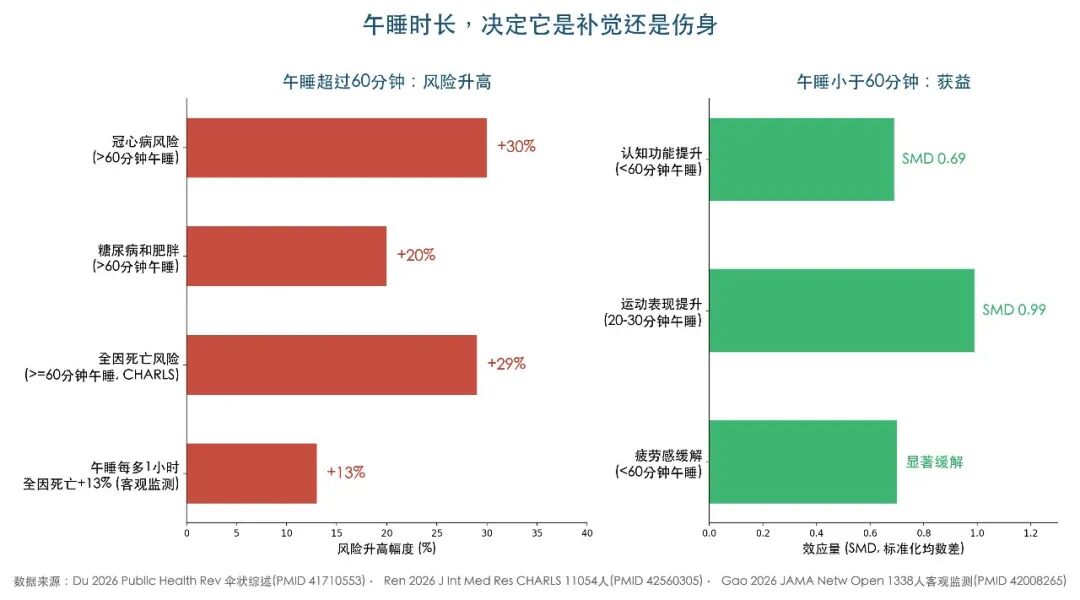
A February 2026 umbrella review published in Public Health Reviews, which pooled 16 meta-analyses covering 244 health outcomes, reached a clear conclusion: napping under 60 minutes boosts cognition (SMD 0.69) and relieves fatigue, while napping over 60 minutes is associated with a 30% higher risk of coronary heart disease and a 20% higher risk of diabetes and obesity[[1]].
✦ ✦ ✦
1. Where Do the Risk Numbers for Napping Over 1 Hour Come From?
This isn't the only study. Two large-sample studies reached similar conclusions:
-
CHARLS cohort (11,000 adults aged 60 and older): napping ≥60 minutes per day was associated with a 29% higher risk of all-cause mortality (HR 1.289)[[2]];
-
JAMA Network Open 2026 (1,338 participants, objectively monitored with wearable devices): each 1-hour increase in nap duration was associated with a 13% higher risk of all-cause mortality (AHR 1.13); the more frequent the napping, the higher the risk[[3]].
Interestingly, "sleeping too much during the day" is often not an independent cause but a signal of poor nighttime sleep quality — the worse you sleep at night, the more you nap during the day, and the more you nap, the more disrupted your sleep becomes, creating a vicious cycle.
✦ ✦ ✦
2. Why Does Short Napping Refresh You While Long Napping Harms You?
Sleep cycles in stages. A short 20–30 minute nap mostly stays in light sleep, leaving you refreshed upon waking — it's a "quick recharge." The umbrella review showed that 20–30 minute naps produced the most notable improvements in athletic performance and recovery (SMD 0.99)[[1]].
Once you exceed 60 minutes, your body enters deep sleep and being forcibly awakened produces "sleep inertia": grogginess, sluggish reactions — worse than not sleeping at all. Long-term long napping is also linked to disrupted nighttime sleep rhythms and metabolic disturbances, which may be the mechanism connecting it to chronic disease risk.
✦ ✦ ✦
3. Autumn Sleepiness Is Also Related to Changes in Light Exposure
Autumn fatigue isn't pseudoscience. A 2026 analysis based on 185,000 nights of wearable data from 49 countries found that sleep duration varies with sunshine duration — for every 1-hour increase in sunshine, average sleep decreased by about 4.4 minutes[[4]]. When light changes abruptly at the turn of summer to autumn, the biological clock needs to recalibrate, making people naturally drowsy. Giving your body time to adjust is more effective than toughing it out.
✦ ✦ ✦
4. The Science-Based Nap Checklist (Follow It Directly)
-
Duration: 20–30 minutes is optimal; no more than 60 minutes;
-
Timing: Nap between 1 PM and 3 PM; don't push it to the evening, or it will affect falling asleep at night;
-
Position: Lie down if you can rather than sleeping on your stomach, which compresses your arms and cervical spine; dim the lights and put your phone away;
-
Frequency: A regular daily nap is better for your heart than catching up aggressively on weekends;
-
Foundation: Napping is a supplement, not a substitute — nighttime sleep (7–8 hours) is fundamental[[4]].
If you sleep a full 7 hours at night and still feel extremely sleepy during the day, don't just dismiss it as "autumn fatigue" — see a doctor to rule out issues such as sleep apnea.
✦ ✦ ✦
Napping is your body's "fast charge" — 20 minutes is enough; over 1 hour is like chronically overloading your heart. Now that autumn has arrived, napping correctly matters more than napping longer.
Consider sharing this with the elders in your family who love long afternoon naps, and save this 20–30 minute nap checklist.
If you found this content helpful, feel free to hit "Like" or "Wow," and leave a comment telling us what topics you'd like to see.
✦ ✦ ✦
Disclaimer: This article is based on published scientific research and is intended for general health education reference only. It does not constitute medical advice. Individual circumstances vary — please consult a healthcare professional for any health concerns.
Conflict of Interest Statement: The author of this article has no conflicts of interest with any of the studies or institutions mentioned.
© 2026 Sun Saint Hua (Beijing) Medical Technology Co., Ltd.
References
-
Du P, Li J, Hua Z, et al. Multiple Health Outcomes of Daytime Napping: A Comprehensive Umbrella Review. Public Health Rev. 2026;47:1609013. PMID: 41710553.
-
Ren P, Zhang W, Du Z, et al. Nighttime sleep, midday napping, and mortality in Chinese older adults: A China Health and Retirement Longitudinal Study longitudinal cohort study. J Int Med Res. 2026;54(8):3000605261467619. PMID: 42560305.
-
Gao C, Cai R, Zheng X, et al. Objectively Measured Daytime Napping Patterns and All-Cause Mortality in Older Adults. JAMA Netw Open. 2026;9(4):e267938. PMID: 42008265.
-
Akhtar F, Brownlee A, Crawford C. Variation in sleep duration across latitudes and countries: a Bayesian hierarchical analysis of wearable data. NPJ Biol Timing Sleep. 2026;3(1):27. PMID: 42332253.