The True Value of Weight-Loss Drugs May Not Be on the Scale
This article is for health education purposes only and is intended for informational reference; it does not constitute medical advice. If you have any health concerns, please consult a professional physician.
If you think GLP-1 drugs are simply "a shot that helps you lose weight," you may be underestimating them. In 2023, a trial of more than ten thousand people published in the
New England Journal of Medicine (NEJM) found that in overweight/obese individuals without diabetes, semaglutide reduced the risk of major cardiovascular events by 20%. In other words, the change in the number on the scale may not be the greatest value of this class of drugs.
1. The Data Shock: Beyond Weight Loss, What Happened to the Heart and Kidneys?
Let's look at two key sets of data first: The SELECT trial (NEJM 2023): enrolled 17,604 adults aged ≥45 years who were overweight or obese and had established cardiovascular disease but no diabetes. Over a follow-up of approximately 3.3 years, semaglutide 2.4 mg/week reduced the risk of major adverse cardiovascular events (cardiovascular death, nonfatal myocardial infarction, nonfatal stroke) by 20% compared with placebo[1]. The FLOW trial (NEJM 2024): enrolled 3,533 patients with type 2 diabetes and chronic kidney disease. Semaglutide 1.0 mg/week reduced the risk of the kidney composite endpoint (sustained decline in kidney function, need for dialysis/transplantation, kidney disease death, or cardiovascular death) by 24% compared with placebo[2]. The significance of these two studies lies in this: they demonstrated for the first time in large-scale randomized controlled trials that the cardiorenal protective effects of GLP-1 receptor agonists cannot be fully explained by "weight loss."
2. How Does GLP-1 Protect the Cardiovascular System?
GLP-1 (glucagon-like peptide-1) receptor agonists were initially developed as glucose-lowering drugs, but subsequent research found that they have multidimensional effects on the cardiovascular system: Improving metabolic indicators: lowering blood glucose, triglycerides, and low-density lipoprotein cholesterol, with an average reduction in systolic blood pressure of 2–5 mmHg[3]. Reducing systemic inflammation: inflammatory markers such as C-reactive protein (CRP) decline significantly, and inflammation is one of the core drivers of atherosclerosis progression. Direct vascular protection: GLP-1 receptors are present on vascular endothelial cells and smooth muscle cells, and animal experiments and human studies suggest that they can improve endothelial function and reduce foam cell formation. Indirect benefits from weight loss: a 5%–15% reduction in body weight can improve multiple cardiovascular risk factors, but statistical models show that in SELECT, weight loss could explain only about one-third to one-half of the cardiovascular benefit, with the rest coming from effects beyond weight.
Simply put: GLP-1 is not taking an indirect route—while helping you lose weight, it is also directly "relieving the pressure" on the cardiovascular system.
3. GLP-1 and Kidney Protection: The Underestimated Organ
Diabetic nephropathy and obesity-related nephropathy are major causes of end-stage renal disease worldwide. Before the FLOW trial, some GLP-1 receptor agonists had already shown signals of reducing kidney events in cardiovascular outcome trials, but FLOW was the first large RCT with kidney outcomes as the primary endpoint.
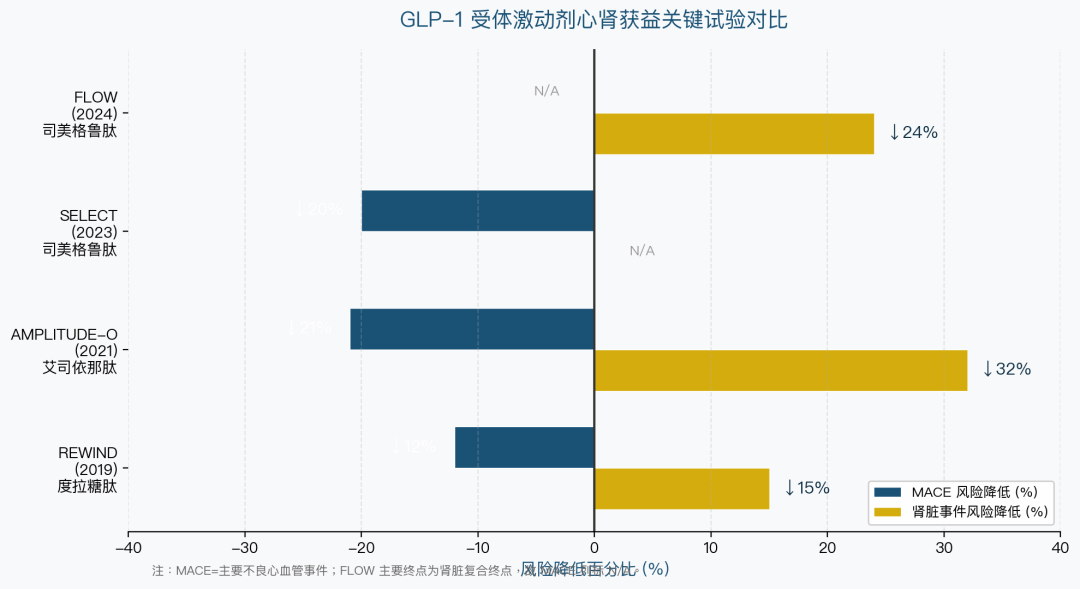
| Trial | Population | Drug | Key kidney/cardiovascular results |
|---|
| SELECT (2023) | Overweight/obesity + CVD, without diabetes | Semaglutide 2.4 mg | MACE ↓20% |
| FLOW (2024) | T2DM + CKD | Semaglutide 1.0 mg | Kidney composite endpoint ↓24% |
| AMPLITUDE-O (2021) | T2DM + CVD/high risk | Efpeglenatide | MACE ↓21%, kidney composite endpoint ↓32% |
| REWIND (2019) | T2DM + CVD/high risk | Dulaglutide | MACE ↓12%, kidney composite endpoint ↓15% |
Mechanistically, GLP-1 receptor agonists may slow the progression of kidney disease through multiple pathways, including reducing glomerular hyperfiltration, exerting anti-inflammatory and antioxidant stress effects, and improving metabolic indicators.
IV. Who Should Pay the Most Attention to Cardiorenal Benefits?
Based on current evidence, the following groups may derive particularly significant cardiorenal protection from GLP-1 receptor agonists: individuals with overweight/obesity and established cardiovascular disease (even without diabetes)—the SELECT population. Patients with type 2 diabetes and chronic kidney disease—the FLOW population. Patients with metabolic syndrome: the presence of three or more of the following—abdominal obesity, hypertension, dyslipidemia, and abnormal blood glucose. Patients with obesity-related obstructive sleep apnea (OSA): recent studies suggest that GLP-1 receptor agonists can improve OSA severity, and OSA itself is an independent cardiovascular risk factor. It must be emphasized: whether to use these drugs, which one to use, and at what dose must be decided by a physician based on individual circumstances. Not all GLP-1 drugs currently have the same level of evidence for cardiorenal benefits, and these drugs also have common side effects such as gastrointestinal reactions.
V. Action Recommendations
General public: Do not purchase or use GLP-1 drugs on your own for weight loss. If BMI ≥28, or BMI ≥24 with comorbid hypertension/diabetes/dyslipidemia/OSA, it is recommended to visit an endocrinology department or weight management clinic to assess whether pharmacotherapy is appropriate. Patients already using GLP-1: Do not stop the medication on your own just because your weight has dropped to a "satisfactory" level. Cardiorenal protection requires continuous medication, and weight and metabolic indicators often rebound after discontinuation. Please discuss a long-term treatment plan with your attending physician. Follow-up recommendations: During treatment, monitor weight, waist circumference, blood pressure, fasting blood glucose, glycated hemoglobin (HbA1c), lipids, and liver and kidney function; patients with CKD should have eGFR and urine albumin-to-creatinine ratio (UACR) monitored regularly as advised by their physician.
Final Thoughts
GLP-1 drugs are moving beyond the labels of "glucose-lowering drugs" and "weight-loss drugs," gradually revealing their potential as comprehensive metabolic-cardiovascular intervention agents. The number on the scale is enticing, but what truly changes long-term health outcomes may be those invisible benefits—cleaner blood vessels, a safer heart, and more durable kidneys. If someone in your family is using or considering GLP-1 drugs, consider sharing this article with them and saving it for discussion with their doctor at the next follow-up visit.
References
[1] Lincoff AM, Brown-Frandsen K, Colhoun HM, et al. Semaglutide and Cardiovascular Outcomes in Obesity without Diabetes. N Engl J Med. 2023;389(24):2221-2232. PMID: 37952131.[2] Perkovic V, Tuttle KR, Rossing P, et al. Semaglutide and Kidney Outcomes in Type 2 Diabetes and Chronic Kidney Disease. N Engl J Med. 2024;390(12):1089-1101. PMID: 38446557.[3] Wilding JPH, Batterham RL, Calanna S, et al. Once-Weekly Semaglutide in Adults with Overweight or Obesity. N Engl J Med. 2021;384(11):989-1002. PMID: 33567185.[4] Gerstein HC, Colhoun HM, Dagenais GR, et al. Dulaglutide and cardiovascular outcomes in type 2 diabetes (REWIND): a double-blind, randomised placebo-controlled trial. Lancet. 2019;394(10193):121-130. PMID: 31189511.[5] Cherney DZI, Charbonnel B, Cosentino F, et al. Effects of efpeglenatide on kidney outcomes in type 2 diabetes (AMPLITUDE-O). Circulation. 2022;145(7):518-528. PMID: 35143287.[6] World Health Organization. Obesity and overweight. Fact sheet. 2024. Available at: https://www.who.int/news-room/fact-sheets/detail/obesity-and-overweight[7] GBD 2015 Obesity Collaborators. Health Effects of Overweight and Obesity in 195 Countries. N Engl J Med. 2017;377(1):13-27. PMID: 28604169.This article was originally compiled by Sunshenghua (Beijing) Medical Technology Co., Ltd. and is intended for health education reference only. The drugs mentioned in this article are all prescription medications and must be used under the guidance of a physician. This article does not constitute any diagnostic or treatment advice, nor does it constitute a recommendation or promotion of any drug. The data are current as of the article's publication date; subsequent research may update the conclusions. For reprinting, please contact Sunshenghua for authorization. © 2026 Sunshenghua (Beijing) Medical Technology Co., Ltd.