How to Break Through a Weight Loss Plateau? First, Understand That Your Body Is in "Power-Saving Mode"
This article is for health education purposes only and is intended for informational reference. It does not constitute medical advice; please consult a professional doctor for any health concerns.
For the first few weeks of weight loss, the scale gives you a pleasant surprise almost every day; by the second month, it suddenly "goes on strike."
Don't rush to blame yourself — a 2026 review puts it plainly: plateaus are a nearly universal "standard feature" on the weight loss journey[[1]]. It's not that you've slacked off; it's that your body has activated "power-saving mode."
Why does weight get "stuck"? Start with this data:
-
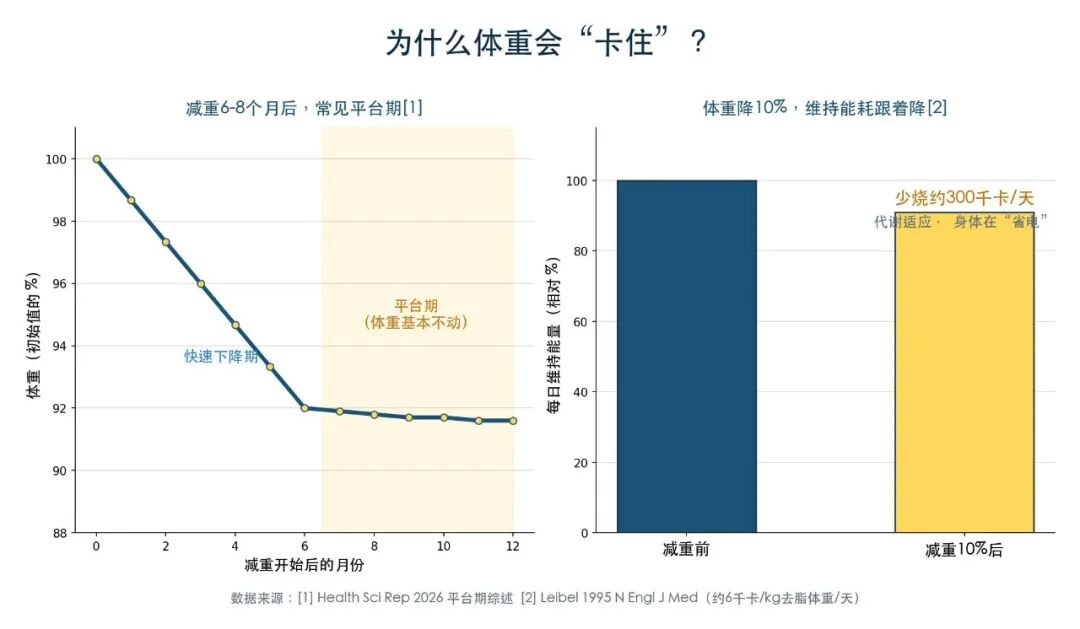
2026 review: Plateaus typically occur about 6-8 months after starting weight loss, and can happen even with strict adherence to diet and exercise. The core issue is "metabolic adaptation" — when you eat less, your body's energy expenditure drops across the board, while hunger actually increases[[1]];
-
1995 NEJM classic study: For every ~10% reduction in body weight, the daily energy needed to maintain the new weight decreases compensatorily — on average, about 6 fewer kcal burned per kilogram of fat-free mass per day[[2]], roughly equivalent to burning 300 fewer kcal per day;
-
2016 study: Even 6 years after weight loss, resting metabolic rate remains lower than expected based on current body weight[[3]] — your body truly "remembers" that you were once heavier.
Q1: Why does weight stop budging after losing some?
Three factors compound:
-
Energy conservation: A lighter body naturally requires less energy to move around;
-
Metabolic adaptation: Calorie restriction causes all components of total energy expenditure to decline together — resting metabolism, daily activity expenditure, and the thermic effect of food all "shrink"[[1]];
-
Appetite rebound: Reduced calories increase hunger and decrease satiety, so the portion you cut back gets offset by "wanting to eat more"[[1]].
Together, these three factors erase your daily energy deficit — no deficit, no weight loss.
Q2: If the scale doesn't move, has all the effort been wasted?
First, distinguish two scenarios:
-
Short-term (1-2 weeks) no change: Mostly water and glycogen fluctuations — daily swings of 1-2 kg are common. Fat may still be decreasing, just masked by water;
-
Long-term (4+ weeks) no change: Only when both weight and waist circumference remain unchanged is it a true plateau.
To judge whether you've actually stalled, don't fixate on a single day's scale reading — look at three indicators: waist circumference, how your clothes fit, and 4-week average weight.
Q3: Is regaining weight after losing it really a willpower problem?
No. After weight loss, the body remains in "energy-saving mode" long-term — a 2016 study that tracked weight-loss competition contestants for 6 years found that most had resting metabolic rates significantly lower than expected for their current body weight even 6 years after the competition ended[[3]].
At the same body weight, they burn less than people who never lost weight. This isn't willpower collapsing — it's physiology "pulling you back." Knowing this, you won't punish yourself with "I'm such a failure."
Q4: How to scientifically break through a plateau? 5 actions
-
Stop cutting calories endlessly — the harder you cut, the more your metabolism suppresses, and you're more likely to lose muscle;
-
Eat enough protein — about 1.2-1.7 g per kg of body weight during energy restriction, to help preserve lean mass (2025 study[[4]]);
-
Add strength training — muscle is the "engine" of metabolism; twice a week is enough to see results;
-
Increase daily activity (NEAT) — walking, taking stairs, standing, doing housework — this is the most flexible component of energy expenditure[[5]];
-
After 4 full weeks, try a "maintenance phase" — restore calories to maintenance level for 1-4 weeks before restarting. Research suggests this "diet-rest" alternation improves weight loss efficiency (MATADOR study[[6]]).

Q5: How long does a plateau usually last?
Individual variation is huge — from a few weeks to several months. The 2026 review notes that most people enter a plateau after 6-8 months of weight loss, by which point they've often already lost a considerable amount of weight[[1]].
Shift your mindset from "I must lose weight every week" to "track body fat percentage, circumference, and energy levels" — and the plateau becomes far less intimidating.
One-sentence action tip:
Only when weight and waist circumference remain unchanged for 4 consecutive weeks is it a true plateau — don't double down on calorie restriction first. Get protein, strength training, daily activity, and sleep all dialed in; if needed, enter a 1-4 week "maintenance phase" before restarting.
On the weight loss journey, getting stuck isn't scary — giving up is.
Share this with family and friends who are losing weight, and save this "break the plateau" self-check list to refer to when you get stuck.
If you found this helpful, give it a like or a "reading" — and feel free to leave a comment telling us what topics you'd like to see.
Disclaimer: This article is based on publicly available medical literature and is intended for health education reference only. It does not constitute medical advice; individual situations vary, so please consult a professional doctor for specific health concerns. Conflict of interest statement: The author of this article has no conflicts of interest with the research mentioned. © 2026 Sun Saint Hua (Beijing) Medical Technology Co., Ltd.
References: 1. Ashtary-Larky D, Mohammadi S. Weight loss plateau: reasons, challenges, and solutions: a narrative review. Health Sci Rep. 2026;9(7):e72803. 2. Leibel RL, Rosenbaum M, Hirsch J. Changes in energy expenditure resulting from altered body weight. N Engl J Med. 1995;332(10):621-628. 3. Fothergill E, et al. Persistent metabolic adaptation 6 years after "The Biggest Loser" competition. Obesity (Silver Spring). 2016;24(8):1612-1619. 4. Kanaan MF, Nait-Yahia S, Doucet É. The effects of high protein intakes during energy restriction on body composition, energy metabolism and physical performance in recreational athletes. Eur J Clin Nutr. 2025;79(6):544-552. 5. Levine JA, Eberhardt NL, Jensen MD. Role of nonexercise activity thermogenesis in resistance to fat gain in humans. Science. 1999;283(5399):212-214. 6. Byrne NM, et al. Intermittent energy restriction improves weight loss efficiency in obese men: the MATADOR study. Int J Obes (Lond). 2018;42(2):129-138.