How to Eat Protein While Losing Weight: 5 Numbers That Help You Lose 0.87 kg More Fat
This article is for health education purposes only and is not intended as medical advice. Please consult a professional doctor if you have any health concerns.
When most people think about losing weight, the first thing that comes to mind is "eat less": cut rice in half, go easy on meat, and have greens and tofu at every meal. The number on the scale does go down, but you also feel flabby and drained—and once you go back to eating normally, the weight comes back even faster.
What you're losing is often not fat, but muscle and water. If you want to shed fat and keep muscle, there's a commonly overlooked key factor—whether you're eating enough protein.
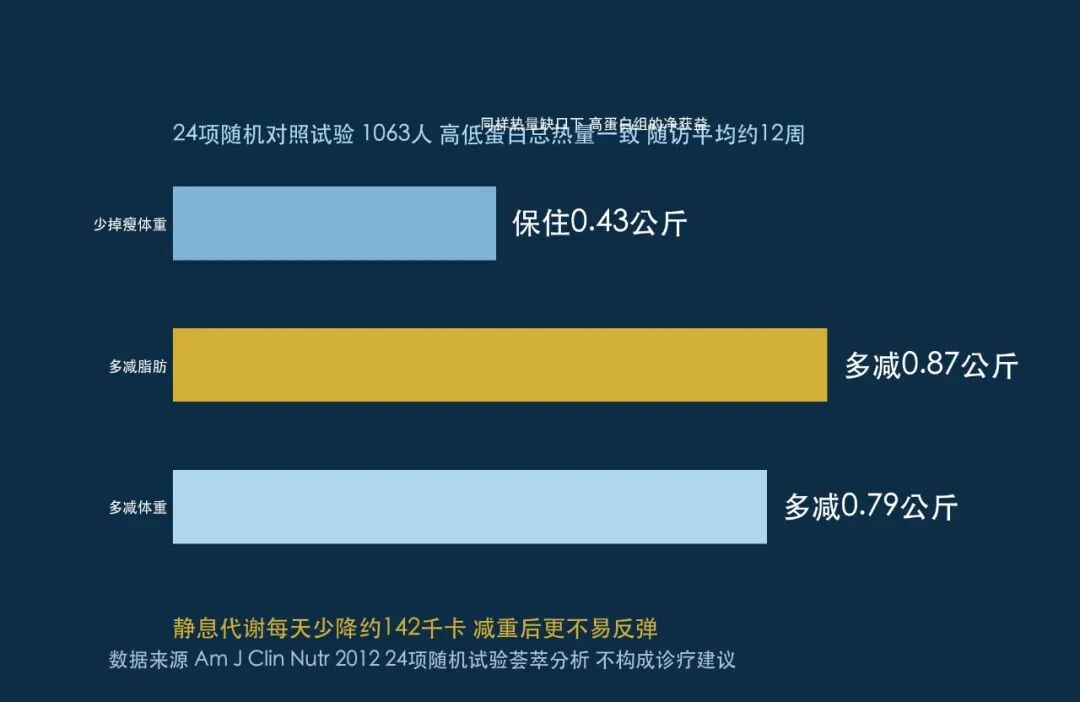
Let's start with the hard data. A meta-analysis pooling 24 randomized controlled trials with a total of 1,063 participants found that: under the same calorie restriction and the same calorie deficit, the group eating more protein lost on average 0.79 kg more body weight and 0.87 kg more fat than the standard-protein group, while also losing 0.43 kg less muscle—and even their resting metabolic rate declined more slowly[1].
How much protein should you eat, and how should you eat it? Remember these 5 numbers.
Number 1: 0.87 kg—Eat enough protein, and more of what you lose is fat
In the meta-analysis above, the high-protein group and the standard group had the same total calories and the same fat intake—the only difference was the ratio of protein to carbohydrates[1].
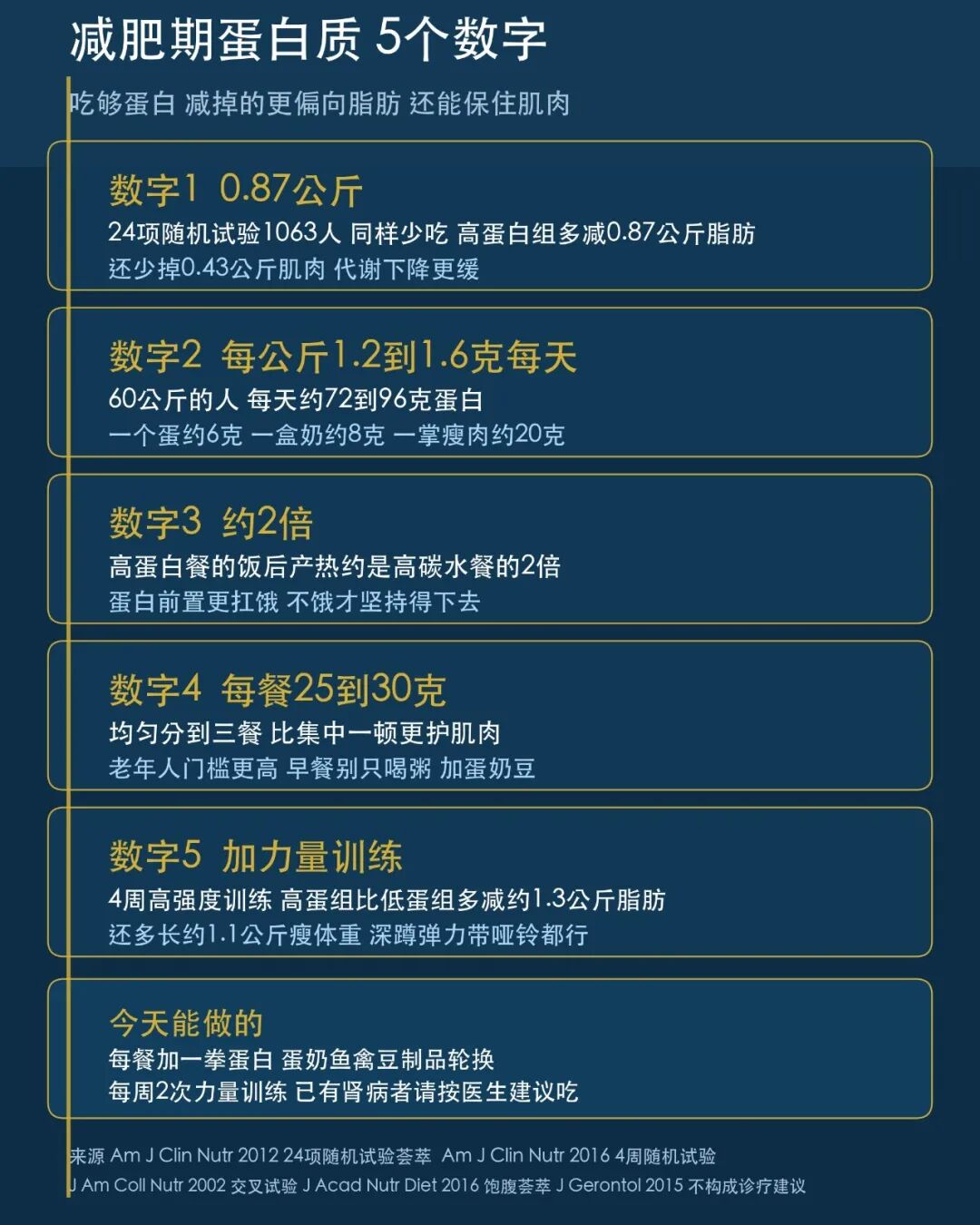
The result: nearly all the extra weight lost by the high-protein group was fat (0.87 kg), while they preserved about 0.43 kg of lean body mass (mainly muscle), and their daily resting energy expenditure dropped about 142 kcal less.
This means two things: first, your body looks firmer; second, your basal metabolism doesn't get "starved down," making it less likely to rebound once you return to normal eating.
Number 2: 1.2 to 1.6 grams—Daily protein per kilogram of body weight
The approach that actually worked in the research was raising protein during weight loss to about 1.2 to 1.6 grams per kilogram of body weight per day[1].
For a 60 kg person, that's roughly 72 to 96 grams of protein per day. Rough conversions: one egg is about 6 grams, a 250 mL carton of milk is about 8 grams, a palm-sized portion (about 100 grams) of chicken breast or fish/shrimp is about 20 grams, and a palm-sized piece of tofu is about 8 grams. Spreading a serving across all three meals is more effective than concentrating it in one meal.
Number 3: About 2 times—Protein has a higher "after-meal burn" and keeps you fuller
Digesting food itself burns calories—this is called the thermic effect of food. A crossover trial found that post-meal thermogenesis after a high-protein meal is about 2 times that of a high-carbohydrate meal[3].
Protein also keeps you fuller. A meta-analysis of multiple intervention studies showed that a meal with protein eaten first and a higher protein proportion had significantly higher post-meal fullness scores[4]. If you're not hungry, you can stick with a diet—rather than just toughing it out.
Number 4: 25 to 30 grams per meal—Distribute evenly across three meals; older adults need a bit more
It's not enough to hit your total daily protein target—every meal needs protein. Research shows that in young people, muscle synthesis efficiency plateaus at about 0.24 grams per kilogram of body weight per meal; for older adults, this threshold rises to about 0.40 grams per kilogram[5].
Converted, that's roughly 25 to 30 grams of quality protein per meal. For a 60 kg older adult, that's about 24 grams per meal—roughly "a fist-sized portion of meat + a glass of milk + an egg." Breakfast especially shouldn't be just congee—adding eggs, milk, and soy products protects muscle better than loading up at lunch and dinner.
Number 5: + Strength training—Lose 1.3 kg more fat and gain 1.1 kg more muscle
Eat enough protein, then give your muscles some stimulation, and the effect is amplified.
A randomized trial in which young men trained intensely for 4 weeks under a large calorie deficit: the group eating 2.4 grams of protein per kilogram of body weight lost about 1.3 kg more fat (4.8 vs. 3.5 kg) and gained about 1.1 kg more lean body mass (+1.2 vs. +0.1 kg) than the group eating 1.2 grams[2]. A meta-analysis likewise confirmed that protein supplementation during resistance training produces more pronounced muscle gains[7].
Simply put: during weight loss, "high protein + lifting weights/resistance bands/squats" is the golden combination for preserving muscle and shedding fat; doing only cardio without enough protein puts you at higher risk of losing muscle.
Two safety reminders
For healthy people, eating protein at the amounts above—or even higher short-term—is usually nothing to worry about. One study had resistance-trained men eat about 3.3 grams per kilogram per day for a full year, with no adverse effects on blood lipids, liver, or kidney function[6]. However, those who already have kidney disease should not increase protein on their own—please follow your doctor's or dietitian's advice; also, try to get protein from fish, poultry, eggs, milk, and soy products, and limit breaded fried foods and processed meats.
3 things you can do today
-
Add a fist-sized portion of protein to every meal: eggs/milk at breakfast; rotate fish, shrimp, chicken breast, lean beef, or soy products at lunch and dinner.
-
Eat protein and vegetables first, then staples: keeps you fuller and helps stabilize post-meal blood sugar.
-
Schedule strength training twice a week: squats, resistance bands, or dumbbells all work—give the protein you eat somewhere to go.
Weight loss isn't about fighting food—it's about eating the right structure. Don't let all that hard-earned weight loss be mostly muscle and water.
If you found this useful, consider saving this "5 numbers" article and sharing it with family and friends who are eating less to lose weight and always feeling drained.
If this helped you, give it a like or a "reading" tap, and feel free to leave a comment telling us what topics you'd like to see.
✦
Disclaimer: This article is for health education and cannot replace an in-person consultation with a professional doctor or individualized nutritional guidance. If you have underlying conditions such as kidney disease, gout, or diabetes, please consult a doctor or registered dietitian before adjusting your diet.
Conflict of interest statement: This article does not involve any product or drug recommendations, and the author has no financial relationship with the research institutions or manufacturers cited.
References:
[1] Wycherley TP, et al. Effects of energy-restricted high-protein, low-fat compared with standard-protein, low-fat diets: a meta-analysis of randomized controlled trials. Am J Clin Nutr. 2012;96(6):1281-1298. PMID: 23097268
[2] Longland TM, et al. Higher compared with lower dietary protein during an energy deficit combined with intense exercise promotes greater lean mass gain and fat mass loss: a randomized trial. Am J Clin Nutr. 2016;103(3):738-746. PMID: 26817506
[3] Johnston CS, Day CS, Swan PD. Postprandial thermogenesis is increased 100% on a high-protein, low-fat diet versus a high-carbohydrate, low-fat diet in healthy, young women. J Am Coll Nutr. 2002;21(1):55-61. PMID: 11838888
[4] Dhillon J, et al. The Effects of Increased Protein Intake on Fullness: A Meta-Analysis and Its Limitations. J Acad Nutr Diet. 2016;116(6):968-983. PMID: 26947338
[5] Moore DR, et al. Protein ingestion to stimulate myofibrillar protein synthesis requires greater relative protein intakes in healthy older versus younger men. J Gerontol A Biol Sci Med Sci. 2015;70(1):57-62. PMID: 25056502
[6] Antonio J, et al. A High Protein Diet Has No Harmful Effects: A One-Year Crossover Study in Resistance-Trained Males. J Nutr Metab. 2016;2016:9104792. PMID: 27807480
[7] Cermak NM, et al. Protein supplementation augments the adaptive response of skeletal muscle to resistance-type exercise training: a meta-analysis. Am J Clin Nutr. 2012;96(6):1454-1464. PMID: 23134885
? 2026 Sun Saint Hua (Beijing) Medical Technology Co., Ltd.