Which to Train First for Weight Loss? An 8-Month Trial: Aerobic and Strength Training Differ This Much
This article is for health education and informational purposes only. It does not constitute medical advice; please consult a professional doctor if you have any health concerns.
There are two kinds of people at the gym: one racking up miles on the treadmill, the other lifting iron in the free-weight area. For weight loss, which should you do first? Some say only aerobic exercise moves the scale, others say only strength training prevents rebound. A 119-person, 8-month randomized controlled trial from Duke University provides a direct answer[[1]].
The Conclusion Up Front: Aerobic Training for Losing Weight, Strength Training for Preserving Muscle, and Combining Both Is Optimal
119 sedentary overweight/obese adults were randomly divided into three groups: aerobic only, strength only, and a combination of both, with comparable weekly training volumes, for a full 8 months[[1]]. The results were clear-cut: the strength-only group barely lost any weight, while the aerobic and combination groups showed significant drops in body weight and fat mass[[1]]. But the more critical finding was hidden in the second half of the sentence—only the training groups that included strength work gained lean body mass (muscle mass)[[1]]. Weight loss has never been just about the number on the scale, a lesson repeatedly confirmed by new research in 2026, 8 months later.

✦ ✦ ✦
1. Comparing Weight Loss Alone: Aerobic Is More Direct
The STRRIDE-AT/RT trial showed that aerobic and combined training produced significantly better weight loss and fat loss than strength training alone, while there was no notable difference between aerobic and combined training[[1]]. The reason isn't hard to understand: aerobic exercises like brisk walking, jogging, cycling, and swimming burn calories at a steady rate per unit of time, have a low barrier to entry, are easy to stick with, and are most friendly to sedentary people. If your immediate goal is simply to get the number on the scale down first, aerobic exercise is the efficient choice[[1]].
2. Aerobic Only, and You May Lose Muscle
In the same trial, the aerobic-only group did not gain lean body mass, while the groups that included strength training all gained muscle[[1]]. Muscle is the body's "metabolic engine": the more muscle mass you have, the higher your resting metabolism, and the more calories you burn for the same meal. This is also why some people "get weaker the more they lose"—the number on the scale drops, but part of what's lost is muscle, and rebound is only a matter of time.
3. What to Guard Against Most During Weight Loss: Muscle Loss
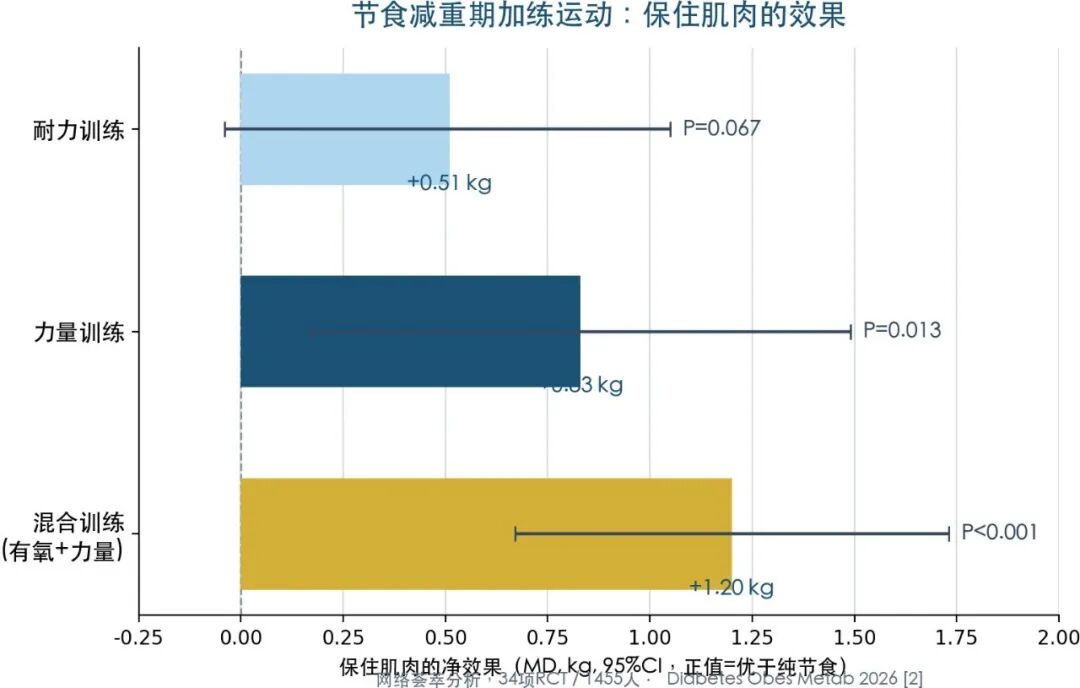
A systematic review just published in August 2026 (34 randomized controlled trials, 1,455 people) provided a quantitative answer: dieting alone reduces both fat and muscle, while adding exercise can preserve nearly half (45.7%) of the muscle loss[[2]]. Further network meta-analysis showed that, from highest to lowest, the muscle-preserving effects were: combined training (+1.20 kg) > strength only (+0.83 kg) > endurance only (+0.51 kg, not statistically significant)[[2]]. In other words, during calorie restriction, doing "aerobic + strength" together protects muscle best.
4. Don't Be Superstitious About the "Afterburn Effect"
You often hear that high-intensity exercise lets you "burn fat even while lying down"—the afterburn effect (EPOC) does exist, but its magnitude depends on exercise intensity and duration, and the afterburn from low-intensity, short-duration exercise is almost negligible[[3]]. Treating it as your main fat-loss method will leave you disappointed; the calories aerobic exercise actually burns are the real foundation for moving the scale.
5. Metabolic Indicators: Aerobic and Combined Are Better
A follow-up analysis from the same STRRIDE series showed: 8 months of strength training alone did not significantly improve metabolic syndrome scores, while aerobic and combined training significantly improved them[[4]]. If you also have concerns about blood pressure, blood lipids, or blood sugar, the "side benefits" of aerobic exercise are more valuable than you might imagine[[4]].
✦ ✦ ✦
Action Recommendations: Don't Choose One Over the Other—Combination Is Optimal
-
If you want to lose weight first: 150-300 minutes per week of moderate-intensity aerobic exercise (brisk walking/jogging/cycling), with intensity kept at a level where "you can talk but can't sing";
-
If you want to preserve muscle and prevent rebound: strength training at least twice a week, prioritizing compound movements like squats, push-ups, rows, and deadlifts, 20-40 minutes each session;
-
Eat enough protein during weight loss: 1.2-1.6 grams per kilogram of body weight per day, combined with strength training, for a lower risk of muscle loss;
-
If you're heavy or have knee discomfort: start with swimming, the elliptical, or brisk walking, and begin strength training with bodyweight movements, progressing gradually.
Weight loss is a long-term battle of "wanting it both ways": you want to lose fat and keep muscle. The next time you walk into the gym, don't rush to pick a side—after finishing on the treadmill, save another 20 minutes for the dumbbells. Bookmark this exercise recipe and share it with that friend who's trying to lose weight.
If this content was helpful to you, feel free to hit "Like" or "Wow," and leave a comment telling us what topics you'd like to see.
✦ ✦ ✦
References
-
Willis LH, Slentz CA, Bateman LA, et al. Effects of aerobic and/or resistance training on body mass and fat mass in overweight or obese adults. J Appl Physiol (1985). 2012;113(12):1831-1837. PMID: 23019316.
-
Deller M, Weiershaus J, Held S, Brinkmann C. Effects of calorie restriction with and without strength, endurance or mixed training on fat-free and skeletal muscle mass in overweight or obese individuals—a systematic review with pairwise meta-analysis and network meta-analysis of randomized controlled studies. Diabetes Obes Metab. 2026;28(8):6810-6823. PMID: 42144246.
-
Børsheim E, Bahr R. Effect of exercise intensity, duration and mode on post-exercise oxygen consumption. Sports Med. 2003;33(14):1037-1060. PMID: 14599232.
-
Bateman LA, Slentz CA, Willis LH, et al. Comparison of aerobic versus resistance exercise training effects on metabolic syndrome (from the Studies of a Targeted Risk Reduction Intervention Through Defined Exercise—STRRIDE-AT/RT). Am J Cardiol. 2011;108(6):838-844. PMID: 21741606.
Disclaimer: This content is for health education and informational purposes only and does not constitute any medical advice or medication guidance; please adjust specific exercise plans according to your own situation, and consult a professional doctor if you have any health concerns.
Conflict of Interest Statement: The author of this article has no conflicts of interest with the studies described.
© 2026 Sun Saint Hua (Beijing) Medical Technology Co., Ltd.