This article is for health education and informational purposes only and does not constitute medical advice; please consult a professional doctor if you have any health concerns.
✦ ✦ ✦
Today is September 1 — National Healthy Lifestyle Day. Since it was established in 2007, this day has been observed for nearly 20 years[[7]]. What the country reminds us of year after year comes down to just six words: Three Reductions, Three Healths — reduce salt, reduce oil, reduce sugar; healthy mouth, healthy weight, healthy bones[[7]]. But first, let's look at a set of data: how far are we from the "Three Healths"?
✦ ✦ ✦
Half of Adults Are Overweight or Obese, and One in Four Has High Blood Pressure
The Report on the Nutrition and Chronic Disease Status of Chinese Residents (2020) shows: among residents aged 18 and above, the overweight rate is 34.3% and the obesity rate is 16.4%, a combined 50.7% — more than half of adults are overweight or obese[[1]]; the prevalence of hypertension is 27.5%, meaning one in every four adults has high blood pressure[[1]].
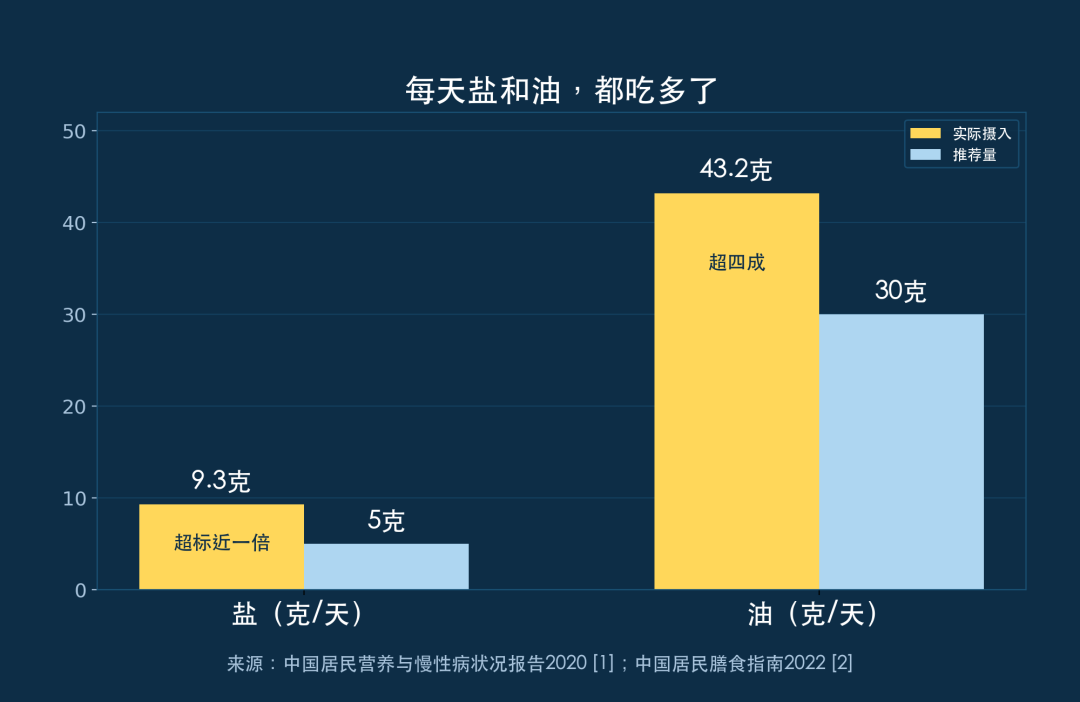
Now look at what goes into our mouths every day: the average person uses 9.3 grams of cooking salt per day, nearly double the recommended amount of 5 grams (the World Health Organization and dietary guidelines both consistently recommend salt intake below 5 grams per day); cooking oil use is 43.2 grams, more than 40% above the recommended upper limit of 30 grams[[1]][[2]][[4]]. And these are just averages — many families add even more salt and oil when cooking.
✦ ✦ ✦
Reduction One: Start with Salt — Both Blood Pressure and Weight Benefit
The relationship between salt and blood pressure is very direct. A Cochrane systematic review pooled 34 randomized trials involving 3,230 people: reducing salt by about 4.4 grams per day lowered systolic blood pressure by an average of 4.18 mmHg and diastolic blood pressure by 2.06 mmHg[[5]]. When blood pressure is stable, the burden on the cardiovascular system is lighter.
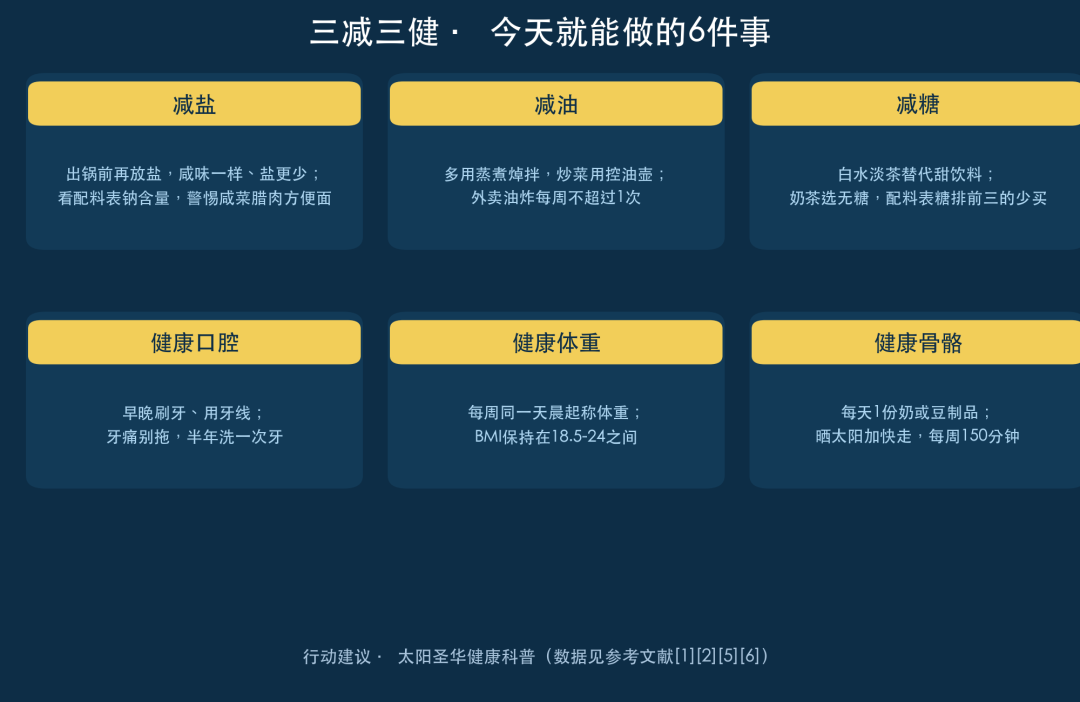
How to reduce: ① Add salt just before taking the dish off the heat — same salty taste, less salt used; ② When buying packaged foods, check the "sodium" on the ingredient list first; ③ Watch out for the big hidden sources of salt — pickled vegetables, cured meat, instant noodles, and dried noodles may not taste salty, but they contain plenty of sodium.
Reduction Two: Then Reduce Oil — Save Several Pounds a Year
The average person uses 43.2 grams of oil per day, more than 40% above the recommended amount (25-30 grams)[[1]][[2]]. Too much oil doesn't just mean high calories — it also tends to quietly raise blood lipids. The oil used in cooking alone brings about 390 kcal a day, equivalent to eating two extra bowls of rice. How to reduce: use steaming, boiling, blanching, and tossing more often; use an oil-control dispenser when cooking; limit takeout fried food to no more than once a week.
Reduction Three: Finally, Reduce Sugar — Start with Sugary Drinks
The World Health Organization recommends keeping free sugar intake below 10% of total energy (about 50 grams), and keeping it under 25 grams is even better[[3]]. Sugar-sweetened beverages are one of the biggest sources — a meta-analysis of 32 studies showed that for each additional serving of sugar-sweetened beverages per day, adults gained about 0.22 kg more weight per year[[6]]. How to reduce: replace your first drink of the day with plain water or light tea; choose sugar-free milk tea; buy fewer products where sugar ranks in the top three on the ingredient list.
✦ ✦ ✦
Three Healths at a Glance: Mouth, Weight, Bones — One Rule for Each
The Three Healths may look like three separate directions, but they really rest on the same thing: your body's foundation, built up little by little through daily habits.
-
Healthy mouth: brush morning and night, use dental floss, and don't put off tooth pain;
-
Healthy weight: weigh yourself on a fixed morning once a week, and keep BMI between 18.5 and 24;
-
Healthy bones: have one serving of milk or soy products daily, get sunlight and take brisk walks, aiming for a cumulative 150 minutes per week[[8]].
✦ ✦ ✦
Action suggestions: Do just three small things today — ① switch to a smaller salt spoon and add one less spoonful of salt; ② replace your first sugary drink of the day with plain water; ③ weigh yourself tonight and write it down. The Three Reductions and Three Healths aren't about eating less — they're about eating right.
If this was helpful to you, give it a like or a "reading" and feel free to leave a comment telling us what topics you'd like to see. Share it with the person who does the cooking at home, save this checklist, and use it together as a family.
✦ ✦ ✦
Disclaimer: The content of this article is compiled based on publicly available academic literature and authoritative institutional materials. It is for health education reference only and does not constitute medical advice; please consult a professional doctor for your individual situation.
Conflict of interest statement: The author has no conflicts of interest with the studies mentioned in this article.
© 2026 Sun Holy Health (Beijing) Medical Technology Co., Ltd.
References
-
Report on the Nutrition and Chronic Disease Status of Chinese Residents (2020). Issued by the National Health Commission, December 2020.
-
Chinese Nutrition Society. Chinese Dietary Guidelines (2022). People's Medical Publishing House.
-
World Health Organization. Guideline: Sugars intake for adults and children. WHO; 2015.
-
World Health Organization. Guideline for sodium intake for adults and children. WHO; 2023.
-
He FJ, Li J, MacGregor GA. Effect of longer term modest salt reduction on blood pressure. BMJ. 2013;346:f1325. PMID:23558162
-
Malik VS, Pan A, Willett WC, Hu FB. Sugar-sweetened beverages and weight gain in children and adults: a systematic review and meta-analysis. Am J Clin Nutr. 2013;98(4):1084-102. PMID:23966427
-
National Healthy Lifestyle Action (launched on September 1, 2007, initiated by the former Ministry of Health and organized by the Chinese Center for Disease Control and Prevention).
-
World Health Organization. WHO guidelines on physical activity and sedentary behaviour. WHO; 2020.