This article is for health education purposes only and is intended for informational reference only. It does not constitute medical advice. If you have health concerns, please consult a professional physician.
Can Artificial Sweeteners Help You Lose Weight? Data from 100,000 People Over 9 Years Says the Opposite
Supermarket shelves are increasingly filled with "zero sugar" and "0 calorie" labels. Many people swap sugary drinks for artificially sweetened ones, thinking they can satisfy their sweet tooth without gaining weight—but the truth may be exactly the opposite.
A large cohort study from France involving more than 100,000 people and nearly 10 years of follow-up found that the more artificial sweeteners consumed, the higher the risk of cardiovascular disease, cancer, and type 2 diabetes[[1-3]]. The World Health Organization (WHO) officially issued guidelines in 2023 stating that non-sugar sweeteners are not recommended for controlling body weight or reducing disease risk[[4]].
What exactly is going on with artificial sweeteners? Aren't they "zero calorie"? This article uses 6 key studies to explain the metabolic truth about artificial sweeteners all at once.
✦ ✦ ✦
1. A 100,000-Person Cohort: The More Artificial Sweeteners You Consume, the Higher Your Cardiovascular Risk
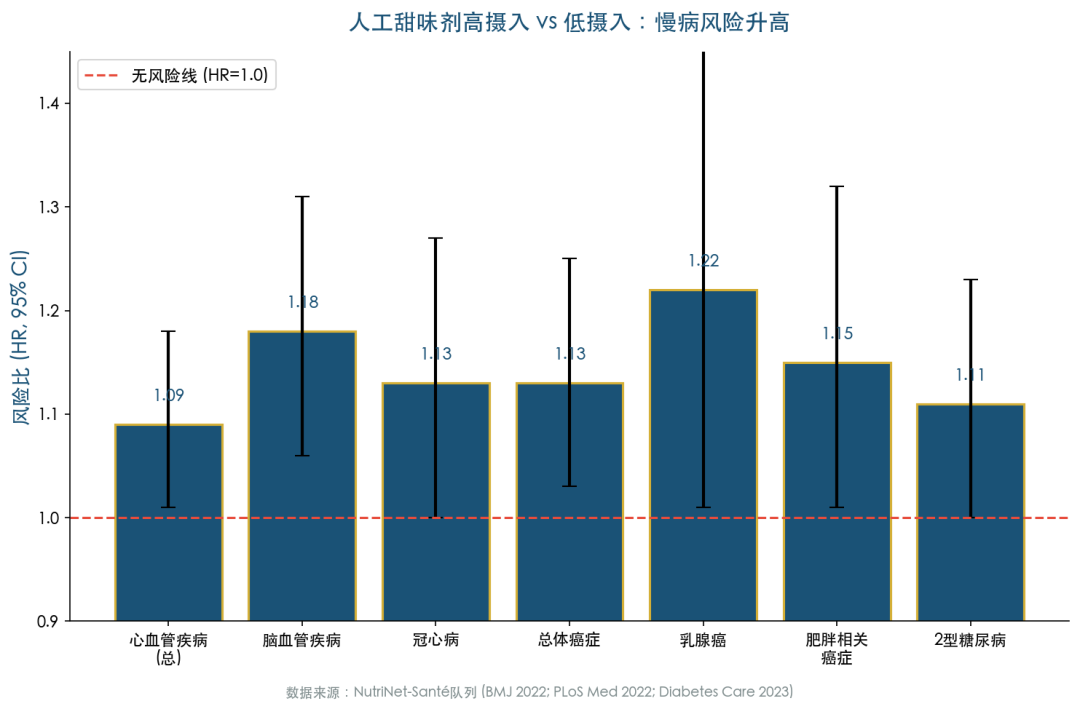
The NutriNet-Santé cohort study published in BMJ in 2022 included 103,388 French adults with a median follow-up of 9.1 years[[1]]. The results showed:
-
Those with higher total artificial sweetener intake had a 9% higher risk of cardiovascular disease (HR 1.09, 95% CI 1.01-1.18);
-
The risk of cerebrovascular disease was even more pronounced, reaching 18% (HR 1.18, 95% CI 1.06-1.31);
-
Aspartame was associated with an increased risk of cerebrovascular events, while acesulfame-K and sucralose were associated with an increased risk of coronary heart disease[[1]].
The researchers pointed out that artificial sweeteners are not a "safe substitute" for sugary drinks. Even low-dose daily intake may be independently associated with cardiovascular risk.
✦ ✦ ✦
2. Artificial Sweeteners and Cancer: Overall Cancer Risk Up 13%, Breast Cancer Most Prominent
A cancer analysis from the same cohort (2022, PLoS Medicine) found[[2]]:
-
Those with higher artificial sweetener intake had a 13% higher overall cancer risk (HR 1.13, 95% CI 1.03-1.25);
-
Breast cancer risk was 22% higher (HR 1.22, 95% CI 1.01-1.48);
-
Obesity-related cancer risk was 15% higher (HR 1.15, 95% CI 1.01-1.32);
-
Aspartame and acesulfame-K showed the most significant associations.
In 2023, the International Agency for Research on Cancer (IARC), WHO, and a joint expert committee of the Food and Agriculture Organization classified aspartame as a Group 2B carcinogen (possibly carcinogenic to humans)[[6]]. It should be noted that Group 2B means "limited evidence," not confirmed carcinogenicity, but it is enough to make consumers re-examine their daily intake.
✦ ✦ ✦
3. Artificial Sweeteners and Diabetes: People Who Drink Diet Drinks Actually Have Worse Blood Sugar
A diabetes analysis from NutriNet-Santé published in Diabetes Care in 2023 showed[[3]]:
-
Those with higher total artificial sweetener intake had about an 11% higher risk of type 2 diabetes (HR 1.11);
-
Aspartame, acesulfame-K, and sucralose all showed positive associations;
-
The association persisted even among people with normal BMI and no baseline metabolic disease.
This is consistent with the conclusions of a systematic review and meta-analysis published in CMAJ in 2017: randomized controlled trials did not show sustained benefits of non-nutritive sweeteners for body weight, while observational studies instead suggested associations with increased risk of weight gain, obesity, hypertension, diabetes, and coronary heart disease[[4]].
Simply put: you may want to use artificial sweeteners to control blood sugar, but the data show that artificial sweeteners may actually make blood sugar control worse.
✦ ✦ ✦
4. Mechanisms Revealed: Zero Calories Does Not Mean Zero Impact
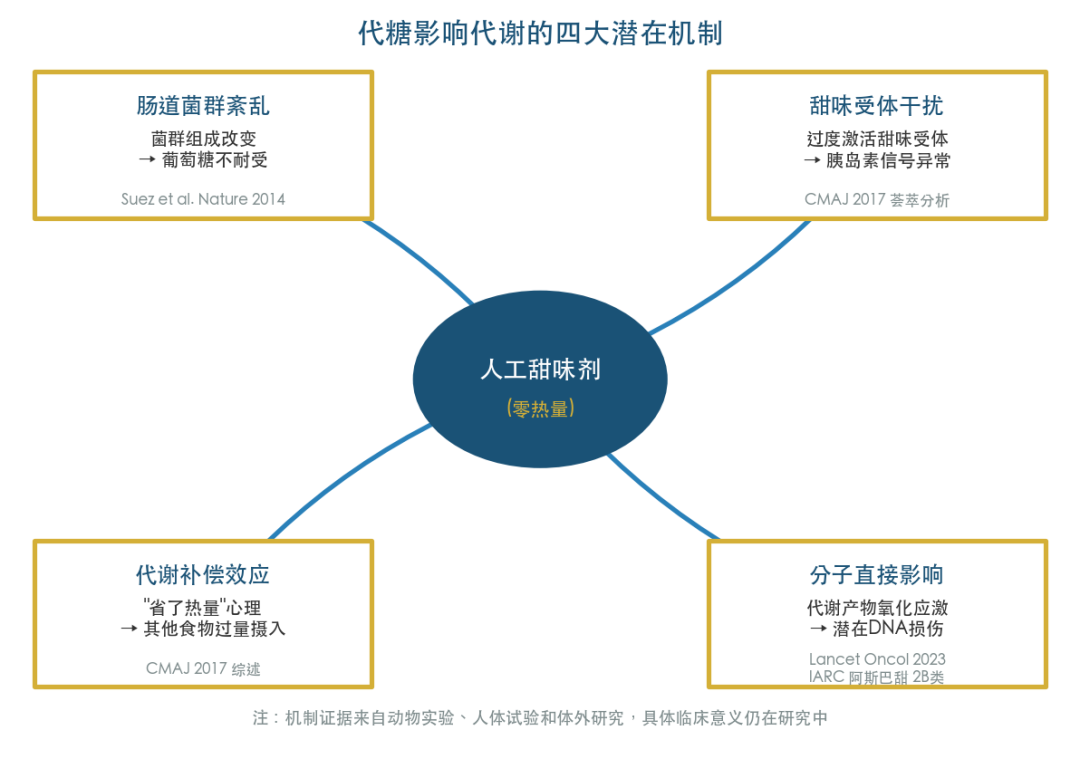
Why do zero-calorie artificial sweeteners cause metabolic problems? Current research has proposed several key pathways:
1. Gut microbiota disruption
A landmark 2014 Nature study found that saccharin and other artificial sweeteners can alter the composition of gut microbiota and induce glucose intolerance in mice; in human trials, healthy volunteers who consumed the maximum acceptable daily intake of saccharin for 7 consecutive days also showed worsened blood sugar regulation[[5]].
2. Sweet taste receptor interference
Artificial sweeteners are hundreds to tens of thousands of times sweeter than sucrose, and may overactivate sweet taste receptors in the mouth and gut, interfering with insulin secretion and glucose regulation signals.
3. Metabolic compensation effect
After drinking a "zero-calorie" beverage, you may psychologically feel you have "saved calories," and instead consume more of other foods; there is also evidence that sweet taste stimulation itself can trigger gut hormone responses and increase appetite.
4. Direct molecular damage
In vitro experiments suggest that the metabolic products of aspartame (such as methanol and formaldehyde) may cause oxidative stress and DNA damage at high doses, although the significance of this mechanism at daily human intake levels remains controversial[[6]].
✦ ✦ ✦
5. Do Different Artificial Sweeteners Carry the Same Risk?
Type of sweetener Common brand names Study findings
Aspartame NutraSweet, Equal IARC Group 2B; associated with cerebrovascular events, breast cancer, and diabetes risk[1-3,6]
Acesulfame-K Sunett Associated with coronary heart disease and obesity-related cancer risk[1-2]
Sucralose Splenda Associated with coronary heart disease and diabetes risk; may alter gut microbiota[3-4]
Saccharin Sweet'N Low Clearly alters gut microbiota and induces glucose intolerance[5]
It should be emphasized that the above associations mostly come from observational studies, and residual confounding cannot be completely ruled out (for example, people with obesity may themselves be more likely to choose artificial sweetener products). However, multiple prospective cohorts, RCTs, and mechanistic studies point in the same direction, and the strength of evidence is accumulating.
✦ ✦ ✦
Action Advice for You
-
Do not use artificial sweeteners as a weight-loss tool: WHO clearly does not recommend non-sugar sweeteners for weight control. Long-term use has no weight-loss benefit and may instead increase the risk of chronic disease.
-
The safest drink is water: Plain water, light tea, and black coffee are better choices; if you want something with flavor, you can add lemon slices, mint leaves, or a small amount of fruit juice for taste.
-
Reduce gradually: If you drink multiple cans of diet drinks every day, try reducing by one can per week and replacing it with sparkling water. Your taste buds will adapt to lower sweetness within 2-4 weeks.
-
Read the ingredient list: Aspartame, acesulfame-K, sucralose, saccharin, and neotame are all non-sugar sweeteners. "Sugar-free" does not mean "free of artificial sweeteners."
-
Special populations should be more cautious: Pregnant women, children, and people with diabetes should minimize artificial sweetener intake and prioritize whole foods and natural beverages.
Artificial sweeteners are not poison, and occasional enjoyment does not require anxiety; but treating them as a "health pass" and drinking them every day—data from 100,000 people over 9 years tells you—this may be a bad deal.
We suggest saving this article and taking a look before you pick up a "zero sugar" drink in the supermarket next time. You are also welcome to share it with family and friends around you who are always drinking sugar-free beverages.
If this content has been helpful to you, feel free to give it a "Like" or "Wow," and leave a comment telling us what topics you would like to see.
✦ ✦ ✦
References
-
Debras C, Chazelas E, Srour B, et al. Artificial sweeteners and risk of cardiovascular diseases: results from the prospective NutriNet-Santé cohort. BMJ. 2022;378:e071204. PMID: 36638072.
-
Debras C, Chazelas E, Sellem L, et al. Artificial sweeteners and cancer risk: Results from the NutriNet-Santé population-based cohort study. PLoS Med. 2022;19(3):e1003950. PMID: 35324894.
-
Debras C, Chazelas E, Porcherie A, et al. Artificial Sweeteners and Risk of Type 2 Diabetes in the Prospective NutriNet-Santé Cohort. Diabetes Care. 2023;46(9):1681-1690. PMID: 37490630.
-
Azad MB, Abou-Setta AM, Chauhan BF, et al. Nonnutritive sweeteners and cardiometabolic health: a systematic review and meta-analysis of randomized controlled trials and prospective cohort studies. CMAJ. 2017;189(28):E929-E939. PMID: 28716847.
-
Suez J, Korem T, Zeevi D, et al. Artificial sweeteners induce glucose intolerance by altering the gut microbiota. Nature. 2014;514(7521):181-186. PMID: 25231862.
-
Riboli E, Beland M, Lachenmeier DW, et al. Carcinogenicity of aspartame, methyleugenol, and isoeugenol. Lancet Oncol. 2023;24(8):848-850. PMID: 37454664.
✦ ✦ ✦
Disclaimer: The research data cited in this article all come from publicly published peer-reviewed journal papers and official WHO guidelines. They are intended only for the dissemination of health knowledge and do not provide diagnostic or treatment advice for any individual. Everyone's physical condition is different. For specific health issues, please consult a licensed physician or registered dietitian.
Conflict of Interest Statement: The author of this article and Sun Sheng Hua (Beijing) Medical Technology Co., Ltd. have no conflicts of interest with the above studies or any artificial sweetener or beverage brands.
© 2026 Sun Sheng Hua (Beijing) Medical Technology Co., Ltd.