120 Million People in China Have Worsening Kidneys, Yet Routine Checkups Miss It
This article is for health education purposes only and is intended for informational reference. It does not constitute medical advice; if you have health concerns, please consult a professional physician.
When you flip to the "kidney function" section of a health checkup report and see a string of normal reference ranges after serum creatinine, many people breathe a sigh of relief and turn the page. But the picture painted by a 2012 national survey covering 13 provinces and 47,204 adults was this: the prevalence of chronic kidney disease among Chinese adults was 10.8%, with an estimated 120 million patients[1].
What's more noteworthy is how these 120 million people were identified. Only 1.7% had an estimated filtration rate below 60, while 9.4% had elevated urinary albumin[1]. In other words, most people's problems don't show up on the serum creatinine line—they show up on the urinalysis slip that many people casually skip.
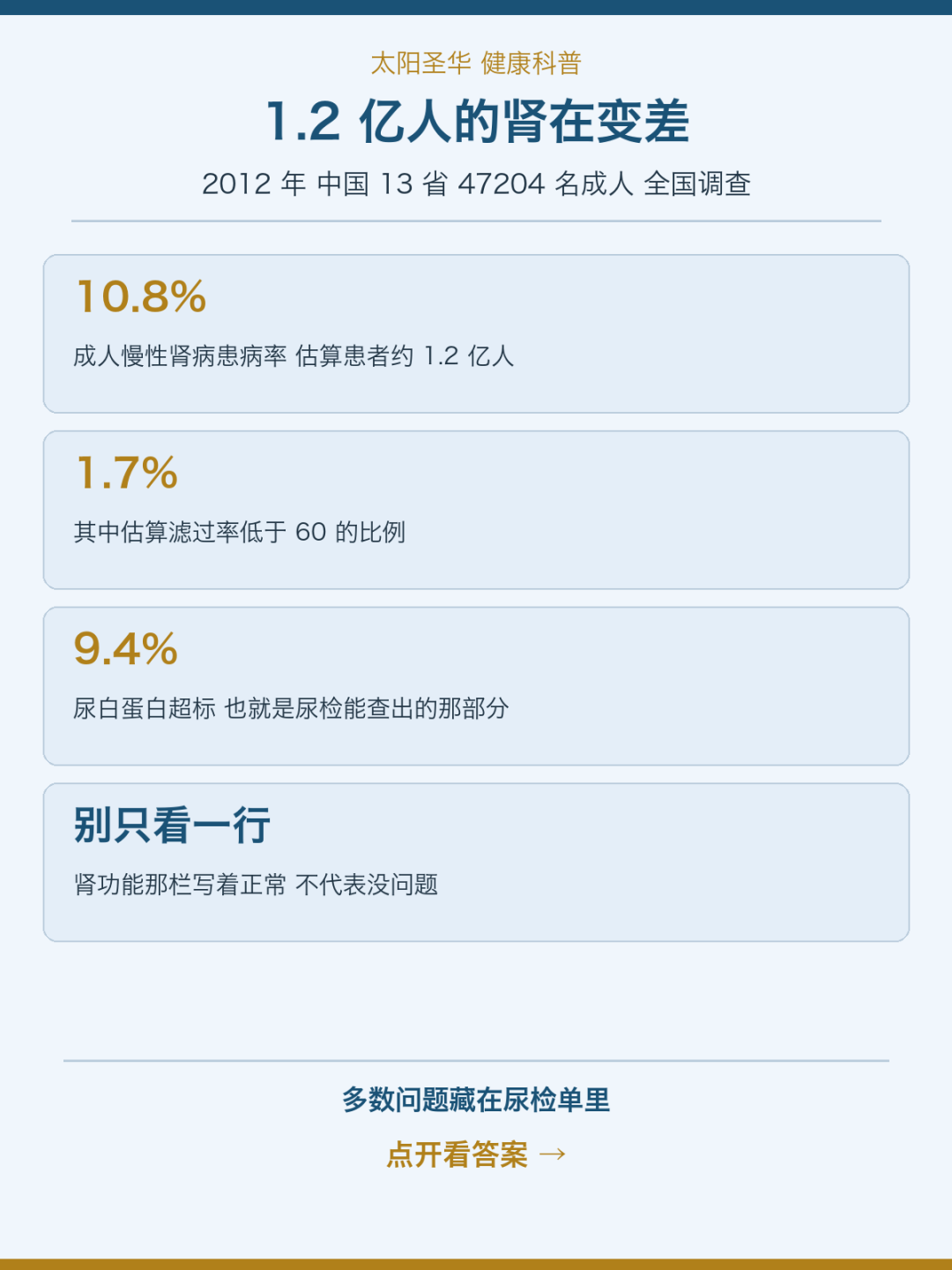
Caption: The prevalence of chronic kidney disease among Chinese adults is 10.8%, approximately 120 million people, of whom only 1.7% have a filtration rate below 60, while 9.4% have elevated urinary albumin.
✦ 1. Checking Your Kidneys Requires Three Numbers, Not Just Creatinine
Serum creatinine is tested on almost everyone, but it is heavily influenced by muscle mass: people who work out regularly tend to have higher creatinine, while older adults with less muscle may show normal-looking creatinine. That's why clinicians pay more attention to the estimated glomerular filtration rate—the eGFR on your report—which is calculated from serum creatinine, age, and sex together. The third number is the urine albumin-to-creatinine ratio, usually written as UACR, which comes from urinalysis and reflects whether the kidney's filtration mesh is leaking protein. The KDIGO 2024 guideline assessment framework specifically calls for looking at both the filtration rate and albuminuria together[6].
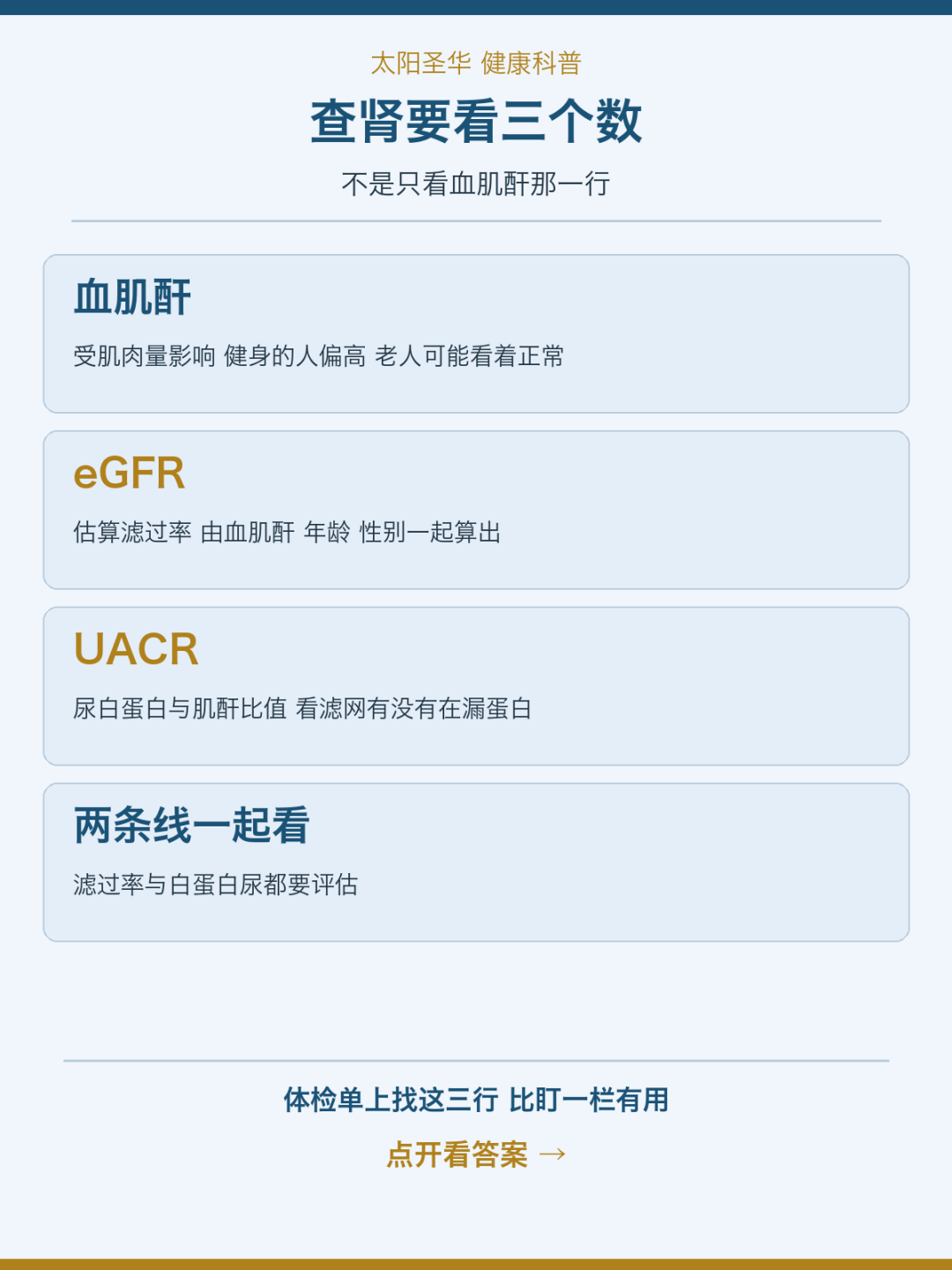
Caption: The three kidney check indicators—serum creatinine, estimated filtration rate eGFR, and urine albumin-to-creatinine ratio UACR—each reflect different aspects.
✦ 2. That Little Bit of Protein in Urine Carries Risk on Its Own
Many people assume urinary protein is just a "mild abnormality." A Canadian cohort of 920,000 people showed a different magnitude: over a median follow-up of 35 months, those with a filtration rate above 60 but heavy proteinuria had an all-cause mortality rate of 7.2 per 1,000 person-years, while those whose filtration rate had already dropped to 45–59.9 but had normal proteinuria had only 2.9[3]. A person with acceptable filtration rate but positive proteinuria had more than double the risk of someone with reduced filtration rate but negative proteinuria, with a rate ratio of 2.5[3]. Hospitalization for myocardial infarction, progression to kidney failure, and doubling of serum creatinine all pointed in the same direction[3].
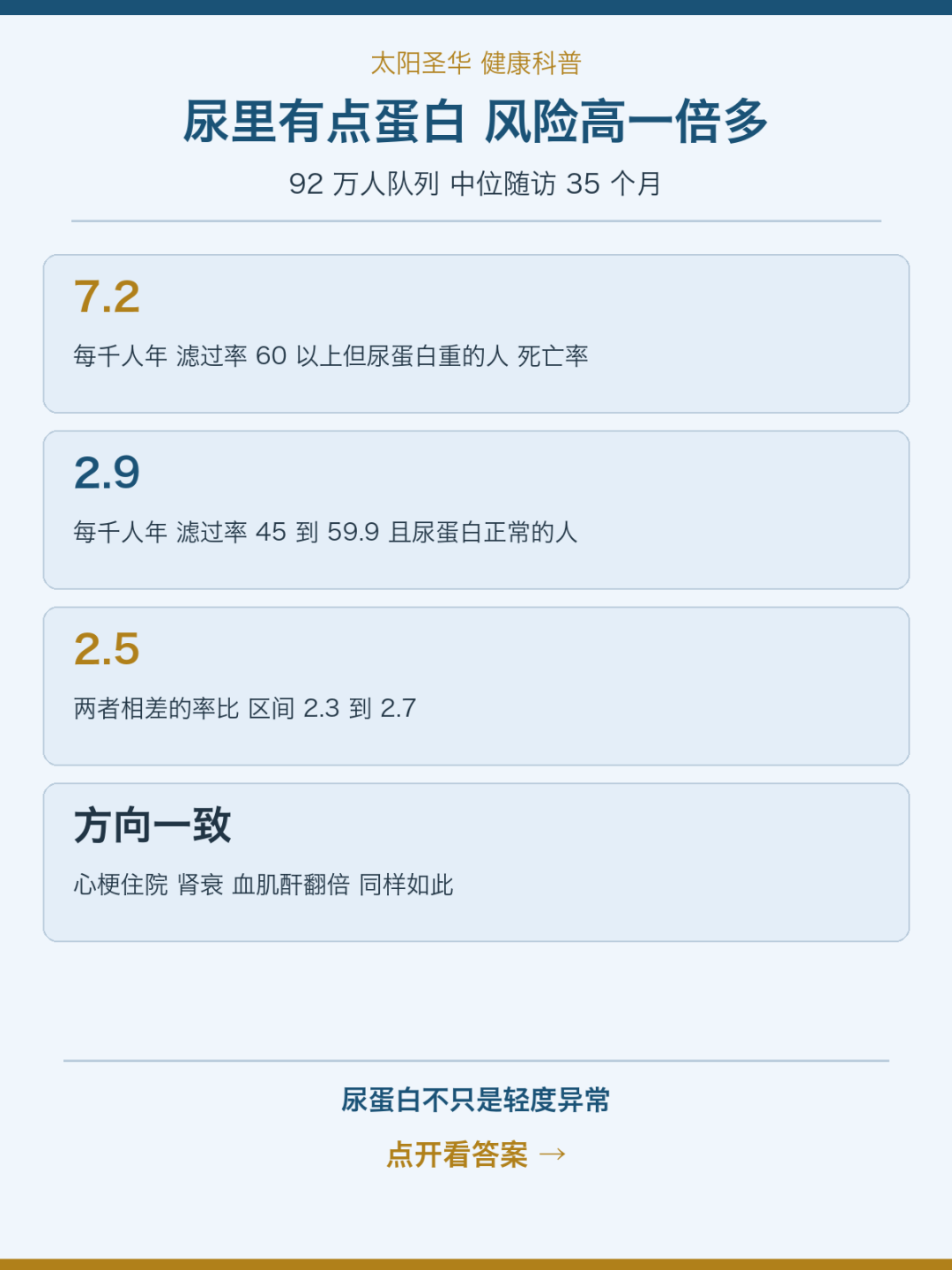
Caption: In the 920,000-person cohort, at the same filtration rate level, heavier proteinuria meant higher mortality; those with filtration rate above 60 but heavy proteinuria had 7.2 per 1,000 person-years, compared with 2.9 for those at 45–59.9 with normal proteinuria.
✦ 3. Salt Is One Dial You Can Turn Right Now
A 2021 Cochrane updated systematic review pooled 21 randomized controlled trials involving 1,197 chronic kidney disease patients: reducing salt by 4.2 grams per day—roughly equivalent to 1,690 milligrams of sodium—lowered systolic blood pressure by 6.91 mmHg, diastolic blood pressure by 3.91 mmHg, and urinary albumin by 36%, both with high-certainty evidence[4]. It should be noted that these trials lasted only 1 to 36 weeks, which is not enough to prove that eating less salt reduces dialysis or death[4]. But the two intermediate pathways—blood pressure and urinary protein—point clearly in the right direction. In practice, switch to a salt-measuring spoon and factor in the hidden salt from soy sauce, oyster sauce, pickled foods, and takeout.
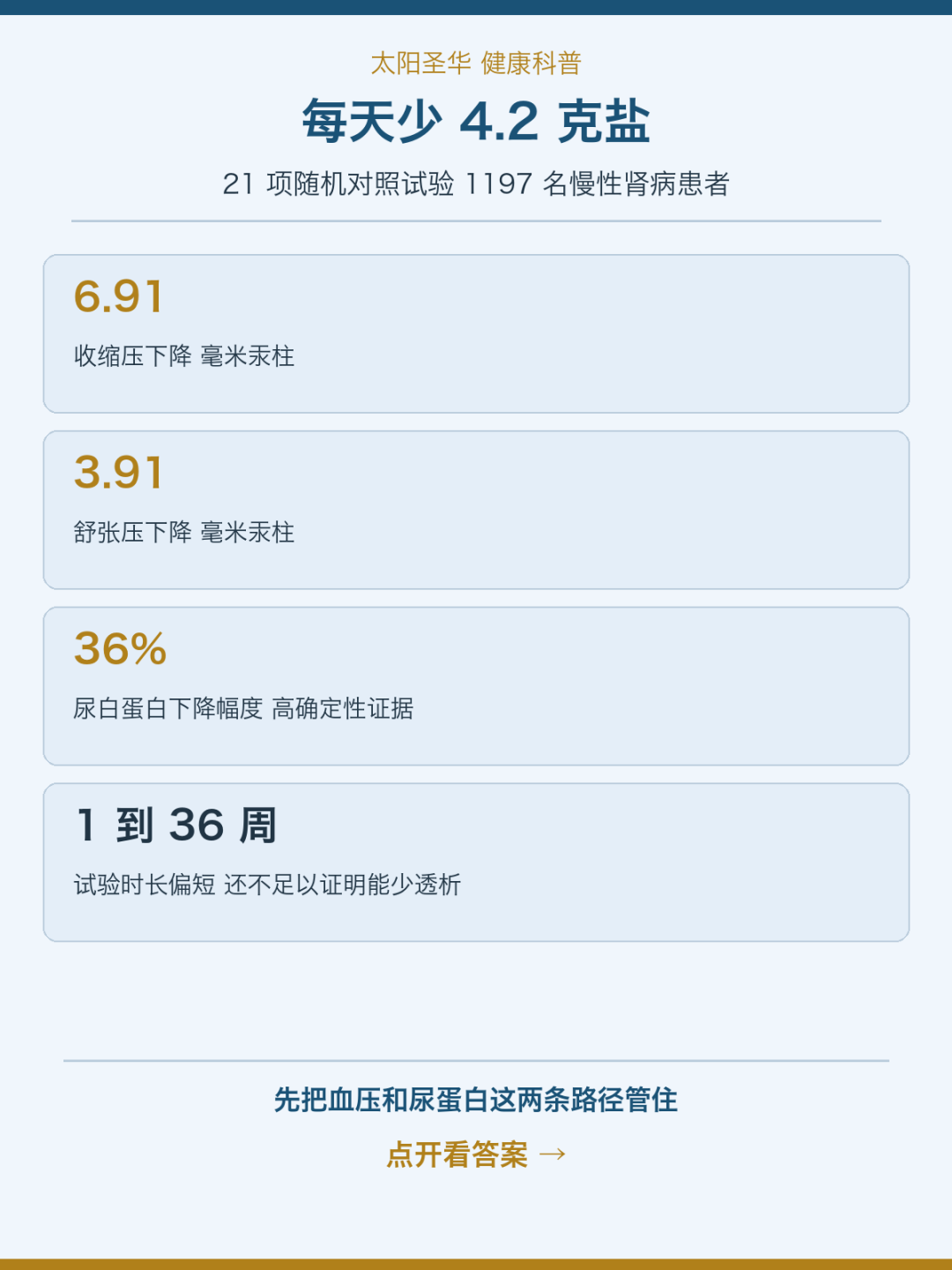
Caption: Reducing salt by 4.2 grams per day lowered systolic and diastolic blood pressure by 6.91 and 3.91 mmHg respectively, and urinary albumin by 36%, based on 21 randomized controlled trials.
✦ 4. Weight and Waist Circumference Are a Long-Term Bill
The KDIGO 2026 controversies conference on obesity and chronic kidney disease noted that long-term obesity, early-onset obesity, and longer duration of obesity all increase the risk of chronic kidney disease; the foundation of management is diet, physical activity, and behavioral changes around both[5]. The global picture is similarly heavy: in 2017, there were 697.5 million cases of chronic kidney disease worldwide, a prevalence of 9.1%, with 1.2 million deaths, and all-age mortality has risen 41.5% since 1990[2]. The significance of weight loss for the kidneys goes beyond the number on the scale.

Caption: Five things you can do today, and the warning signs that warrant a prompt checkup.
✦ 5. These Groups Should Get Checked Once a Year
People with diabetes, hypertension, hyperuricemia, a history of cardiovascular disease, or obesity; those with a family history of kidney disease; and long-term users of pain relievers are advised to get a urinalysis plus kidney function test once a year[1][6]. Physical signals to watch for include: increased nighttime urination, persistent foam in urine that doesn't dissipate, puffiness around the eyes or ankles upon waking, fatigue and loss of appetite, and blood pressure that was previously well-controlled suddenly rising. None of these are specific, but they are worth getting checked.
Don't treat normal creatinine as a free pass for your kidneys. That urinalysis slip you casually skip is often the one that speaks up earlier.
If this article has been helpful to you, give it a like or a "reading" mark, and feel free to leave a comment telling us what topics you'd like to see. Please also share it with that person who gets a blood test every year at checkup but never a urine test.
✦
Disclaimer: This article is for health education purposes only and is intended for informational reference. It does not constitute medical advice. The data cited come from publicly published national surveys, cohort studies, and systematic reviews; observational studies can only demonstrate association, not causation. Whether further examination or treatment is needed must be evaluated by a professional physician.
Conflict of interest statement: This article does not involve any recommendations for medications, supplements, or devices, and has no conflicts of interest with the research institutions mentioned.
References
[1] Zhang L, Wang F, Wang L, et al. Prevalence of chronic kidney disease in China: a cross-sectional survey. Lancet. 2012;379(9818):815-822. PMID: 22386035
[2] GBD Chronic Kidney Disease Collaboration. Global, regional, and national burden of chronic kidney disease, 1990-2017: a systematic analysis for the Global Burden of Disease Study 2017. Lancet. 2020;395(10225):709-733. PMID: 32061315
[3] Hemmelgarn BR, Manns BJ, Lloyd A, et al. Relation between kidney function, proteinuria, and adverse outcomes. JAMA. 2010;303(5):423-429. PMID: 20124537
[4] McMahon EJ, Campbell KL, Bauer JD, Mudge DW, Kelly JT. Altered dietary salt intake for people with chronic kidney disease. Cochrane Database Syst Rev. 2021;6(6):CD010070. PMID: 34164803
[5] Furth SL, Colhoun HM, Kanbay M, et al. The relationship between obesity and chronic kidney disease: conclusions from a Kidney Disease: Improving Global Outcomes (KDIGO) Controversies Conference. Kidney Int. 2026;109(3):442-464. PMID: 41176308
[6] Kidney Disease: Improving Global Outcomes (KDIGO) CKD Work Group. KDIGO 2024 Clinical Practice Guideline for the Evaluation and Management of Chronic Kidney Disease. Kidney Int. 2024;105(4S):S117-S314. PMID: 38490803
© 2026 Sunshenghua (Beijing) Medical Technology Co., Ltd.