This article is for health education purposes only and is intended for informational reference; it does not constitute medical advice. If you have health concerns, please consult a professional doctor.
Breakfast has been pulled back and forth between two camps for years. One camp says skipping breakfast makes you gain weight and harms your metabolism; the other says skipping a meal means eating less, making weight loss easier. Both sides can produce data.
Let's lay out both sides of the ledger and use 5 numbers to figure it out clearly: should you eat breakfast, and who should be more careful about it?
✦ ✦ ✦
First, the direction: Pooling 13 randomized controlled trials, the breakfast-eating group did not weigh less—they actually averaged 0.44 kg heavier than the skipping group[1]. Using breakfast as a weight-loss tool doesn't hold up.
But on the other side, people who skip breakfast don't look good on diabetes and cardiovascular data: in a meta-analysis of 96,000 people, those who frequently skipped breakfast had a 33% higher risk of type 2 diabetes[2]; in a meta-analysis of 242,000 people, skipping breakfast was associated with 27% higher all-cause mortality and 28% higher cardiovascular mortality[4].
Both directions hold true simultaneously. This is where breakfast is easily misread: it is neither a weight-loss switch nor a meal that can be casually cut.
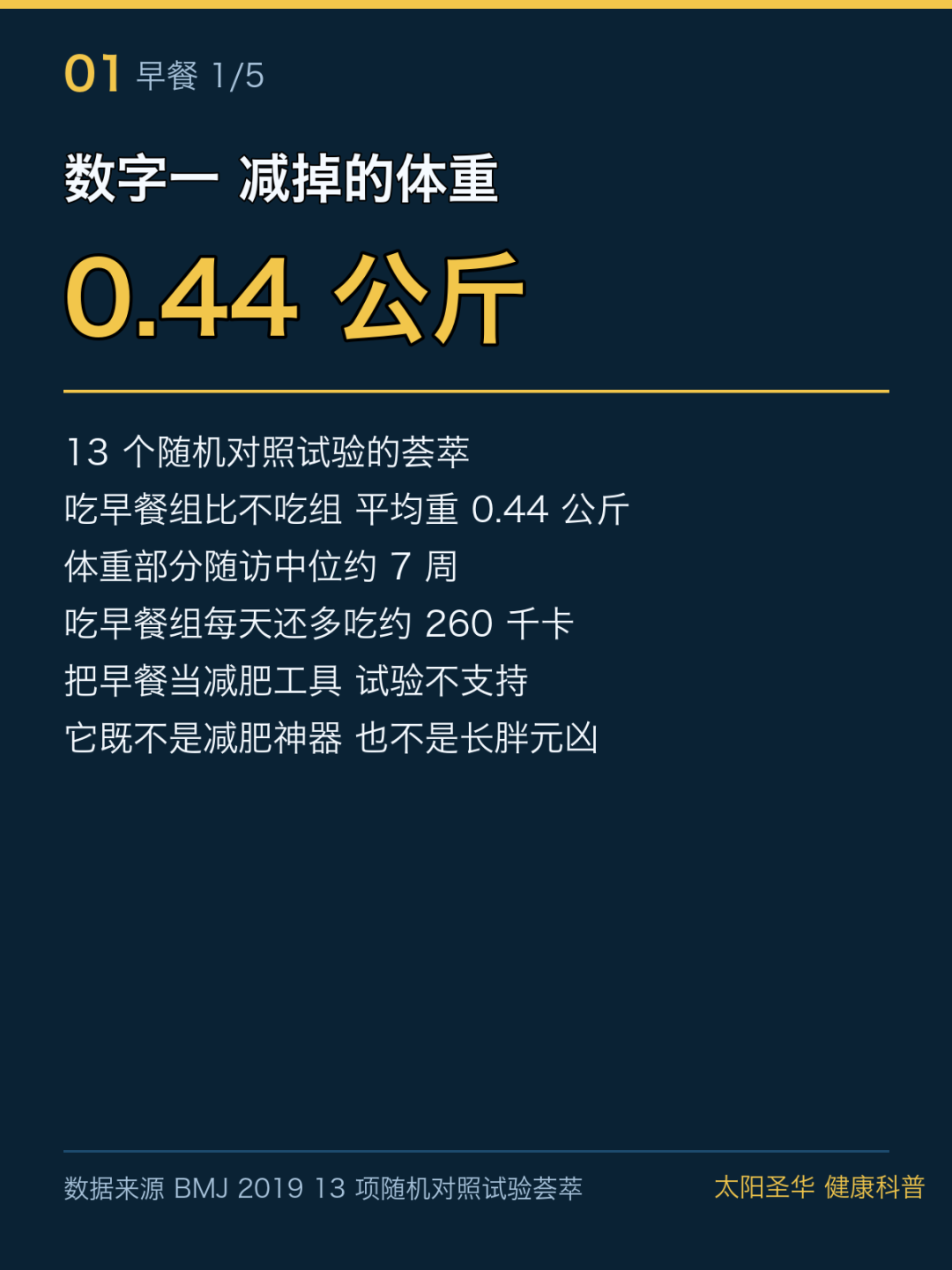
01 | 0.44 kg: Breakfast is not a weight-loss tool
Among the 13 trials, 7 measured body weight and 10 measured daily energy intake; the median follow-up for the weight portion was only about 7 weeks[1].
The result: the breakfast-eating group averaged 0.44 kg heavier than the skipping group. In other words, the claim that "eating breakfast helps you lose weight" is not supported by existing randomized trials.
In plain terms: breakfast is neither a weight-loss miracle nor the culprit behind weight gain. It's just one meal in the day and shouldn't be burdened with so many tasks.

02 | 260 kcal: What's added is often not breakfast but extra snacks
In the same batch of trials, the breakfast-eating group consumed about 260 kcal more per day in total energy intake than the skipping group[1].
The key lies in the trial design: this was "adding a breakfast on top of the existing diet," not "replacing late-night snacks or junk food with breakfast." Adding 260 kcal, of course body weight wouldn't be lower.
So what really matters isn't "whether you eat" but "what you eat and what it replaces."

03 | 33% and 22%: The diabetes side
6 prospective cohort studies, 96,175 people, 4,935 new cases of type 2 diabetes: those who frequently skipped breakfast had a 33% higher risk than those who never skipped[2].
After adjusting for body mass index, the hazard ratio dropped to 1.22—still 22% higher[2]. This suggests that part of the risk runs through body weight—among people who skip breakfast, the proportions of late sleepers, those with poor overall diets, and those with higher body weight were already not low to begin with.
There's also a detail in the dose-response: skipping 4 to 5 days a week already reached a plateau (about 1.55), and skipping more days didn't push it any higher[2].
In plain terms: it's not "one day of skipping and something goes wrong," but "skipping year after year" does add up on the ledger.
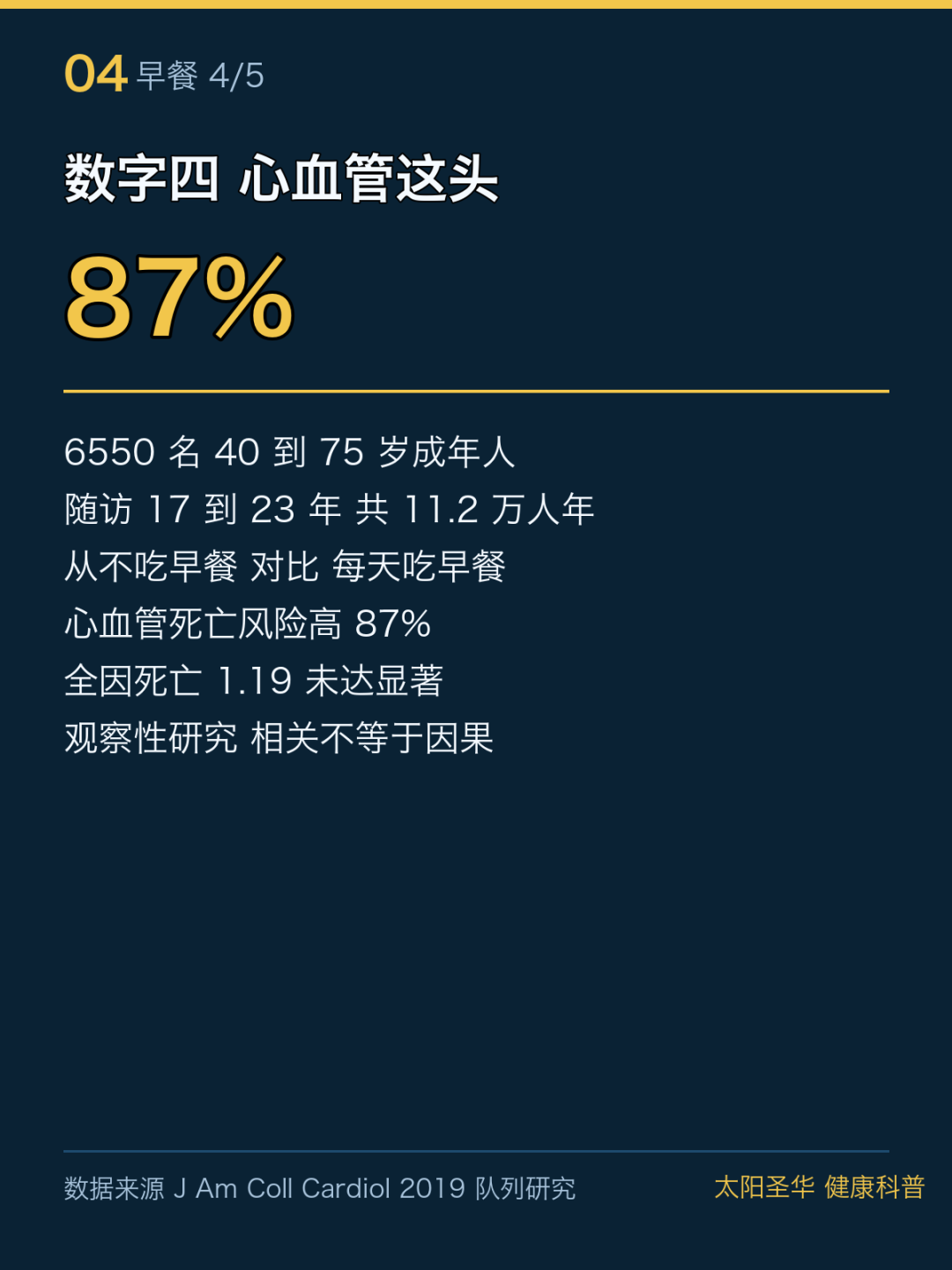
04 | 87%: The cardiovascular side—but you need to see clearly that this is observational data
The US NHANES III cohort of 6,550 adults aged 40 to 75, followed for 17 to 23 years, totaling 112,000 person-years[3].
People who never ate breakfast, compared with those who ate breakfast every day: 87% higher cardiovascular mortality risk (hazard ratio 1.87, 95% confidence interval 1.14 to 3.04); all-cause mortality hazard ratio 1.19 (0.99 to 1.42), not statistically significant[3].
It must be made clear: this is observational research. The habit of "never eating breakfast" is often tied together with smoking, late nights, income level, and overall diet quality, so it cannot be directly read as "skipping breakfast causes heart disease."
There is also consistent evidence from a 2024 meta-analysis: 9 cohorts, 242,000 people—skipping breakfast was associated with 27% higher all-cause mortality, 28% higher cardiovascular mortality, and 34% higher cancer mortality, but the authors themselves rated the evidence level as low to very low[4].
The conclusion is not meant to scare, but is a plain judgment: the habit of long-term breakfast skipping has not been shown to have any health benefit.

05 | Within 1 to 2 hours of waking: How you eat matters more than whether you eat
The American Heart Association's 2017 scientific statement indicated: irregular eating patterns are more detrimental to body weight, blood lipids, insulin resistance, and blood pressure; consciously scheduling the timing and frequency of meals is more meaningful than obsessing over any single meal[5].
Three things you can do starting today:
① If you already eat breakfast, don't cut it out long-term for weight loss—especially if your blood sugar or blood lipids are already on the high side.
② If you do eat, eat enough protein: eggs, milk, soy products, unsweetened yogurt, paired with a serving of whole grains and a serving of fruit. Eating only plain congee with pickles, or bread with sweet milk tea, will leave you hungry again two hours later—hard to make it to lunch.
③ Fix the timing: finish eating within 1 to 2 hours of waking; don't drag it past 10 a.m. as "brunch"—that's essentially moving lunch earlier.
✦ ✦ ✦
When to see a doctor
If you've had noticeable weight changes recently, elevated fasting blood sugar, or you feel palpitations and tremors every morning, don't just rely on adjusting breakfast to get by—go to the hospital and check your blood sugar and thyroid function.
Breakfast is not a weight-loss switch; it's the starting line for your daily metabolism.
Consider sharing this with that colleague who never eats breakfast, and save these 5 cards—next time someone tries to convince you that "skipping breakfast helps you lose weight," just show them this.
If you found this helpful, give it a like or a "reading" click, and feel free to leave a comment telling us what topics you'd like to see.
Disclaimer: This article is for health education purposes only and is intended for informational reference; it does not constitute medical advice. For specific treatment plans, please follow your doctor's instructions.
Conflict of interest statement: This article does not involve any drug or product recommendations, and the author has no financial relationship with the research institutions of the studies cited.
© 2026 Sun Saint Hua (Beijing) Medical Technology Co., Ltd.
References
[1] Sievert K, Hussain SM, Page MJ, et al. Effect of breakfast on weight and energy intake: systematic review and meta-analysis of randomised controlled trials. BMJ. 2019;364:l42. PMID: 30700403
[2] Ballon A, Neuenschwander M, Schlesinger S. Breakfast Skipping Is Associated with Increased Risk of Type 2 Diabetes among Adults: A Systematic Review and Meta-Analysis of Prospective Cohort Studies. J Nutr. 2019;149(1):106-113. PMID: 30418612
[3] Rong S, Snetselaar LG, Xu G, et al. Association of Skipping Breakfast With Cardiovascular and All-Cause Mortality. J Am Coll Cardiol. 2019;73(16):2025-2032. PMID: 31023424
[4] Breakfast skipping and risk of all-cause, cardiovascular and cancer mortality among adults: a systematic review and meta-analysis of prospective cohort studies. Food Funct. 2024;15(11):5703-5713. PMID: 38738978
[5] St-Onge MP, Ard J, Baskovich M, et al. Meal Timing and Frequency: Implications for Cardiovascular Disease Prevention: A Scientific Statement From the American Heart Association. Circulation. 2017;135(9):e96-e121. PMID: 28137935