WHO Does Not Recommend Using Sugar Substitutes for Weight Loss; 100,000 People Show 13% Higher Cancer Risk
This article is for health education purposes only and is intended for informational reference. It does not constitute medical advice; if you have health concerns, please consult a professional doctor.
On a summer day, when you open the convenience store freezer, many people grab a drink and first flip it over to check the nutrition label: 0 sugar, 0 calories, 0 fat—and a weight lifts off their mind as they down half the bottle in one go. When you want something sweet while dieting, sugar-free drinks have become almost the "standard answer."
But that answer is being rewritten by science.
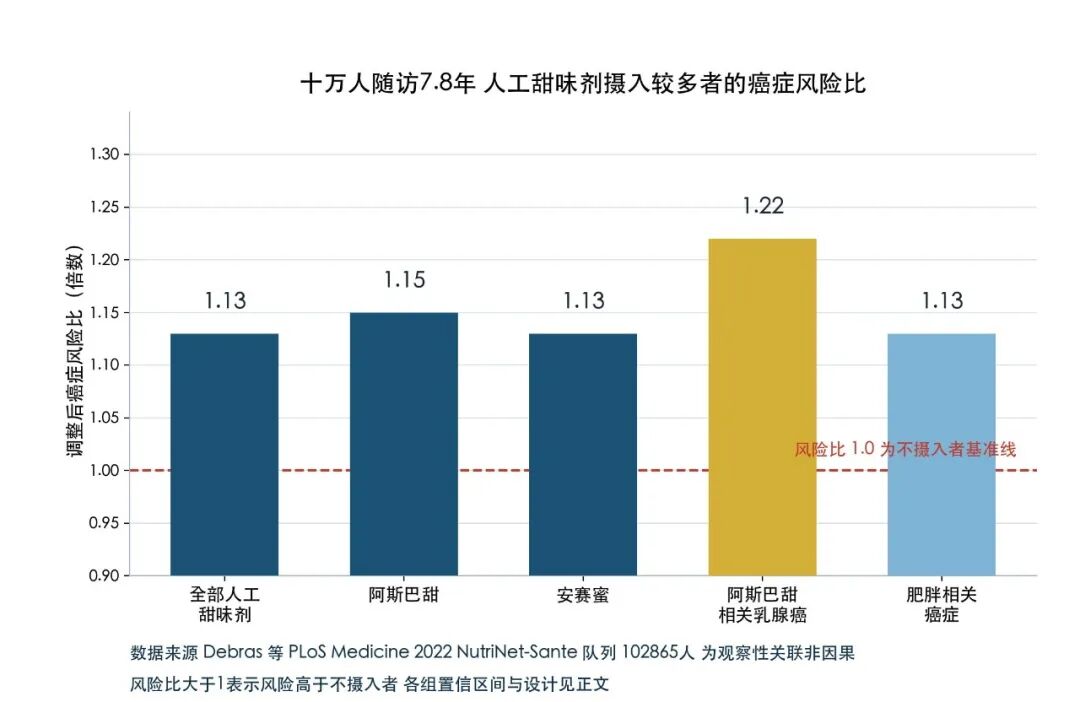
Let's start with the hard data. A French cohort study covering 102,865 adults with a median follow-up of 7.8 years found that people with higher intake of artificial sweeteners had a 13% higher overall cancer risk compared with those who consumed none (hazard ratio 1.13); among them, aspartame was associated with a 15% higher risk and acesulfame-K with a 13% higher risk [6]. In 2023, the World Health Organization went even further and directly issued a guideline: it does not recommend using non-sugar sweeteners to control body weight [1].
1. Why WHO Says You Shouldn't Count on Sugar Substitutes for Weight Loss
In May 2023, WHO released the "Use of Non-Sugar Sweeteners: WHO Guideline," giving a "conditional recommendation": do not use non-sugar sweeteners to control body weight, and do not expect them to reduce the risk of chronic diseases.
The reasoning comes in two parts, and both are solid.
Short-term trials show no weight-loss effect. A team from the University of Manitoba in Canada pooled data from 7 randomized controlled trials involving 1,003 people and found that the use of non-nutritive sweeteners had no significant effect on body mass index [2]. In other words, switching from sugary drinks to sugar-free versions did not actually make people lose weight.
Long-term follow-up instead reveals risk signals. The same study pooled data from 30 prospective cohort studies with a total of 405,907 people and a median follow-up of 10 years: people who regularly consumed sugar substitutes gained more weight and waist circumference, and had higher rates of obesity, hypertension, metabolic syndrome, type 2 diabetes, and cardiovascular events [2].
It should be noted that this is not a "toxicity assessment." WHO made it clear that the guideline does not evaluate the safe dosage of specific sweeteners, and the acceptable daily intake set by the Joint FAO/WHO Expert Committee on Food Additives remains unchanged. It answers a different question: Can "drinking sugar-free" help you lose weight and become healthier? The existing evidence says no. [1]
2. Zero Calories Does Not Mean the Body Has Zero Response
The selling point of sugar substitutes is "sweet taste, no calories." But more and more research suggests that the body's handling of "sweetness" is not just about calories.
A classic 2014 study in Nature found that feeding saccharin to mice changed the composition and function of their gut microbiota and induced impaired glucose tolerance; when the gut microbiota of these mice was transplanted into germ-free mice, even the abnormal glucose tolerance could be "transplanted" along with it; similar phenomena were also observed in a small number of healthy human subjects [3].
In 2022, Cell brought the experiment into humans: 120 healthy adults were randomly assigned to consume saccharin, sucralose, aspartame, or stevia below the acceptable daily intake for 2 consecutive weeks. The results showed that all four sweeteners altered participants' fecal and oral microbiota as well as plasma metabolites, and among them, the blood glucose responses in the saccharin and sucralose groups were significantly worse, with responses varying from person to person and related to individual microbiota [4].
This means: the tongue tastes sweetness, and the bacteria in the gut "taste" it too. Fooling the calories does not necessarily mean fooling metabolism.
3. The Trendy Sugar Substitute Erythritol Harbors Cardiovascular Signals
In recent years, the new name appearing most often on ingredient lists is erythritol. Its taste is close to sugar and its effect on blood glucose is small, so it is widely used in new-style sugar-free drinks and snacks.
A 2023 study in Nature Medicine first found in a U.S. cohort of 1,157 people that the higher the blood erythritol level, the higher the risk of major cardiovascular and cerebrovascular events within 3 years; it was then verified in two independent cohorts of 2,149 people in the U.S. and 833 people in Europe: people with higher erythritol levels (higher quartile versus lower quartile) had 1.80 times and 2.21 times the risk of major cardiovascular and cerebrovascular events, respectively. The study also had 8 healthy volunteers consume 30 grams of erythritol at once, after which plasma erythritol remained high for the following two days, and in vitro tests showed enhanced platelet aggregation and tendency to form blood clots [5].
This study includes observational associations and also small-sample mechanistic experiments, and it still cannot "convict" erythritol, but for people who drink it like water, it is a reminder worth taking seriously.
4. 100,000 People Over 7.8 Years: What the Cancer Data Actually Show
Let's return to the French study from the beginning. A total of 102,865 adults reported their diets through repeated 24-hour dietary records, with a median follow-up of 7.8 years, and 3,358 cases of cancer were diagnosed [6].
-
Those with higher total intake of artificial sweeteners had an overall cancer hazard ratio of 1.13 (95% confidence interval 1.03 to 1.25);
-
Aspartame 1.15, acesulfame-K 1.13;
-
People with higher aspartame intake had a breast cancer hazard ratio of 1.22 (1.01 to 1.48);
-
For obesity-related cancers, the hazard ratio was 1.13 for total sweeteners and 1.15 for aspartame [6].
The numbers must be read accurately: this is an epidemiological "association," not a causal verdict that "drink it and you'll get cancer." People who drink sugar-free beverages may themselves have a higher proportion of overweight and eat more sweets, and residual confounding cannot be completely ruled out. In 2023, the WHO International Agency for Research on Cancer classified aspartame as Group 2B, meaning "possibly carcinogenic to humans," but at the same time the Joint FAO/WHO Expert Committee on Food Additives maintained its acceptable daily intake unchanged—precisely the attitude: evidence is limited, vigilance is needed, but there is no need to panic.
5. If You Want Something Sweet, What Should You Actually Do?
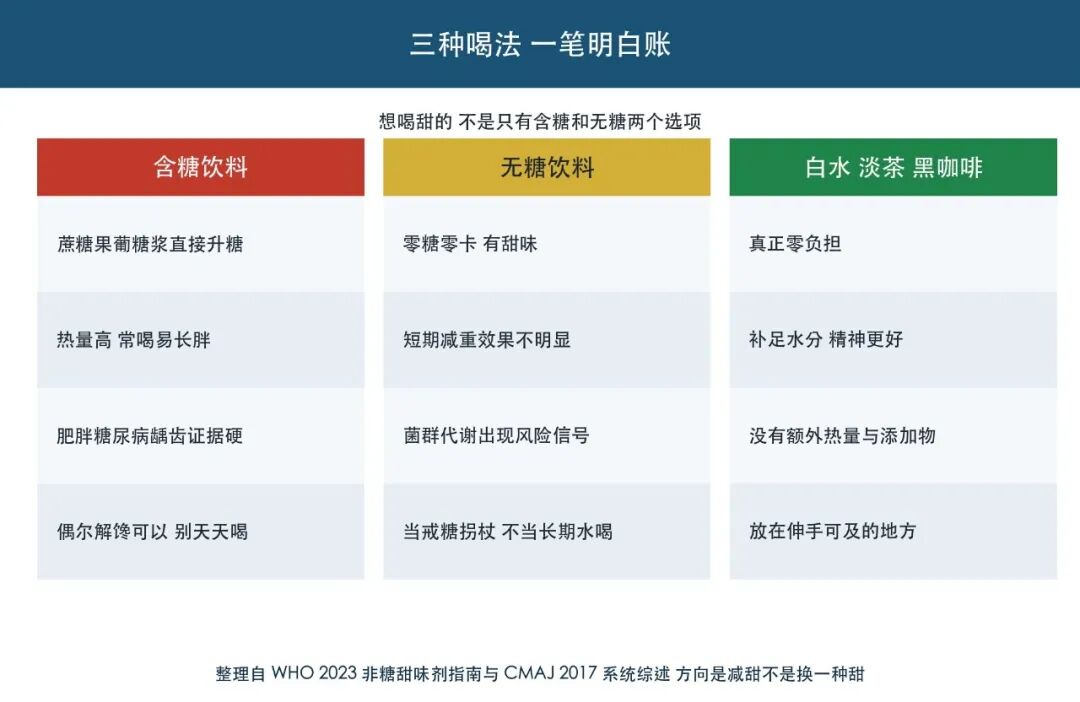
First, get the conclusion right: sugary drinks and sugar-free drinks are both not healthy beverages. The direction is to "reduce sweetness," not to "switch to another kind of sweet."
-
Keep plain water, light tea, and black coffee within arm's reach. These are truly zero-burden drinks. If you find them tasteless, you can steep a few slices of lemon, cucumber, or mint leaves.
-
Treat sugar-free drinks as a "crutch for quitting sugar," not as a long-term destination. If you currently drink two or three cans of sugary drinks a day, switching to sugar-free versions first is a pragmatic step; but it is recommended that over a few weeks to a few months, you gradually switch to sparkling water and light tea, so that your dependence on "intense sweetness" slowly declines.
-
Learn to read ingredient lists. Aspartame, sucralose, acesulfame-K, erythritol, and stevia all belong to sweeteners. "0 sugar" only means no sucrose or high-fructose corn syrup has been added; it does not mean the whole bottle is a healthy product. Sugar-free cookies and sugar-free cakes often still contain plenty of oil and refined carbohydrates.
-
Don't jump from one pit into another. The evidence that sugary drinks cause obesity, diabetes, and tooth decay is stronger than that for sugar substitutes. Seeing negative news about sugar substitutes is not a reason to go back to drinking cola.
Your tongue has been trained by intense sweetness for many years, and it deserves to be gently "retrained" over a few months. It is recommended to forward this article to that friend who orders sugar-free drinks every day but still hasn't lost weight, and also to the person in charge of grocery shopping for the whole family. Save it so you can glance at the ingredient list next time you shop.
If this has been helpful to you, give it a like or mark it as saved, and you are also welcome to leave a comment telling us what topics you'd like to see. ✦ ✦ ✦
Disclaimer: This article is for health education purposes only and is intended for informational reference. It does not constitute medical advice and cannot replace an in-person consultation with a doctor.
Conflict of interest statement: This article did not receive sponsorship from any food, beverage, or health supplement company, and the author has no conflict of interest with the research institutions mentioned in the article.
References:
[1] World Health Organization. Use of non-sugar sweeteners: WHO guideline. Geneva: WHO; 2023. PMID: 37256996
[2] Azad MB, Abou-Setta AM, Chauhan BF, et al. Nonnutritive sweeteners and cardiometabolic health: a systematic review and meta-analysis of randomized controlled trials and prospective cohort studies. CMAJ. 2017;189(28):E929-E939. PMID: 28716847
[3] Suez J, Korem T, Zeevi D, et al. Artificial sweeteners induce glucose intolerance by altering the gut microbiota. Nature. 2014;514(7521):181-186. PMID: 25231862
[4] Suez J, Cohen Y, Valdés-Mas R, et al. Personalized microbiome-driven effects of non-nutritive sweeteners on human glucose tolerance. Cell. 2022;185(18):3307-3328.e19. PMID: 35987213
[5] Witkowski M, Nemet I, Alamri H, et al. The artificial sweetener erythritol and cardiovascular event risk. Nat Med. 2023;29(3):710-718. PMID: 36849732
[6] Debras C, Chazelas E, Sellem L, et al. Artificial sweeteners and cancer risk: Results from the NutriNet-Santé population-based cohort study. PLoS Med. 2022;19(3):e1003950. PMID: 35324894
? 2026 太阳圣华(北京)医疗科技有限公司