This article is for health education purposes only and is for informational reference only; it does not constitute medical advice. If you have any health concerns, please consult a professional doctor.
Today is the Start of Winter. The next three months are the time of year with the densest schedule of dinner gatherings, the fewest steps walked, and the least forgiving bathroom scale.
Almost everyone has heard that sentence: it's fine to gain a few pounds in winter, it'll come off naturally in spring. We pulled the data from five studies and checked them one by one, and the answer is not very optimistic.
First, the conclusion: most of the weight gained in winter does not disappear on its own
The 2000 study in the New England Journal of Medicine recruited ordinary people: 195 adults, weighed four times over more than five months—late September, mid-November, early January, and late February to early March. The following autumn, 165 of them came back to be weighed once more.
The result: during the six to eight weeks of the holiday period, they gained an average of 0.37 kg, and by late February of the following year, net gain relative to baseline was 0.48 kg. The rumored "5 pounds gained over the holidays," about 2.3 kg, is an exaggeration; the key lies in the other half—by the following autumn, that 0.48 kg had not only not come off, but had on average increased by another 0.21 kg (the difference was not significant, but the direction was consistent) [1]. The so-called "it'll come off naturally in spring" did not happen in these 195 people.
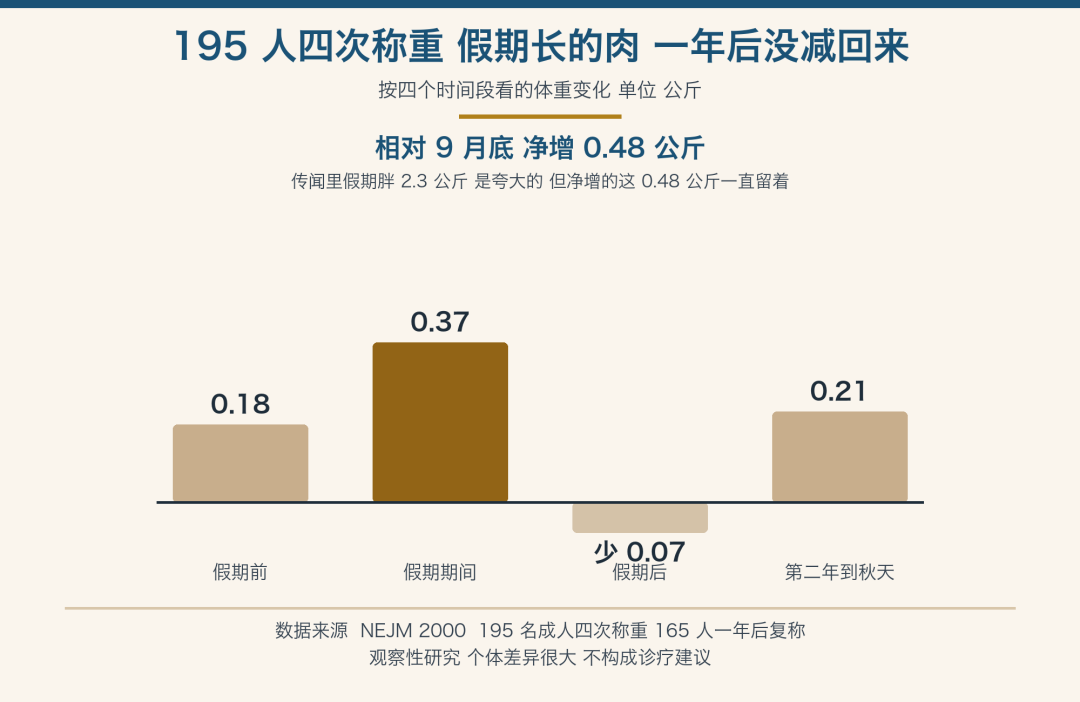
Figure caption: Weight changes in 195 adults across four time points; weight rose the most during the holiday period, showed no automatic decline afterward, and was still overall rising one year later.
Where did that 0.48 kg stay
A Romanian study published in March 2026 is even more direct: 120 adults had their body composition measured once before the holidays, once after the holidays, and once one year later. Weight went from 68.25 to 69.40 kg, and was 69.45 kg one year later; visceral fat area went from 98.49 to 100.54, and was 101.42 cm² one year later [3]. The gain was not much, but a year later, none of it had gone back down.
Weight gain is not like a cycle of "gain this year, lose next year"; it is more like a staircase, one step at a time: each step is only half a kilogram, invisible to the naked eye, but added up over ten or twenty years, it becomes those tens of kilograms at which metabolic indicators start to look bad. Visceral fat is especially sensitive to this kind of change, and it is also the fat most closely tied to blood sugar, blood lipids, and blood pressure.
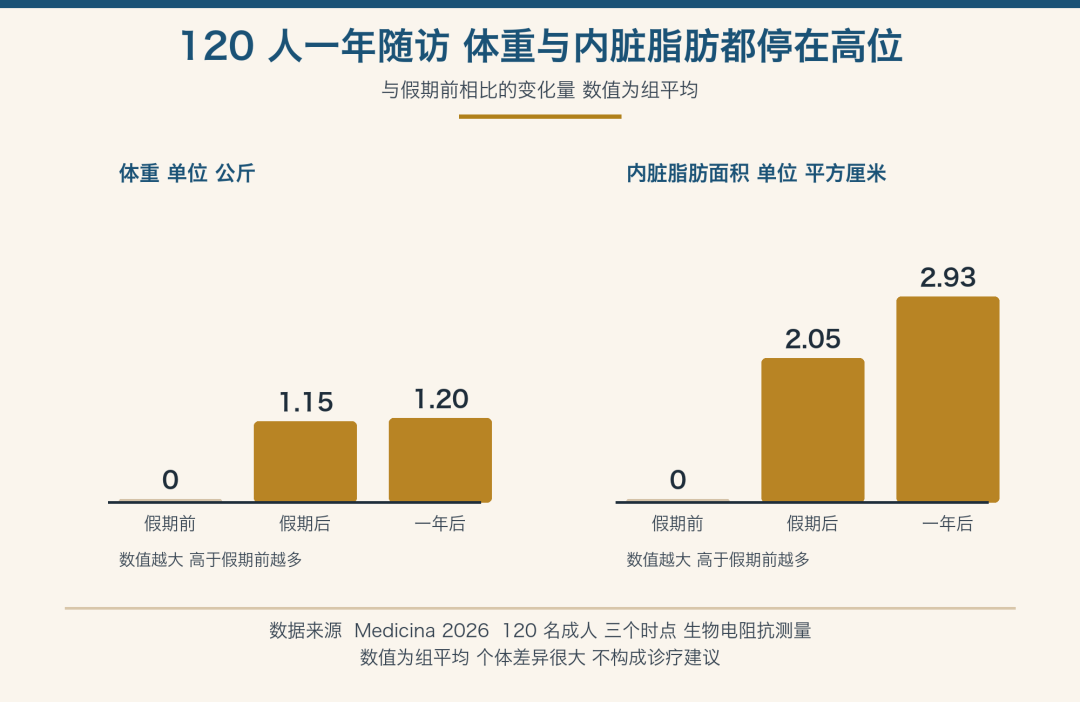
Figure caption: 120 people measured three times over one year; weight and visceral fat area rose after the holidays and remained at the elevated level one year later.
It's not that metabolism slows in winter—it's that three windows collided
Many people assume that metabolism slows in cold weather, which is why it's easy to gain weight. That claim doesn't hold up. A study of 23 adults with obesity used the doubly labeled water method to measure total energy expenditure: during the holiday period compared with before the holidays, energy expenditure did not change; what changed was eating patterns—more meals eaten out, and average daily energy intake increased by about 80 kcal (not statistically significant) [5]. What pushed people up was eating more, not burning less.
Now look at more objective evidence. A Canadian study had 166 adults with type 2 diabetes wear pedometers for two weeks in each of the four seasons: average steps per day were 4,901 in autumn and winter versus 5,659 in spring and summer—758 fewer steps per day in autumn and winter; over the same period, systolic blood pressure was on average 4 mmHg higher [4]. Walking a few hundred fewer steps doesn't sound like much, but it happens every day.
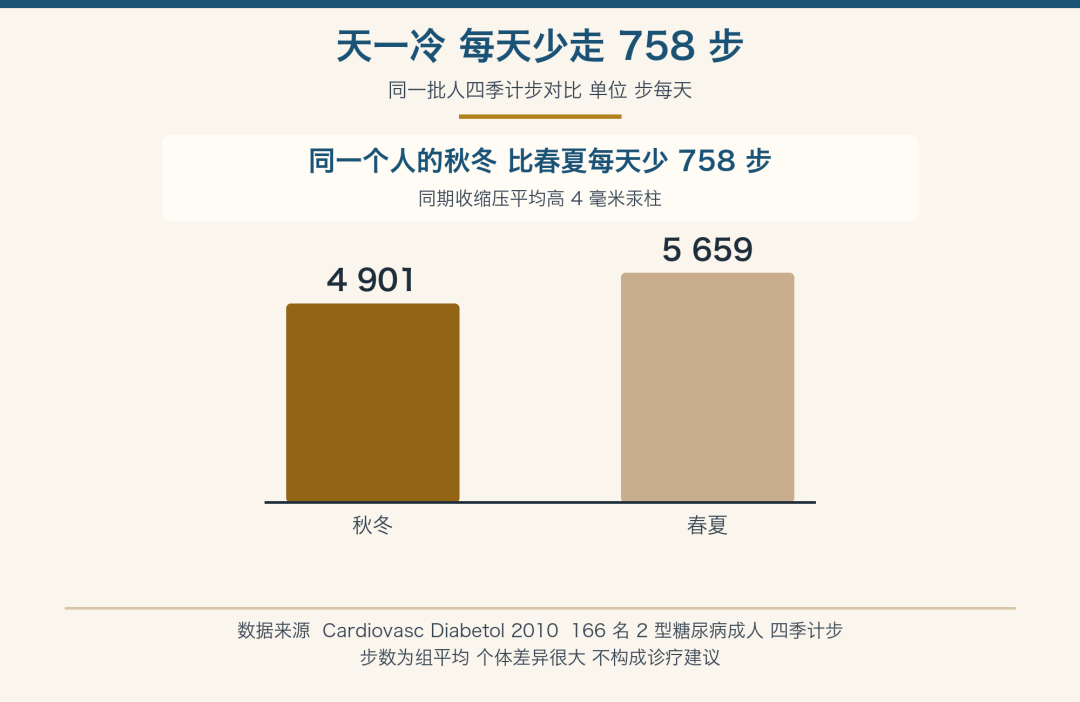
Figure caption: Step counts compared across the four seasons in the same group of people; in autumn and winter they walked an average of 758 fewer steps per day, and systolic blood pressure was also higher over the same period.
Weekends and festivals are more worth guarding against than "the season"
A 2023 Australian study in JAMA Network Open kept daily weight records for 368 adults over 12 months. The median gain over the whole year was only 218 g, milder than one might imagine; but within-week fluctuation was 252 g, with Monday and Tuesday the heaviest, and Friday 0.18% lighter than Monday; weight jumped by 0.65% at once during Christmas and New Year, and by 0.29% at Easter [2].
This study was conducted in the Southern Hemisphere, where Christmas falls in summer, and the heaviest season of the year was actually summer. This precisely shows that what determines that jump is not temperature, but the concentration of festivals and weekends. Transplanted to where we are, that corresponds to the three months from the Start of Winter to the Spring Festival.
✦
Four things you can do right away after the Start of Winter
-
Fix your weighing rhythm: weigh yourself once a week on the same day, in the morning, after emptying your bladder and bowels, and compare only week to week. Fluctuations of around 250 g within a week are normal noise.
-
Mark the windows on your calendar: in the week with dense dinner gatherings, leave a light day on each side; don't let yourself go several days in a row on weekends.
-
Hold the bottom line on steps: set a winter minimum you can actually achieve, and make it up on cold days with indoor walking and stair climbing.
-
Don't use "metabolism is higher in winter" as an excuse for extra snacks: in the actual measurement above, energy expenditure did not rise during the holiday period.
One sentence to close: weight is not accounted for year by year, but window by window. The account recorded during these three winter months will mostly still be there the following spring.
If this article has been helpful to you, give it a like or a "reading" click, and feel free to leave a comment telling us what topics you'd like to see; you're also welcome to forward it to that person who gains three jin every winter and always says in spring, "it'll come off in a while."
✦
Disclaimer: This article is for health education purposes and does not constitute medical advice; if you have any health concerns, please consult a professional doctor. The data in this article come from publicly published observational studies; individual differences are considerable, so do not adjust medication or treatment plans based on this article.
Declaration of interests: This article does not involve any drug or product recommendations and has no conflict of interest with the research institutions mentioned in the text.
© 2026 Sun Saint Hua (Beijing) Medical Technology Co., Ltd.
References
[1] Yanovski JA, Yanovski SZ, Sovik KN, et al. A prospective study of holiday weight gain. N Engl J Med. 2000;342(12):861-867. PMID: 10727591 [2] Maher C, Ferguson T, Curtis R, et al. Weekly, Seasonal, and Festive Period Weight Gain Among Australian Adults. JAMA Netw Open. 2023;6(7):e2326038. PMID: 37498598 [3] Udroiu IV, Albai A, Lazar S, et al. Persistence of Body Composition Changes Observed During the Winter Holiday Period: A Three-Time-Point, One-Year Longitudinal Study. Medicina (Kaunas). 2026;62(3):511. PMID: 41901591 [4] Dasgupta K, Joseph L, Pilote L, et al. Daily steps are low year-round and dip lower in fall/winter: findings from a longitudinal diabetes cohort. Cardiovasc Diabetol. 2010;9:81. PMID: 21118567 [5] Bhutani S, Wells N, Finlayson G, et al. Change in eating pattern as a contributor to energy intake and weight gain during the winter holiday period in obese adults. Int J Obes (Lond). 2020;44(7):1586-1595. PMID: 32203107