NEJM: This Class of Weight-Loss Drugs Cuts Sleep Apnea Events in Half
This article is for health education and informational purposes only and does not constitute medical advice; if you have health concerns, please consult a professional physician.
At three in the morning, the snoring of the person beside you suddenly stops. The silence is alarming—ten seconds, twenty seconds, thirty seconds, then a choking gasp for air. This is not sound sleep; it is an episode of obstructive sleep apnea (OSA). Many people assume snoring is "a minor problem of overweight people," but the two phase III SURMOUNT-OSA trials published in NEJM in 2024 produced a result that surprised even physicians: one year of tirzepatide treatment reduced apnea events in patients with moderate-to-severe OSA by more than half on average, and nearly half of patients were completely freed from a moderate-to-severe diagnosis. More importantly, these benefits do not depend on weight loss and hold even in people who do not use a breathing machine (CPAP).
1. The Underestimated "Nighttime Killer": Nearly 1 Billion People Worldwide
Sleep apnea is not simply "snoring." Patients experience repeated upper airway collapse at night, possibly dozens of breath-holding episodes per hour, with repeated drops in blood oxygen and sleep fragmented into countless pieces. About 936 million people worldwide have the condition, including about 425 million with moderate-to-severe disease, making it one of the most common sleep disorders in the world (Benjafield et al.,Lancet Respir Med2019). In China, among people aged 30 and older, the prevalence of OSA is about 20%, with about 10% having moderate-to-severe disease, yet the diagnosis rate is less than 20%—the vast majority of people do not even know they have it. Untreated moderate-to-severe OSA raises the risk of hypertension by about 2-fold, the risk of atrial fibrillation by about 2-fold, and the risk of stroke by about 2-fold, and is also closely associated with insulin resistance, fatty liver, cognitive decline, and traffic accidents.
| Risk Dimension | Impact of Moderate-to-Severe OSA |
|---|
| Resistant hypertension | Risk increased about 2-fold |
| Atrial fibrillation | Risk increased about 2-fold |
| Type 2 diabetes | Risk increased about 30%–50% |
| Daytime sleepiness/traffic accidents | Traffic accident risk increased 2–7-fold |
| All-cause mortality | Long-term mortality risk significantly increased in moderate-to-severe patients |
OSA and obesity are "partners in crime": a thicker neck circumference and fat accumulation in the pharynx compress the airway; nighttime hypoxia in turn disrupts appetite hormones, making people crave high-sugar, high-fat foods, creating a vicious cycle.
2. The Pain Point of Conventional Treatment: CPAP Works, but Many People Can't Tolerate It
The standard treatment for moderate-to-severe OSA is continuous positive airway pressure (CPAP), that is, a sleep breathing machine. It is indeed effective—it can immediately eliminate apnea and improve sleepiness and blood pressure. But the reality is stark: clinical data show that about 30%–50% of patients cannot adhere to CPAP long term, with common reasons including a feeling of breath-holding, nasal congestion, mask leakage, noise, and partner discomfort. The SAVE study published in NEJM in 2016 (McEvoy et al., including 2717 patients with moderate-to-severe OSA and cardiovascular disease) found that although CPAP improved sleepiness and quality of life, average use was only 3.3 hours per night and it did not significantly reduce the primary cardiovascular event endpoint. Adherence is the key bottleneck. Weight loss has long been recommended as a foundational treatment for OSA, but "watching what you eat and exercising more" is often difficult to sustain for patients with moderate-to-severe obesity. There is an urgent clinical need for a drug regimen that can both reduce weight and directly improve OSA without relying on devices. The emergence of GLP-1/GIP drugs has filled exactly this gap.
3. SURMOUNT-OSA: A Weight-Loss Drug "Conquers" Apnea for the First Time in Phase III Trials
In August 2024, the New England Journal of Medicine published two phase III randomized controlled trials with nearly identical designs—SURMOUNT-OSA Trial 1 and Trial 2 (Malhotra A et al., NEJM2024;391:727-750)—evaluating the efficacy and safety of tirzepatide (a GLP-1/GIP dual receptor agonist) in treating obesity with moderate-to-severe OSA. Trial 1 enrolled 469 patients with moderate-to-severe OSA (BMI ≥28) who could not tolerate or refused CPAP, randomized 1:1 to receive once-weekly tirzepatide 10 mg or placebo for 52 weeks. The results were encouraging: the apnea-hypopnea index (AHI) fell by an average of 55%: from about 31 events per hour at baseline to about 13; the placebo group fell by only about 6%. In 45% of patients in the tirzepatide group, AHI dropped to <5 (i.e., essentially back to normal), and another approximately 23% improved from severe to mild; fewer than 7% of the placebo group achieved remission. Body weight fell by an average of 19.9% (about 21 kg), versus 1.3% in the placebo group. Patient-reported nighttime gasping awakenings, snoring, and daytime sleepiness (ESS score) all improved significantly, and systolic blood pressure fell by an average of about 7–9 mmHg. Benefits began to appear by 16 weeks of treatment and were still ongoing at 52 weeks.
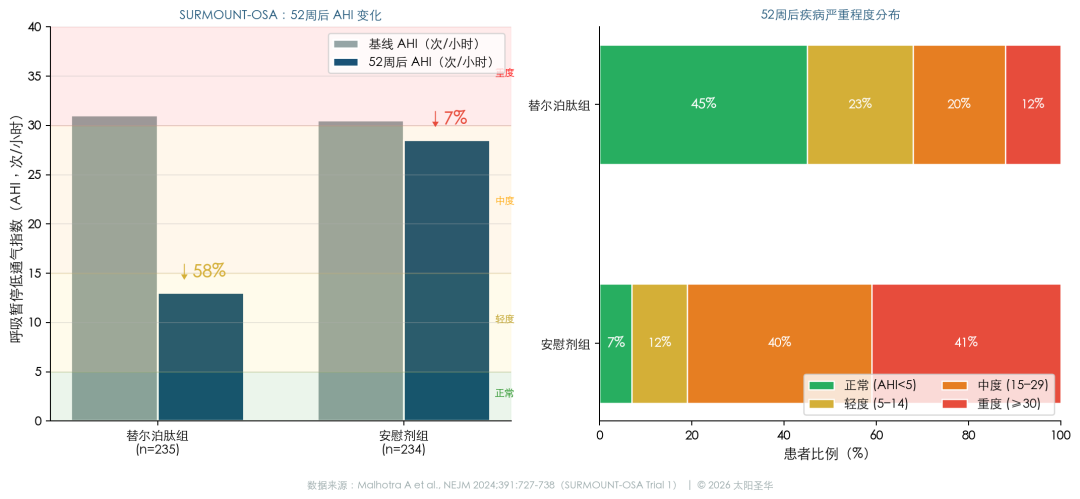
Trial 2 enrolled 466 patients, about half of whom were using CPAP and half not. The results were consistent: in the CPAP subgroup, tirzepatide further reduced AHI; in the non-CPAP subgroup, the reduction in AHI was comparable to that in Trial 1; weight loss was about 18%–20%; this suggests that tirzepatide's improvement of OSA is "additive" on top of the breathing machine, rather than merely a substitute. A deeper finding was that only part of the improvement in AHI could be explained by weight loss. Using statistical models, the researchers found that even after adjusting for weight change, AHI in the tirzepatide group remained significantly better than placebo—meaning that GLP-1/GIP signaling may act directly on OSA through multiple pathways, including reducing pharyngeal fat, improving neural control of airway dilator muscles, reducing airway inflammation, and modulating central respiratory drive. Simply put: it is not just that losing weight reduces snoring; the drug itself may be "clearing the airway."
4. The 4 Questions Doctors and Patients Care About Most
Q1: Does getting a weight-loss injection mean I no longer need to wear a breathing machine? It cannot be understood simply that way. SURMOUNT-OSA enrolled people who were "intolerant to or refused CPAP," for whom medication is an important alternative; however, for patients with severe hypoxia or comorbid cardiovascular disease, CPAP remains the fastest-acting option with the most robust evidence. What is more likely in clinical practice is a combination regimen of "medication + weight loss + CPAP when necessary," rather than an either-or choice. Whether to stop using the breathing machine must be decided by a sleep specialist based on follow-up results. Q2: Does semaglutide have the same effect? Currently, the large-scale phase III evidence for GLP-1 drugs in treating OSA is mainly concentrated on tirzepatide. OSA-related studies of semaglutide (such as the OASIS program) are also underway, and published early data show benefits in a similar direction, but the complete phase III results have yet to be published. From a mechanistic perspective, GLP-1 receptor agonism is very likely a "class effect," but data from drug A cannot be directly applied to drug B. Q3: Will there be rebound after stopping the medication? This is a common problem with all weight-loss drugs. Existing data show that after stopping GLP-1/GIP drugs, body weight typically rebounds by about two-thirds within one year, and AHI may also rise accordingly. As a chronic disease, OSA may require long-term management like hypertension and diabetes, rather than being "cured with a few courses of treatment." Please do not readily believe promotional claims that "a few shots can eradicate the root cause." Q4: Who is suitable and who is not? The evidence from SURMOUNT-OSA supports adults with BMI ≥28 and comorbid moderate-to-severe OSA (AHI ≥15). The following groups require particular caution or are not eligible: those with a personal/family history of medullary thyroid carcinoma or multiple endocrine neoplasia type 2, pregnancy/lactation, severe gastrointestinal disease, a history of pancreatitis, etc. Medication must be evaluated by a doctor beforehand, and drugs must not be purchased and used on one's own.
V. Action recommendations: 3 things you can do tonight
Measure your neck circumference: a neck circumference ≥38 cm in men and ≥35 cm in women is a strong warning signal for OSA; if there is also BMI ≥28, waking up gasping at night, morning headaches, or daytime sleepiness, it is recommended to go to a respiratory department or sleep center as soon as possible for a polysomnography (PSG) or home sleep apnea test (HSAT). Sleep on your side + abstain from alcohol: lying on your back causes the base of the tongue to fall backward and aggravate airway collapse, while side sleeping can reduce AHI by 20%–50% in some patients with mild-to-moderate OSA; drinking alcohol within 3 hours before bedtime suppresses respiratory drive and worsens hypoxia, and should be avoided. Do not treat weight-loss drugs as "internet-famous injections": GLP-1/GIP drugs are prescription medications with clear indications and contraindications. The significance of SURMOUNT-OSA lies in providing a new evidence-based treatment pathway for patients with obesity and OSA, but whether to use them, which one to use, and for how long should be left to sleep specialists or endocrinologists. Snoring is not evidence of sleeping soundly, and repeated breath-holding at night is not something to "just endure until it passes." If your family member suddenly goes quiet while snoring and then gasps sharply, please take it seriously—this may be the body crying for help. It is recommended to forward this article to the person beside your pillow, or save it and talk with your doctor at your next physical examination. References Malhotra A, Grunstein RR, Fietze I, et al. Tirzepatide for the Treatment of Obstructive Sleep Apnea in Adults with Obesity (SURMOUNT-OSA Trial 1). N Engl J Med. 2024;391(8):727-738. PMID: 39185901. Malhotra A, Grunstein RR, Fietze I, et al. Tirzepatide for Obstructive Sleep Apnea in Adults with Obesity (SURMOUNT-OSA Trial 2). N Engl J Med. 2024;391(8):739-750. PMID: 39185902. Benjafield AV, Ayas NT, Eastwood PR, et al. Estimation of the global prevalence and burden of obstructive sleep apnoea: a literature-based analysis. Lancet Respir Med. 2019;7(8):687-698. PMID: 31296399. McEvoy RD, Antic NA, Heeley E, et al. CPAP for Prevention of Cardiovascular Events in Obstructive Sleep Apnea (SAVE). N Engl J Med. 2016;375(10):919-931. PMID: 27566458. Lyons OD, Ryan S, Nolan P, et al. Obesity and obstructive sleep apnea: pathogenesis and target for treatment. Metabolism. 2024;153:155802. PMID: 38219953. Jordan AS, McSharry DG, Malhotra A. Adult obstructive sleep apnoea. Lancet. 2014;383(9918):736-747. PMID: 23910433. Disclaimer: The research data cited in this article all come from publicly published peer-reviewed literature and are intended only for health science popularization and academic information reference, and do not constitute any diagnostic, treatment, or medication advice. Tirzepatide and other GLP-1/GIP receptor agonists are prescription drugs and must be used under the guidance of a doctor; this article does not recommend any specific drug, nor does it constitute purchasing guidance. If you have health problems related to sleep, breathing, or metabolism, please promptly visit a qualified medical institution. Conflict of interest statement: Sunsheng Hua (Beijing) Medical Technology Co., Ltd. is a medical communication and medical technology company. The author and reviewers of this article have no commercial interest relationship with the manufacturers of the drugs mentioned in the article and have not received funding from the relevant companies. © 2026 Sunsheng Hua (Beijing) Medical Technology Co., Ltd.